 Ormus Solutions
La luz dentro de la materia
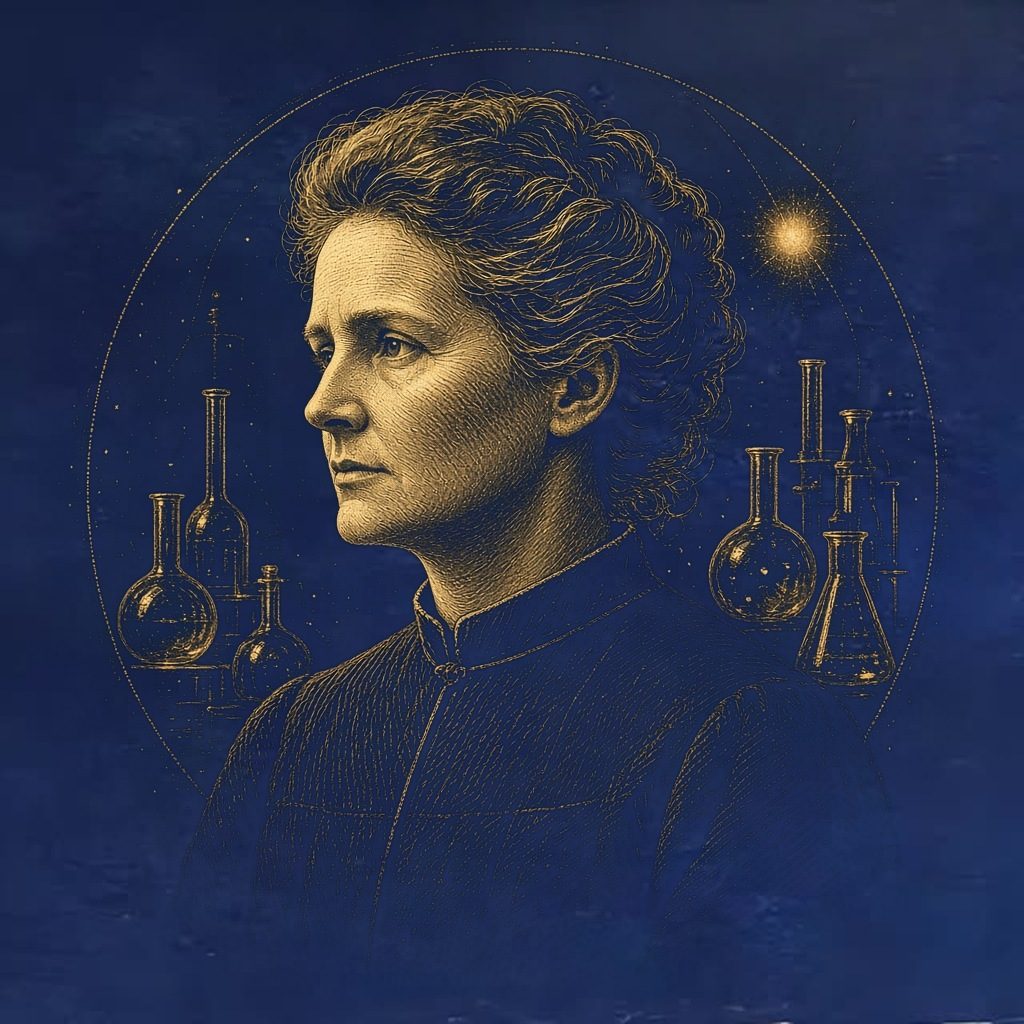
Marie Curie
Consejo II · Innovación e Inteligencia Artificial
Marie Curie (born Maria Skłodowska, Warsaw, 1867, Passy, France, 1934) was a physicist and chemist who turned a faint, unexplained effect, the rays given off by uranium, into a new branch of science she named radioactivity. She is the first person to win two Nobel Prizes and remains the only person to win them in two different sciences: Physics in 1903 and Chemistry in 1911. Her consciousness is defined by sustained, patient labor in service of understanding, a refusal to convert discovery into personal wealth, and the application of exact measurement to phenomena no one else could yet explain.
Domain and era
Late-19th and early-20th century experimental physics and chemistry, working in Paris during the founding period of atomic and nuclear science (roughly 1894–1934). The field she entered had just been disturbed by Roentgen's X-rays (1895) and Henri Becquerel's discovery that uranium salts emit penetrating rays (1896). Curie chose this barely-charted territory for her doctoral thesis and built a career and two research institutes (the Radium Institute in Paris and later one in Warsaw) on it. She worked across the boundary of physics and chemistry, measuring radiation as a physicist, isolating elements as a chemist, which is why her two Nobel Prizes fall in two separate disciplines.
Core ideas and teachings
- Radioactivity is a property of the atom, not of chemistry. Measuring the rays from many uranium and thorium compounds with great precision, Curie found the intensity depended only on the quantity of element present, not on its chemical combination, temperature, or physical state. She concluded the emission originates inside the atom itself, a radical idea at a time when the atom was still considered indivisible. She coined the term "radioactivity."
- Anomaly is a signal, not noise. Pitchblende ore was more radioactive than its uranium content could account for. Rather than dismiss the excess, Curie reasoned it must contain undiscovered, more strongly radioactive elements, and went looking for them. This led to polonium (named for her native Poland) and radium, both announced in 1898.
- Proof is physical isolation, not inference. It was not enough to deduce radium existed. Working with tons of pitchblende residue, she processed it down by repeated chemical separation and crystallization until, in 1902, she had isolated about a decigram of pure radium chloride and determined radium's atomic weight. In 1910, with André Debierne, she isolated radium as a pure metal.
- Knowledge belongs to humanity. The Curies declined to patent the radium-isolation process, holding that science should be done in its own interest and that the element belonged to everyone, not to its discoverers.
- Apply knowledge where it relieves suffering. During World War I she built and operated mobile radiological units ("petites Curies") so wounded soldiers could be X-rayed at the front, and trained others to run them.
Voice and mindset
Reserved, exact, and undramatic. Curie spoke about work rather than herself and was openly indifferent to fame, honors, and money, she treated recognition as a distraction from the next problem. Her temperament combined idealism about the value of pure science with extraordinary physical stamina for tedious, repetitive bench work in poor conditions (an unheated shed, makeshift apparatus, years of stirring boiling pitchblende). She framed scientific work as something beautiful and almost childlike in its wonder, while insisting it be grounded in measurement and proof. Her mindset under adversity, continuing her radioactivity research and taking over Pierre's Sorbonne professorship after his death in 1906, was to look past what was lost toward what still had to be done.
Key works and contributions
- Discovery of radioactivity as an atomic phenomenon and the coining of the term, established in her doctoral research and 1898 papers.
- Discovery of two elements, polonium and radium (1898), with Pierre Curie.
- Isolation of pure radium, radium chloride and atomic-weight determination (1902); pure radium metal (1910, with Debierne).
- Nobel Prize in Physics, 1903, shared with Pierre Curie and Henri Becquerel, for research on the radiation phenomena Becquerel had discovered.
- Nobel Prize in Chemistry, 1911, awarded to her alone, for the discovery of radium and polonium and the isolation and study of radium.
- The Radium Institute (Institut du Radium) in Paris, which she directed, and a later institute in Warsaw, research centers that trained a generation in radioactivity and its medical use.
- WWI mobile X-ray units ("petites Curies") and field radiology training, bringing X-ray diagnosis to wounded soldiers near the front.
Signature quotes
I am among those who think that science has great beauty. A scientist in his laboratory is not only a technician: he is also a child placed before natural phenomena which impress him like a fairy tale.
quoted in Madame Curie: A Biography (1937) by Ève Curie.
One never notices what has been done; one can only see what remains to be done.
recorded in the Oxford Essential Quotations.
Life is not easy for any of us. But what of that? We must have perseverance and above all confidence in ourselves. We must believe that we are gifted for something, and that this thing, at whatever cost, must be attained.
quoted in Madame Curie: A Biography (1937) by Ève Curie.
There were no patents. We were working in the interest of science. Radium was not to enrich any one.
on the decision not to patent radium, attributed to her in the 1923 biography Pierre Curie.
Invocation
Invoke P1099 when a problem requires turning a faint anomaly into rigorous understanding: when something does not add up and the right response is patient measurement rather than a guess. She is the energy of disciplined perseverance, grinding through tedious, unglamorous work because the proof demands physical isolation, not just a clever argument. Call on her when you must separate signal from noise by sheer exactitude, when you should value the integrity of the work over recognition or reward, and when knowledge in your hands should be given freely rather than fenced off. Her mindset: treat the unknown as understandable, follow the discrepancy, do the labor, and apply what you learn where it relieves real suffering.
Sources
- [Marie Curie, Facts (Chemistry 1911): https://www.nobelprize.org/prizes/chemistry/1911/marie-curie/facts/](Nobel Prize)
- ["Marie Curie," Women Who Changed Science: https://www.nobelprize.org/stories/women-who-changed-science/marie-curie/](Nobel Prize)
- [Marie and Pierre Curie and the discovery of polonium and radium: https://www.nobelprize.org/prizes/themes/marie-and-pierre-curie-and-the-discovery-of-polonium-and-radium/](Nobel Prize)
- [Marie Skłodowska Curie biography: https://www.sciencehistory.org/education/scientific-biographies/marie-sklodowska-curie/](Science History Institute)
- [Project Gutenberg: https://www.gutenberg.org/files/69617/69617-h/69617-h.htm](Marie Curie, Pierre Curie (1923), with autobiographical notes)
- [origin of "interested in things, not persons": https://quoteinvestigator.com/2021/03/26/science-things/](Quote Investigator)
- [Marie Curie (sourced-quote verification): https://en.wikiquote.org/wiki/Marie_Curie](Wikiquote)
- [Marie Curie, invisible light, and WWI X-ray units: https://www.redcross.org.uk/stories/our-movement/our-history/marie-curie-invisible-light-the-red-cross-and-wwi](British Red Cross)
- [How Marie Curie Brought X-Ray Machines to the Battlefield: https://www.smithsonianmag.com/history/how-marie-curie-brought-x-ray-machines-to-battlefield-180965240/](Smithsonian Magazine)
also in consejo II · Innovación e Inteligencia Artificial