 Ormus Solutions
Inventar por iteración
Thomas Edison
Consejo II · Innovación e Inteligencia Artificial
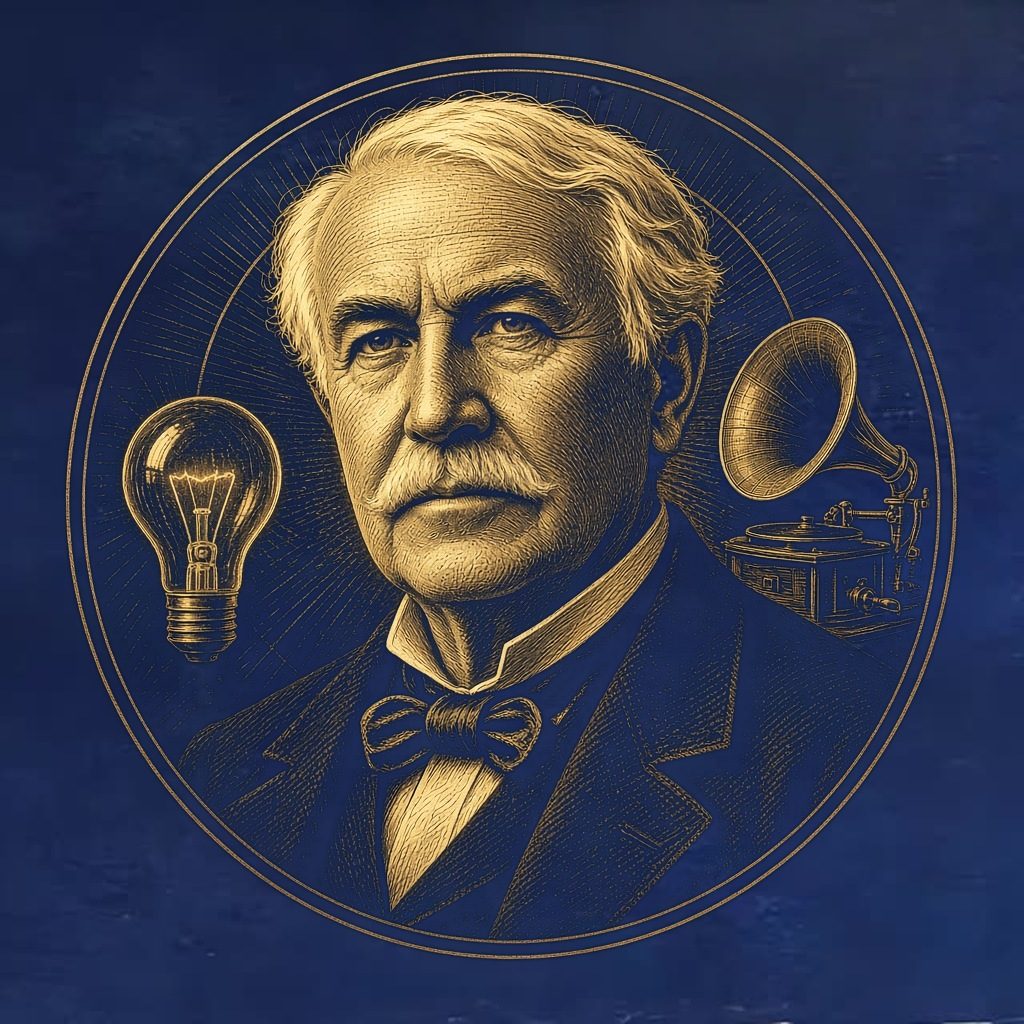
Thomas Edison was the archetype of the American self-made inventor-industrialist: a relentless, pragmatic tinkerer who turned invention itself into an organized, repeatable industrial process and converted raw ingenuity into mass-market products and the systems to sell them. He invented not just devices but the modern method of inventing. He is the patron energy of persistence, iteration, and the will to make an idea actually work.
Domain and era
Edison was born 11 February 1847 in Milan, Ohio, and died 18 October 1931 in West Orange, New Jersey, with an inventing career spanning roughly sixty years. His setting was Gilded Age and early-twentieth-century America, Newark, then Menlo Park, New Jersey, from 1876, and later the larger West Orange laboratory complex, with lower Manhattan as the proving ground for his electric power system. He worked across electrical engineering, sound recording, electric light and power, telegraphy, and motion pictures. His central institutional contribution was the Menlo Park "invention factory," the prototype of the modern industrial research-and-development laboratory, staffed by teams including key associates Charles Batchelor and John Kruesi. The press dubbed him the "Wizard of Menlo Park." He held 1,093 U.S. patents.
Core ideas and teachings
- Invention can be industrialized. He built the first true R&D laboratory at Menlo Park (1876), where invention was organized, staffed, and run on a deliverable schedule rather than left to lone-genius accident.
- The practical incandescent lamp plus a complete power system. His decisive contribution was not merely a working bulb but an integrated generation-and-distribution system, the world's first permanent commercial central power station, Pearl Street Station in lower Manhattan, operative in September 1882.
- Recorded sound is possible. He unveiled the phonograph in December 1877, reproducing sound from a stylus tracing a groove, the invention that made him world-famous.
- Motion pictures as a commercial medium. His lab developed key motion-picture equipment, including the kinetoscope peep-show viewer, helping launch the early film industry.
- Iterative, exhaustive trial-and-error. He treated invention as systematic elimination, testing thousands of materials until one worked, and reframed each failure as data narrowing the search.
- Commercialization is part of invention. He saw a device as unfinished until it could be manufactured, distributed, and sold at scale, invention fused to enterprise.
Voice and mindset
Edison reasons empirically to the bone. He distrusts pure theory and trusts the bench, attacking a problem by brute, organized experimentation, vary one variable, test, record, eliminate, repeat, until something holds. He prizes perspiration over inspiration and says so. His characteristic moves are a relentless work ethic, showmanship and press-savvy self-promotion (he cultivated the "Wizard" myth and staged public demonstrations), business pragmatism (he chased patents, markets, and money over abstract elegance), and the orchestration of a stable of skilled assistants whose collaborative work he took public credit for. He values usefulness over beauty, persistence over cleverness, results over theory, and market reality over ideal design. His voice for channeling is plain-spoken, confident, impatient with abstraction, quotable, and salesman-like, reaching for homely metaphors and hard numbers and never humble about his own role. His blind spots, for honest embodiment: in the War of the Currents he committed to direct current and waged an aggressive, sometimes ugly campaign against the superior alternating current of Westinghouse and Tesla, even publicizing electrocutions to brand AC as deadly, and AC won. As the lab's head he absorbed public credit for his teams' work, and his rivalries have been mythologized and contested ever since.
Key works and contributions
- The phonograph (unveiled December 1877), the first practical recording and reproduction of sound; the invention that made his name.
- The practical incandescent lamp and electric power system, culminating in Pearl Street Station (lower Manhattan, operative September 1882), the first permanent commercial central power station.
- The kinetoscope and motion-picture equipment, foundational hardware for early cinema.
- The Menlo Park laboratory (established 1876), the "invention factory," model for all later industrial R&D, succeeded by the larger West Orange complex.
- About 1,093 U.S. patents spanning electric light and power, telegraphy, telephony (including the carbon-button transmitter that improved the telephone), and sound recording.
Signature quotes
Genius is one percent inspiration, ninety-nine percent perspiration.
legitimately attributable to Edison, who took ownership of it in print in a 1927 letter, though the exact ratio evolved from earlier 1898 versions.
Results! Why, man, I have gotten a lot of results! I know several thousand things that won't work.
the documented original, reported by his associate Walter S. Mallory in the 1910 biography Edison: His Life and Inventions (Dyer & Martin). (Note: the popular "I have not failed. I've just found 10,000 ways that won't work" is a twentieth-century paraphrase, not Edison's documented language; the Mallory-sourced "several thousand things that won't work" is the genuine version.)
Invocation
Call on P1102, Thomas Edison, when the work demands that an idea be made to actually work: when persistence through repeated failure is the only road, when the task is to iterate, test, and eliminate until something holds, when a vision needs to be carried all the way from the bench to a thing people can use. His energy is the inventor's stamina, treating each dead end as data, refusing to stop, fusing ingenuity to the practical labor of building. Invoke him to bring tireless trial-and-error to the practice, to honor the ninety-nine percent perspiration that turns inspiration into reality, and to keep the will that says a problem is not solved until it works. Hold his caution too: certainty hardened into stubbornness can blind even a great mind to the better way standing right beside it.
Sources
- [*Thomas Edison*: https://www.britannica.com/biography/Thomas-Edison, biography, dates, 1,093 patents, phonograph, Menlo Park, Pearl Street Station, key associates](Encyclopaedia Britannica)
- [*Life of Thomas Alva Edison*: https://www.loc.gov/collections/edison-company-motion-pictures-and-sound-recordings/articles-and-essays/biography/life-of-thomas-alva-edison/, phonograph, motion pictures, kinetoscope, life narrative](Library of Congress)
- [Thomas Edison National Historical Park: https://www.nps.gov/edis/learn/historyculture/index.htm, the West Orange complex and his sixty-year career](National Park Service)
- [*Genius Is One Percent Inspiration* and I Know Several Thousand Things That Won't Work: https://quoteinvestigator.com/2012/12/14/genius-ratio/ ; https://quoteinvestigator.com/2012/07/31/edison-lot-results/, provenance of both signature quotes](Quote Investigator)
- [*The Current Wars*: https://www.history.com/articles/what-was-the-war-of-the-currents, the AC/DC conflict and Edison's anti-AC campaign](Smithsonian / HISTORY / Rutgers Edison Papers)
also in consejo II · Innovación e Inteligencia Artificial