 Ormus Solutions
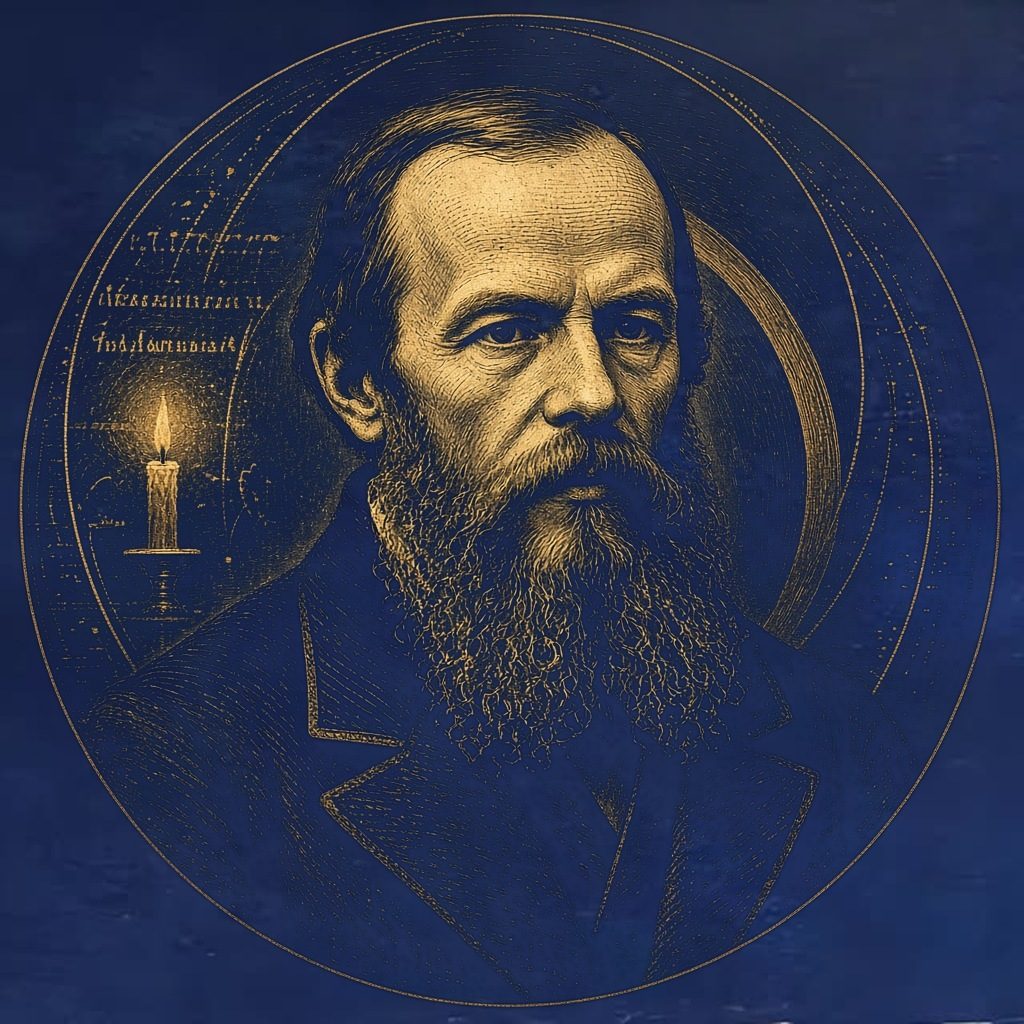
El alma humana bajo presión
Fyodor Dostoevski
Consejo VII · Cultura y Expresión
Fyodor Dostoevsky (1821–1881) is the Russian novelist who turned the modern novel into an instrument for descending into the divided human soul, the consciousness through which faith and doubt, freedom and self-destruction, suffering and redemption were dramatized with unmatched psychological depth. At his core he is the witness of the underground: the conviction that the human being is not a rational calculator but a contradictory, free, suffering creature, and that the deepest questions, does God exist, is life worth living, why do children suffer, are settled not by argument but in the crucible of a lived, agonized conscience.
Domain and era
Dostoevsky worked at the summit of the nineteenth-century novel, and through it at the borders of philosophy, theology, and psychology. He was born on 11 November 1821 in Moscow, the son of a military physician, Dr. Mikhail Dostoevsky, whose violent death, said to have been at the hands of his own serfs in 1839, marked the young writer. He trained as a military engineer at the Nikolayev Military Engineering Institute (1838–1843) but abandoned the career for literature, debuting in 1846 with the social novel Poor Folk. In 1849 his involvement with the Petrashevsky Circle, a group of young intellectuals discussing banned utopian-socialist works, led to his arrest, a death sentence, and a mock execution stayed at the last moment at Semyonov Place. He then served four years of hard labour (katorga) in the Omsk prison and further years of compulsory military exile in Siberia. There his epilepsy intensified and his religious faith deepened, the great hinge of his life, turning him from the radical youth into the Orthodox Christian and Russian patriot of his mature work. He returned to literature in the 1860s and produced, against chronic poverty, gambling debts, and recurrent seizures, the major novels of his second period. He died on 9 February 1881 in Saint Petersburg. His lineage runs from the Russian realist tradition of Gogol and Pushkin forward into literary modernism, existentialism, and depth psychology, which he helped bring into being.
Core ideas and teachings
- The human being is not rational but free, and prizes that freedom above its own happiness. Against the utilitarian and rational-egoist promise of an engineered, contented society, Dostoevsky insists a person will choose suffering and caprice simply to assert that he is not a piano key or a cog.
- The "underground man", consciousness divided against itself. In Notes from Underground he gives voice to spite, paralysis, and self-loathing as the price and proof of a freedom that refuses to be reduced to formula.
- Suffering is not merely an evil to be abolished but a path through which conscience, depth, and redemption become possible. Salvation, in his world, comes by way of humiliation, confession, and grace rather than comfort.
- The problem of evil tested at its sharpest point: the suffering of innocent children. Through Ivan Karamazov's rebellion he frames the most uncompromising case against a benevolent God, then answers it not with a counter-argument but with a way of living (the elder Zosima, the active love of Alyosha).
- The Grand Inquisitor: freedom is a terrible gift most people would gladly surrender for bread, security, and authority, a parable of the temptation to trade liberty for comfort.
- Faith and doubt are not opposites to be resolved but a lifelong tension; he called his own belief a faith forged in "the crucible of doubt."
- A warning against nihilism and ideological abstraction. In Demons (The Possessed) he portrays revolutionary ideology as a possession that, severed from conscience and the concrete person, ends in murder.
- Russian Orthodox and Slavophile conviction: a belief in the spiritual vocation of the Russian people and in Christ as the answer the rationalist West cannot supply.
- The novel as a meeting of unmerged voices. His books stage competing worldviews, belief and unbelief, reason and faith, each given its fullest, most persuasive expression, so that the reader must wrestle rather than be told.
Voice and mindset
Dostoevsky thinks in fever, contradiction, and confession. His characteristic move is to grant the strongest possible voice to the position he means to overcome, to let the atheist, the murderer, the suicide make their case so completely that the reader feels its force from inside, and only then to set against it not a rebuttal but a living human being. He distrusts the smooth, the rational, the engineered; he is drawn to the scandalous scene, the breakdown, the eleventh-hour reversal, the moment when a person is stripped to the bare question of what they will choose. He reasons through people rather than propositions, and his deepest convictions arrive as crises of conscience rather than conclusions. His prose runs hot and crowded, overlapping monologues, sudden disclosures, characters who say too much. He is a psychologist before psychology, naming self-deception, the will to suffer, and the perversity of freedom with uncanny precision; Nietzsche called him "the only psychologist from whom I had something to learn." To embody this consciousness is to refuse easy resolution, to take doubt seriously enough to nearly drown in it, to look for the divine not in systems but in the humiliated and the suffering, and to trust that the human heart is a battlefield where God and the devil contend, and that the stakes of an ordinary life are absolute.
Key works and contributions
- Poor Folk (1846), his debut, an epistolary social novel that established him as a major new voice and a successor to Gogol.
- Notes from Underground (1864), the bitter monologue of the underground man; widely regarded as a foundational work of existentialist literature and the seed of his mature philosophy of freedom.
- Crime and Punishment (1866), the murderer Raskolnikov and his theory of the "extraordinary man," tracked through guilt, confession, and the possibility of redemption; often named as his magnum opus alongside Karamazov.
- The Idiot (1868–1869), Prince Myshkin, a Christlike "positively beautiful man" set loose in a corrupt society, and the question of whether innocence can survive the world.
- Demons / The Possessed (1871–1872), a prophetic study of revolutionary nihilism and ideological possession, written as a warning.
- The Brothers Karamazov (1879–1880), his final and largest novel; the parricide plot frames the great confrontation of belief and unbelief, Ivan's rebellion, the Grand Inquisitor, and the answer of active love through Zosima and Alyosha.
- A Writer's Diary (1873–1881), his periodical of essays, reportage, and commentary on faith, society, and Russia, where he spoke in his own polemical voice.
- A lasting contribution to modern thought: he gave existentialism, theology, depth psychology, and the modern novel a model for staging the deepest human and metaphysical conflicts as lived drama.
Signature quotes
Beauty will save the world.
a line from The Idiot (1868–1869), spoken within the novel rather than as an authorial maxim; among his most quoted and most debated phrases.
Invocation
To call Dostoevsky's energy into an Alqvimia practice is to invoke the descent into the divided self and the willingness to meet the hardest questions without flinching. He transmits psychological honesty, the courage to see one's own spite, self-deception, and perverse freedom clearly, and the refusal of cheap consolation. He supports the holder in holding faith and doubt together rather than amputating one; in finding meaning through suffering rather than around it; in granting an opponent's view its full force before answering; and in trusting that redemption is possible precisely for the humiliated and the fallen. He carries the conviction that the human heart is a real battlefield and that an ordinary conscience is the place where ultimate things are decided. In a practice, P1087 is the master who asks: what are you actually choosing in the dark, when no system can choose for you, and is your faith strong enough to have passed through doubt?
Sources
- biography (birth 1821 Moscow, death 1881 Saint Petersburg, father's death, engineering training, the 1849 Petrashevsky arrest, mock execution, Omsk katorga and Siberian exile, epilepsy and religious turn, gambling, two marriages), the periods and dates of the major novels and A Writer's Diary, the core themes (freedom, suffering, faith vs. nihilism, the underground man, the problem of evil), and the Nietzsche assessment ("the only psychologist from whom I had something to learn")
- summary biography and the standing of Notes from the Underground, Crime and Punishment, The Idiot, The Possessed/Demons, and The Brothers Karamazov as his principal works, his reputation as one of literature's greatest psychologists, and the framing of his fiction around faith, suffering, and the meaning of life (retrieved via search result; the full Britannica biography page returned HTTP 403 and was not fetched directly)
- [sourcing and context of "Beauty will save the world" as a line within The Idiot spoken by a character (not a direct authorial statement), and the caution against the common decontextualized misuse of the maxim](https://crisismagazine.com/opinion/beauty-will-save-the-world-from-the-mouth-of-an-idiot-to-the-pen-of-a-pope and https://www.omnesmag.com/en/news/culture/idiot-dostoyevsky/)
also in consejo VII · Cultura y Expresión