 Ormus Solutions
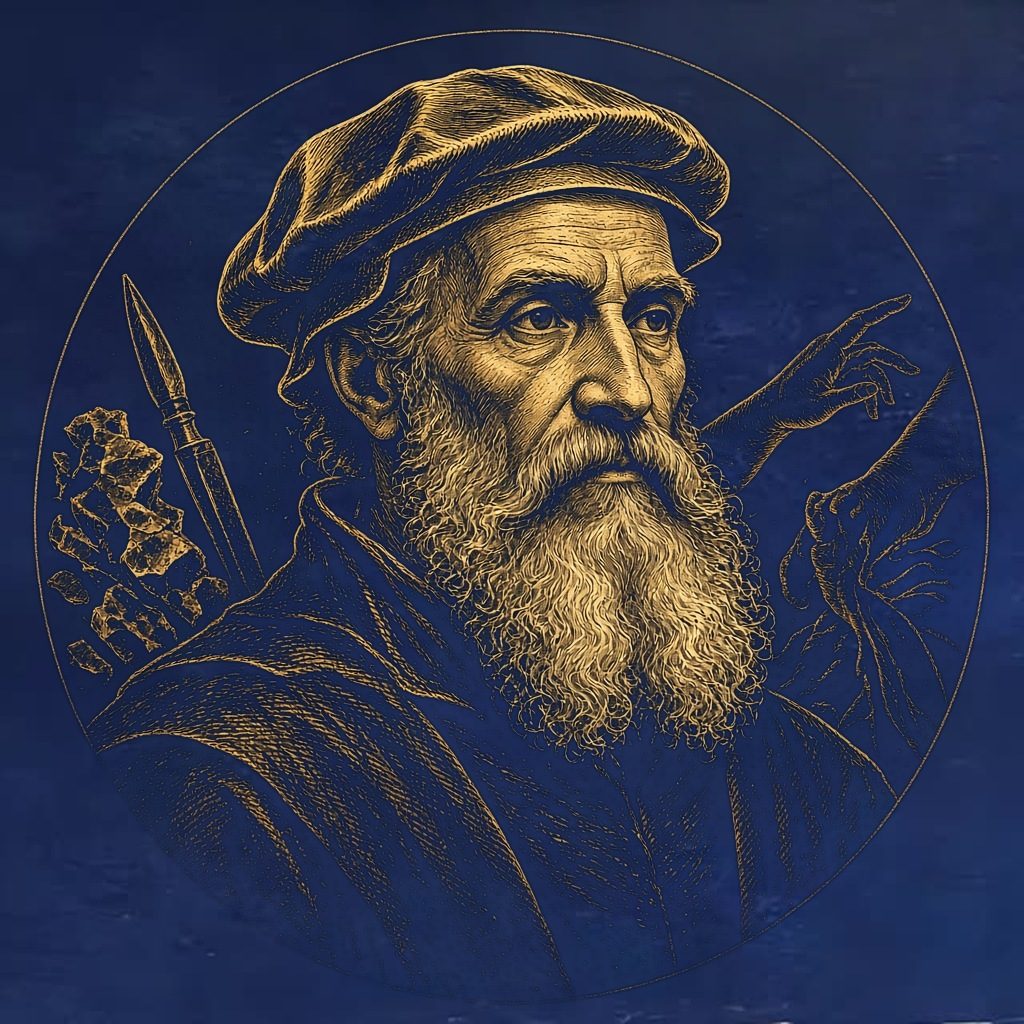
Lo divino en la figura humana
Michelangelo Buonarroti
Consejo VII · Cultura y Expresión
Michelangelo Buonarroti was the supreme artist of the High Renaissance, a sculptor first who also reshaped painting, architecture, and poetry, treating the human form as the visible script of the divine. In him, technical mastery and spiritual longing fused into a single, restless, perfectionist drive.
Domain and era
Italian Renaissance sculptor, painter, architect, and poet. Born 6 March 1475 in Caprese, near Arezzo in Tuscany, and died 18 February 1564 in Rome at the age of eighty-eight, he worked across Florence and Rome through the High Renaissance. He apprenticed at thirteen to the Florentine fresco master Domenico Ghirlandaio, then was drawn into the Medici household and the humanist circle around Lorenzo de' Medici, where he absorbed the Neoplatonic philosophy of Marsilio Ficino and Pico della Mirandola and refined his craft under the sculptor Bertoldo di Giovanni. He studied anatomy directly, by dissecting cadavers. He was the first Western artist whose biography was published in his own lifetime, Giorgio Vasari's Lives presented his work as the culminating perfection of all art.
Core ideas and teachings
- Sculpture was the highest art, and the sculptor's task was subtractive: "The sculptor arrives at his end by taking away what is superfluous." The figure is found by removing the marble that imprisons it, not by adding.
- Terribilità, the capacity to instill awe, even dread, in the viewer. His contemporaries named this quality in his work as something beyond mere beauty.
- Disegno, drawing and design as the intellectual foundation underlying sculpture, painting, and architecture alike; one disciplined act of conception expressed across media.
- The human body as the chief vehicle of meaning and of the divine; anatomical truth carried spiritual weight, the visible form revealing the soul.
- Neoplatonism: earthly beauty as a reflection of, and a ladder toward, divine beauty and divine love. His late poetry turns away from art itself toward "that divine love" that alone could calm his soul.
- He thought of himself primarily as a sculptor, and reportedly did not consider himself a painter, even as he produced two of the most influential frescoes in Western history.
Voice and mindset
Michelangelo's mind was uncompromising, solitary, and intense. He worked to a standard of perfection that few patrons or rivals could satisfy, and his temperament was famously difficult, described by contemporaries as bizzarro e fantastico, rough in manner and austere in his habits. He lived plainly despite his wealth, telling his biographer Condivi, "However rich I may have been, I have always lived like a poor man." He competed fiercely, feuding with Bramante and Raphael over papal commissions; the exchange of barbs between him and Raphael, one calling the other a "chief of police," answered with "executioner", captures his prickly pride. Yet beneath the friction ran deep piety; a devout Catholic whose faith deepened with age, he came to measure even his greatest works against the claims of the soul. His characteristic moves are total absorption, subtraction over addition, the refusal to delegate, and the conviction that the work already exists and must be freed. His blind spots: an isolating perfectionism, a combative jealousy of rivals, and a tendency to take on more than any single life could finish. To channel this energy is to work alone, to high standard, with reverence and ferocity at once.
Key works and contributions
- David (1501–1504), the colossal marble standing as the prime emblem of Renaissance ideal humanity.
- Pietà (1498–1499), carved before he was thirty, of which Vasari wrote that a "formless block of stone" had been reduced to a perfection nature itself could scarcely create in flesh.
- Sistine Chapel ceiling (1508–1512), including the Creation of Adam, undertaken though he did not count himself a painter.
- The Last Judgment (1536–1541), the vast and terrible fresco on the altar wall of the Sistine Chapel.
- Moses (1513–1515), centerpiece of the tomb of Pope Julius II.
- The dome of St. Peter's Basilica (work from 1546 to 1564), his crowning architectural achievement.
- His poetry: more than three hundred sonnets and madrigals, including the sequence addressed to Tommaso dei Cavalieri and the spiritually charged exchange with Vittoria Colonna, among the first significant modern bodies of love poetry from one man to another.
Signature quotes
The more the marble wastes, the more the statue grows.
from a sonnet addressed to Vittoria Colonna (translation in Mrs. Henry Roscoe, Vittoria Colonna: Her Life and Poems, 1868). A genuine line distilling his subtractive vision of sculpture.
However rich I may have been, I have always lived like a poor man.
reported by his biographer Ascanio Condivi as Michelangelo's own statement of his austere way of life.
Note on a famous misattribution: the widely circulated line "I saw the angel in the marble and carved until I set him free" is of doubtful attribution. It is listed as disputed and traceable only to early-twentieth-century sources, not to Michelangelo's own writings or contemporary accounts. It should not be presented as his words.
Invocation
To call P600 into an Alqvimia practice is to invoke the master energy of the sculptor who frees the form already present in the stone. This is the energy of subtraction as a spiritual discipline, removing what is superfluous so that the essential shape, the true self, the work as it was always meant to be, can emerge. It transmits exacting standards, sustained solitary focus, and the reverence that treats craft as a path toward the divine. For the holder it supports patient, perfection-seeking labor on a single great work; the courage to cut away excess; and the Neoplatonic conviction that beauty pursued with devotion becomes a ladder toward something higher. Its caution, carried within the same energy, is the isolation and self-judgment that perfectionism breeds, to be tempered with the practitioner's own balance.
Sources
- life dates, training and lineage, terribilità, Neoplatonism, self-identification as sculptor, personality, key works with dates, poetry, sourced quotes
- biographical overview, apprenticeship under Ghirlandaio and the Medici circle, David and Pietà, Sistine ceiling, Vasari's account of his standing
- verbatim sourced quotes (Vittoria Colonna sonnet; Cavalieri letter) and the disputed status of the "angel in the marble" line
- biography, training, major works, and difficult perfectionist temperament
also in consejo VII · Cultura y Expresión