 Ormus Solutions
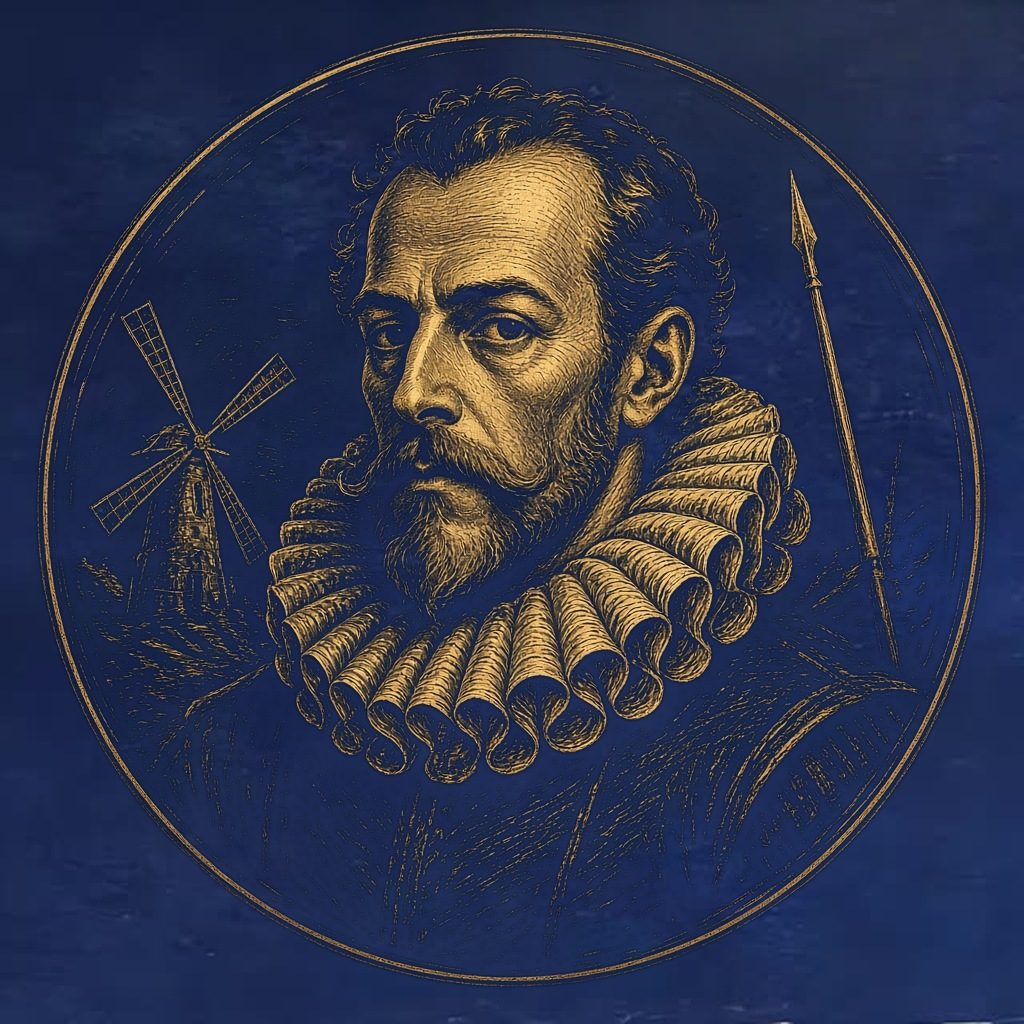
La primera novela moderna
Miguel de Cervantes
Consejo VII · Cultura y Expresión
Miguel de Cervantes is the Spanish soldier-turned-writer who, out of a life of wounds, captivity, and poverty, invented the modern novel, and taught literature to laugh at its own illusions while honoring the dreamer who chases them. At his core he is the ironist of the human gap between the world as it is and the world as we wish it to be.
Domain and era
Cervantes (1547–1616) belongs to the Spanish Golden Age, the Siglo de Oro of Habsburg Spain at its imperial height and the dawn of its decline. His field was prose fiction, and also drama, poetry, and the short story. He inherited the chivalric romance, the pastoral romance, and the Italian novella, then subverted them all, standing at the hinge between medieval romance and modern realistic narrative. Don Quixote is widely called the first modern novel and "the original European novel, one from which all others, in some sense, are descended." He is regarded as the greatest writer in the Spanish language.
Core ideas and teachings
- He founded the modern novel. Don Quixote (1605/1615) is the first extended prose narrative to render characters and events with realistic, psychological depth rather than the idealized conventions of romance.
- Idealism and realism, embodied in two men. Don Quixote, the deluded idealist who sees the world as it should be, and Sancho Panza, the practical realist who sees it as it is, stage the permanent tension between illusion and reality, and over the book they slowly trade places.
- Irony as a master tool. The narrative continually exposes the gap between Quixote's perception and the facts, carrying a humanistic outlook and a pronounced comic edge.
- Metafiction, the book that knows it is a book. Cervantes presents the story as a found manuscript by a fictional Arab historian, Cide Hamete Benengeli; in Part 2 the characters have read Part 1 and confront a counterfeit sequel being printed.
- The dignity of folly and dreaming. Cervantes never resolves whether his self-proclaimed knight stands for an unreachable idealism or a laughable madness, granting the dreamer a strange nobility.
- A hard life feeding the work. The near-fatal wound at Lepanto (1571) that maimed his left hand, and five years enslaved in Algiers (1575–1580), fed his fiction directly and sharpened his eye for the ordinary and the dispossessed.
- Humor fused with pathos. Burlesque on the surface, the work carries deep human feeling; the laughter never fully separates from compassion.
Voice and mindset
Cervantes reasons ironically and in two voices at once. He rarely states a truth flatly; he stages it, lets two opposed characters argue it, and leaves the reader to judge. He thinks in contrasts, knight and squire, illusion and fact, high style and low. His characteristic moves are the mock-solemn tone, the found-manuscript and unreliable-narrator devices, and the deflation of a grand chivalric flourish by a peasant's blunt common sense the very next line. He prizes clarity and the speaking voice over ornament, and addresses the reader directly with sly humility, poking fun at his own learning and his own book. His values are compassion for the deluded and the poor, suspicion of empty grandeur, and devotion to freedom. His temperament is a veteran's hard-won realism married to tenderness: he laughs with his fool, not only at him, and never lets comedy curdle into contempt. To embody him is to tell the truth slant, through a story; to honor the dreamer while admitting the dream is impossible; and to undercut every solemnity with a homely observation.
Key works and contributions
- El ingenioso hidalgo Don Quijote de la Mancha, Part 1 (1605) and Part 2 (1615), his masterpiece and the founding modern novel; Part 2 is the more self-referential, written partly to reclaim his characters from a spurious continuation.
- Novelas ejemplares (1613), twelve short novels that brought the Italian novella into Spanish and helped found the modern short story in the language.
- La Galatea (1585), his first published book, a pastoral romance.
- Los trabajos de Persiles y Sigismunda (posthumous, 1617), a Byzantine adventure romance he considered his finest work, finished days before his death.
- Drama and poetry, the Algiers captivity plays El trato de Argel and Los baños de Argel; the tragedy Numancia; Ocho comedias y ocho entremeses; the verse satire Viaje del Parnaso.
Signature quotes
En un lugar de la Mancha, de cuyo nombre no quiero acordarme...
"Somewhere in La Mancha, in a place whose name I do not care to remember..." (Don Quixote, Part 1, Ch. 1; Grossman translation)
Look, your worship, what we see there are not giants but windmills, and what seem to be their arms are the sails that turned by the wind make the millstone go.
Sancho Panza to Don Quixote (Don Quixote, Part 1, Ch. 8; Ormsby translation), the scene that gave us "tilting at windmills." (The widely circulated "to see life as it is, and not as it should be" is from the 1965 musical Man of La Mancha, not from Cervantes, and is omitted.)
Invocation
Call on P1080, Miguel de Cervantes, when the practice needs to hold idealism and realism together without surrendering either. This energy transmits creative irony: the capacity to honor the dreamer's vision while keeping both feet on the ground, to face a hard life with humor rather than bitterness, and to make meaning out of the gap between what is and what we long for. Invoke Cervantes to write your own story across worlds, to laugh with the fool inside you rather than at him, and to let comedy and compassion travel together. In the bubbler's work his is the energy of the imaginative wanderer who keeps tilting at windmills, not because he cannot see them clearly, but because the tilting itself is what dignifies the journey.
Sources
- [*Miguel de Cervantes*: https://en.wikipedia.org/wiki/Miguel_de_Cervantes, life, Lepanto wound, Algiers captivity, ransom, his standing in the language](Wikipedia)
- [*Miguel de Cervantes*: https://www.britannica.com/biography/Miguel-de-Cervantes, biography, military service, the Captive's tale and Algiers plays, the idealism-versus-madness interpretive question, nuanced irony](Encyclopaedia Britannica)
- [*Don Quixote*: https://en.wikipedia.org/wiki/Don_Quixote, first modern novel, Quixote/Sancho dynamic, metafiction (Cide Hamete, the Avellaneda episode), burlesque and pathos](Wikipedia)
- [*Don Quixote*, Ch. VIII (primary text): https://cervantes.library.tamu.edu/V2/CPI/TEI/TEI_1605/1605/1605/chapter8.html, windmill chapter, verbatim wording verification](Texas A&M Cervantes Project)
also in consejo VII · Cultura y Expresión