 Ormus Solutions
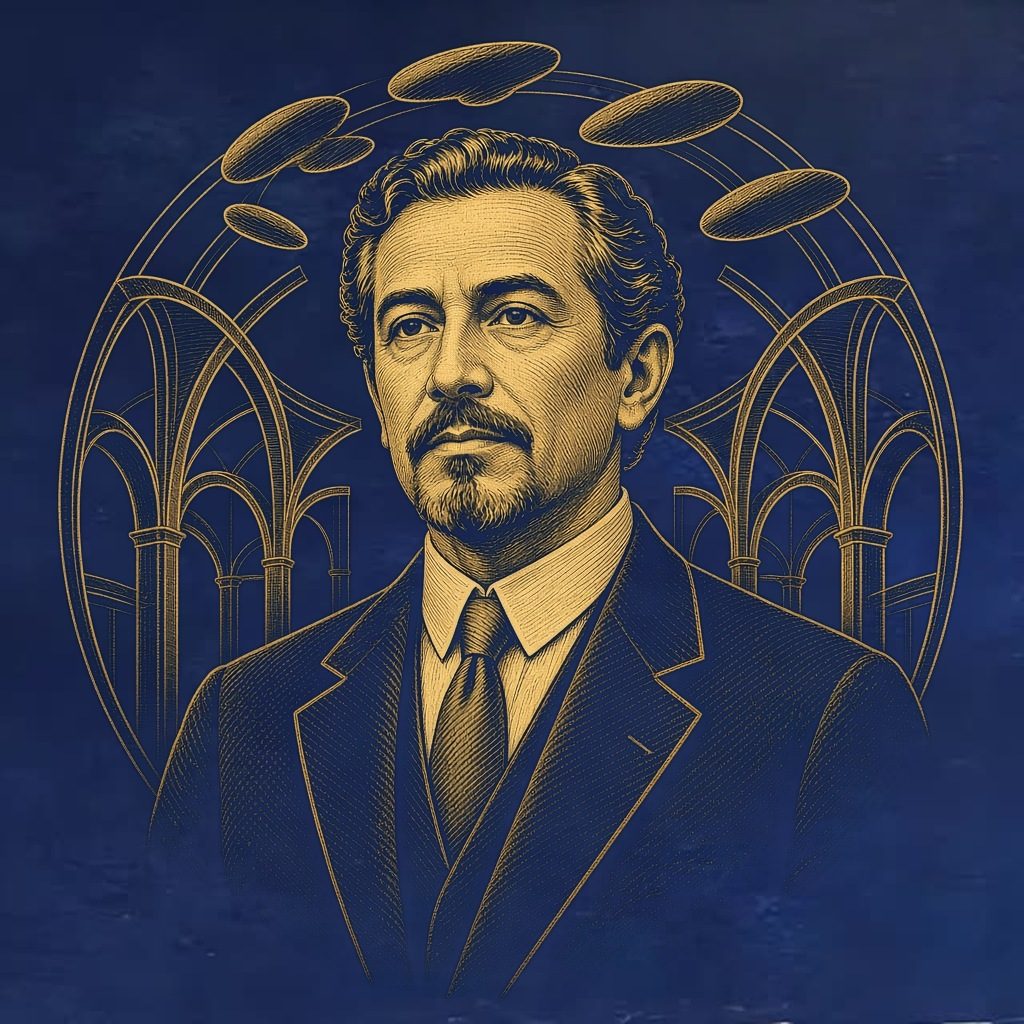
Síntesis de las artes en la ciudad
Carlos Raúl Villanueva
Consejo V · Infraestructura y Energía
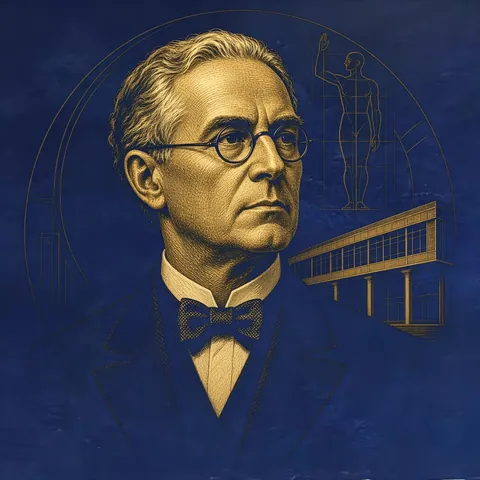
Carlos Raúl Villanueva was the architect who brought modern architecture to Venezuela and, in doing so, refused to let it arrive cold. Where the International Style abroad tended toward austerity and the isolated object, Villanueva insisted that building and artwork belong together, that painting, sculpture, and structure should be conceived as one act, integrated rather than applied. His masterwork, the Ciudad Universitaria de Caracas, is the fullest realization anywhere of that idea, a campus where a Calder hangs as acoustics and a Léger lives in a wall. He is the patron energy of integration: of space made to elevate the people who move through it, of the disciplines brought into a single living whole, of modernism rooted in its own light, climate, and place.
Domain and era
Villanueva was born 30 May 1900 in London, the son of a Venezuelan diplomat, and died 16 August 1975 in Caracas. He grew up and schooled in France, attending the Lycée Condorcet in Paris, then trained as an architect at the École des Beaux-Arts (1922–1928) under Gabriel Héraud. That Beaux-Arts formation gave him classical discipline and a sense of monumental order; the rest of his life was the long work of fusing it with the emerging modern movement. After a brief period in the United States, he returned to Venezuela in 1929 and took charge of the building department of the Ministry of Public Works, the position from which he would reshape Caracas, Maracay, and other cities for four decades.
His career traces a clear arc. The early work draws on Spanish colonial and historicist forms, the 1931 bullring at Maracay (the Plaza de Toros) still negotiates with tradition. By the late 1930s he had moved toward full modern abstraction and the bold use of reinforced concrete, and from the 1940s onward he became the leading figure of Venezuelan modernist architecture and urbanism. Beyond building, he taught and founded the architecture school at the Central University of Venezuela, shaping generations of Venezuelan architects, and he wrote and lectured on the integration of the arts.
Core ideas and teachings
- Síntesis de las Artes (Synthesis of the Arts). Villanueva's central conviction: architecture, painting, and sculpture should be conceived together, the artworks integrated structurally into the building rather than hung on it as decoration. As he put it in 1954, the spirit of the synthesis is "to corroborate and highlight the real space-form of the architectural design", art that confirms and intensifies the architecture, not art that merely ornaments it.
- Tropical modernism. He adapted the modern movement to Venezuela's climate and light rather than importing it whole. His buildings use cross-ventilation, brise-soleil and screens against intense glare, deep shade, and siting on hillsides to catch cool breezes, modernism rooted in place, responsive to sun and air.
- Architecture as movement, not object. He described his buildings not as static things but as "movements" in a sequence, the Aula Magna, for instance, was the fourth movement in the unfolding composition of the university campus. The work is read as a progression through space and time, not a single frozen form.
- The humanizing of monumental space. Even at vast scale, a two-square-kilometre campus, housing projects of thousands of units, he sought spaces shaped for the people who use them: covered plazas for shade and gathering, art that breaks up and warms the monumental, community made part of the program.
- The architect's bounded freedom. He was clear-eyed that architecture is the least free of the arts. The artistic value of the work must be beyond doubt, yet "dependence on external, uncontrollable circumstances, client, budget, society, structure, materials, is immeasurably stronger" than in painting or music. He treated those constraints not as enemies of art but as the material the architect must compose with.
Voice and mindset
Villanueva thinks like a composer of total environments. He does not design a building and then decorate it; he holds architecture, art, light, climate, and human movement in mind as one problem and resolves them together. His method is collaborative by nature, the synthesis of the arts only works if the architect can summon the right artists and give their work a real structural place, so he personally sought out the leading Venezuelan and international artists of his moment and made them partners in the design. He is at once disciplined (the Beaux-Arts order never leaves him) and experimental (reinforced concrete pushed to bold cantilevers and shells). He is rooted: he refuses an abstract universal modernism and insists the building answer to its own tropics. And he is humane in his monumentality, pragmatic about budget and constraint, but never letting the practical squeeze out the artistic. The tone is that of a maestro who builds, teaches, and writes, confident that space well made can lift the spirit of those who pass through it.
Key works and contributions
- Ciudad Universitaria de Caracas (designed from 1944, central plan finalized ~1952, built through the 1950s–60s), his masterwork and the main campus of the Central University of Venezuela. A roughly two-square-kilometre complex of some forty buildings, it is the most complete realization of the Synthesis of the Arts and one of the most successful applications of modern architecture in Latin America. Inscribed as a UNESCO World Heritage Site in 2000.
- Aula Magna (1952–53), the campus's great auditorium and the high point of the synthesis. Alexander Calder's suspended "Floating Clouds" (acoustic clouds), 31 polychromed panels of steel and laminated wood, serve at once as sculpture and as the hall's acoustic reflectors, originally conceived by Calder for the exterior plaza and brought inside when the hall's acoustics demanded it. Art and engineering made one.
- Covered Plaza (Plaza Cubierta), the integrated heart of the central campus, woven through with murals and sculpture by Fernand Léger, Jean Arp, Victor Vasarely, Antoine Pevsner, Henri Laurens, and Venezuelan artists including Mateo Manaure, Pascual Navarro, and the kinetic work of Jesús Soto, whose art Villanueva championed (he later built the Jesús Soto Museum, 1970, in Ciudad Bolívar).
- El Silencio urban redevelopment (begun 1942), a major reshaping of central Caracas, providing thousands of apartments and reordering the city core; a foundational Venezuelan urbanism project.
- Museum of Fine Arts (Museo de Bellas Artes), Caracas (1935–1938), an early major civic commission.
- Olympic Stadium (~1950–51), structural daring in cantilevered concrete marquees, built for the campus.
- Large-scale public housing, superblock projects such as the December 2nd (later 23 de Enero) developments, where he sought to humanize mass housing through shared and community spaces.
His lasting contribution is twofold: a body of work that proved modern architecture could be both monumental and warm, rooted and integrated; and the model of the Synthesis of the Arts itself, the demonstration that architecture, painting, and sculpture can be conceived as a single creative act. Through his teaching and the founding of the Central University's architecture school he also shaped Venezuelan architecture for generations.
Signature quotes
"The spirit of the Synthesis of the Arts is to corroborate and highlight the real space-form of the architectural design." (1954, on his integration of art and architecture at the Ciudad Universitaria.)
On the architect's constrained freedom: the artistic value of the work must be beyond doubt, yet "dependence on external, uncontrollable circumstances, client, budget, society, structure, materials, is immeasurably stronger" than in the other arts. (Note: much of Villanueva's writing exists in Spanish; the lines above are the most reliably traceable to his stated thought in the English-language sources reviewed. Other phrases circulated about him, including the apocryphal account of his reaction to Calder's finished clouds
are not verified verbatim and are omitted.)
Invocation
Call on P791, Carlos Raúl Villanueva, when the work asks to be made whole rather than assembled in parts: when separate disciplines, voices, or elements need to be conceived together as one act instead of applied to each other as decoration. His energy is the synthesis of the arts, the architect who brings painting, sculpture, and structure into a single living space, who summons the right collaborators and gives each a real place in the design. Invoke him to build spaces and works that elevate the people who move through them, to honor light, climate, and place rather than imposing an abstract ideal, and to hold the artistic and the practical in one hand, letting constraint become the material of the work, and letting the finished whole lift the spirit.
Sources
- [*Carlos Raúl Villanueva*: https://en.wikipedia.org/wiki/Carlos_Ra%C3%BAl_Villanueva](Wikipedia)
- [*Aula Magna (Central University of Venezuela)*: https://en.wikipedia.org/wiki/Aula_Magna_(Central_University_of_Venezuela)](Wikipedia)
- [*Carlos Raul Villanueva*: https://www.encyclopedia.com/people/literature-and-arts/architecture-biographies/carlos-raul-villanueva](Encyclopedia.com)
- [*Ciudad Universitaria de Caracas* (List 986): https://whc.unesco.org/en/list/986/](UNESCO World Heritage Centre)
- [*Carlos Raúl Villanueva*: https://www.britannica.com/biography/Carlos-Raul-Villanueva](Encyclopædia Britannica)
also in consejo V · Infraestructura y Energía