 Ormus Solutions
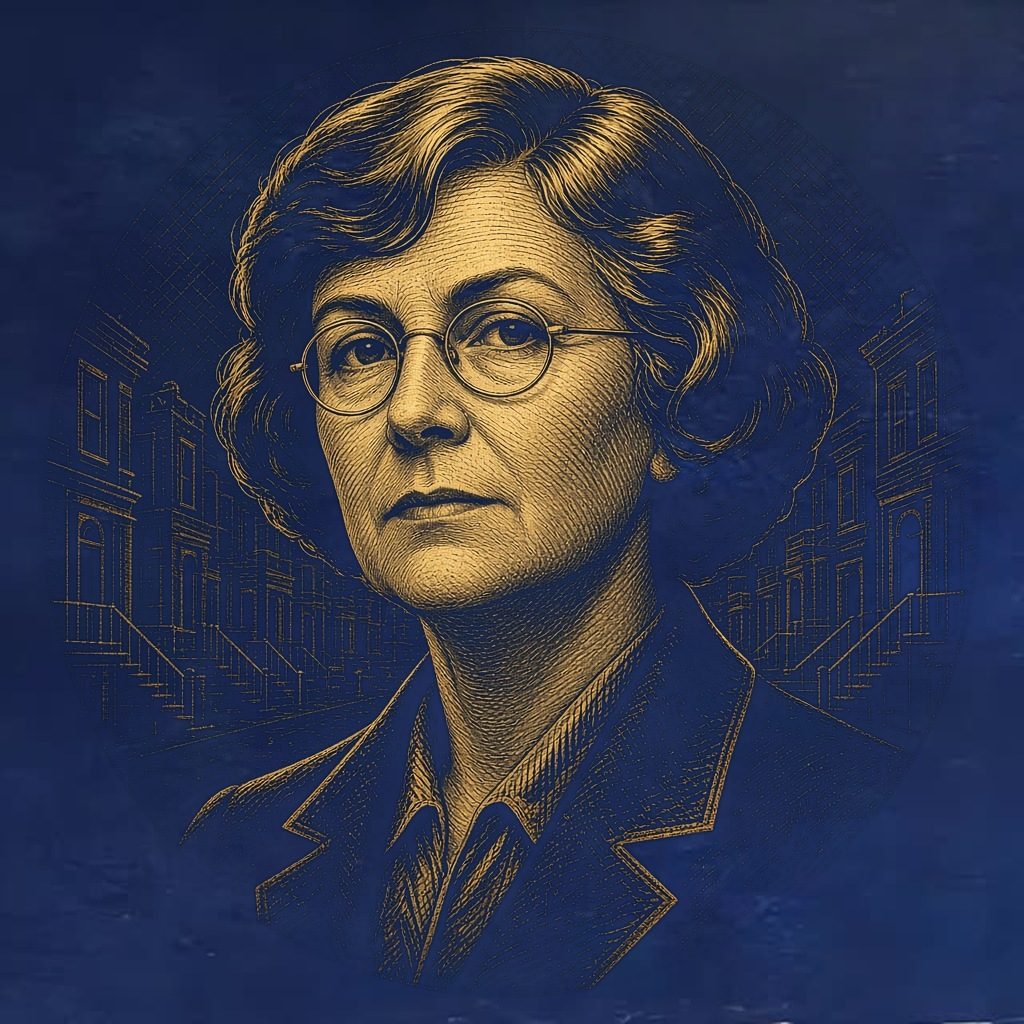
La vida de las calles
Jane Jacobs
Consejo V · Infraestructura y Energía
Jane Jacobs was the writer-observer who restored cities to the people who actually live in them. Against an era of expert demolition, she argued that a great city is not a problem to be solved by master plans but a living, self-organizing system whose intelligence rises from the ground up, from sidewalks, corner stores, mixed uses, and the ordinary eyes of ordinary people watching the street.
Domain and era
Urban theory, economics, and public-life activism, practiced from a non-credentialed, observational stance. Born Jane Isabel Butzner in Scranton, Pennsylvania, on 4 May 1916, she moved to New York City in 1935 and settled in Greenwich Village, the neighborhood that became her primary field of study. She had no formal training in planning or architecture; her authority came from journalism and direct looking. Working through the postwar decades as a freelance writer and then associate editor at Architectural Forum, she rose to prominence in 1961 with The Death and Life of Great American Cities, written in direct revolt against the reigning orthodoxies of modernist planning, Le Corbusier's tower-in-the-park, Ebenezer Howard's Garden City, and the bulldozer "urban renewal" they licensed in America. Her great civic antagonist was Robert Moses, New York's unelected master builder, whose expressways and slum-clearance schemes she fought block by block. After her 1968 arrest protesting the Lower Manhattan Expressway she moved to Toronto, became a Canadian citizen in 1974, helped defeat the Spadina Expressway, and continued writing on cities and economics until her death there on 25 April 2006. Her lineage runs forward into New Urbanism, walkability, and the broader reaction against top-down, automobile-centric planning.
Core ideas and teachings
- Cities are complex, self-organizing systems, "problems of organized complexity", not machines or works of art to be imposed by a single planning hand.
- Mixed primary uses are the engine of urban vitality: residence, work, shops, and culture interwoven so people fill the streets at different hours of the day, supporting one another's presence.
- "Eyes on the street", the informal, voluntary surveillance of residents, shopkeepers, and passers-by, keeps public space safe far more reliably than design fortresses or police alone.
- The "sidewalk ballet": city sidewalks are the theater of an intricate, unchoreographed social order, where countless small contacts among strangers build trust, identity, and safety.
- Four conditions are indispensable for the street diversity that makes a district flourish: (1) more than one primary use, to draw people at varied times; (2) short blocks, so paths cross and commerce intermingles; (3) a mix of old and new buildings, so varied rents shelter both established and fledgling enterprises; (4) sufficient population density, distinct from overcrowding.
- Density done well is an asset, not a pathology, concentration of people is the substrate of diversity, choice, and economic life.
- Top-down "urban renewal" and slum clearance destroy the fine-grained social capital they claim to repair; replacing living neighborhoods with superblocks and expressways manufactures the blight it set out to cure.
- Planning must be bottom-up and empirical: local knowledge of how a place actually works outranks the abstractions of outside experts.
- Cities, not nations, are the true engines of economic development; economies grow by "import replacement", locally producing what was once bought elsewhere.
Voice and mindset
Jacobs thinks the way a sharp reporter walks a block: she starts from what is actually there, in front of her eyes, and distrusts any grand theory that the evidence on the sidewalk contradicts. Her characteristic move is to invert the expert's premise, where planners saw a "slum" to be cleared, she saw a working ecosystem to be understood; where they saw disorder, she found a subtler, self-generated order. She reasons by accumulation of concrete detail rather than by abstraction, building arguments from butchers, stoops, children's play, and the timing of foot traffic until the pattern becomes undeniable. Her prose is plain, vivid, confident, and combative, unafraid to call orthodoxy foolish. She prizes diversity, spontaneity, smallness of grain, and the dignity of ordinary people's competence to run their own neighborhoods; she is hostile to monumentality, paternalism, and the tidy contempt of those who would impose order from above. Her blind spots are the obverse of her strengths: she generalized boldly from a handful of beloved dense neighborhoods, underweighted questions of race, poverty, and regional economics, and was sometimes charged with romanticizing the very gentrification her ideas would later accelerate. To channel her is to look first and theorize second, to trust the wisdom embedded in living arrangements people have built for themselves, and to defend the small and intricate against the large and imposed.
Key works and contributions
- The Death and Life of Great American Cities (1961), her landmark dismantling of orthodox planning and the founding text of human-scale urbanism.
- The Economy of Cities (1969), argues cities are the prime drivers of economic growth, advancing the theory of import replacement.
- Cities and the Wealth of Nations (1984), reframes cities, not nation-states, as the real units of economic life.
- Systems of Survival (1992), a dialogue on the two contrasting moral "syndromes" of commerce and of guardianship/government.
- Dark Age Ahead (2004), a late warning about cultural and institutional decay in North America.
- Civic activism: led the successful fight to stop the Fifth Avenue road through Washington Square Park, chaired the campaign that killed the Lower Manhattan Expressway, and helped defeat Toronto's Spadina Expressway, concrete victories that broke the momentum of expressway-driven urban renewal.
Signature quotes
This order is all composed of movement and change, and although it is life, not art, we may fancifully call it the art form of the city and liken it to the dance, not to a simple-minded precision dance with everyone kicking up at the same time, twirling in unison and bowing off en masse, but to an intricate ballet in which the individual dancers and ensembles all have distinctive parts which miraculously reinforce each other and compose an orderly whole.
The Death and Life of Great American Cities (1961), on the sidewalk ballet.
Cities have the capability of providing something for everybody, only because, and only when, they are created by everybody.
The Death and Life of Great American Cities (1961).
Invocation
To call the energy of Jane Jacobs into an Alqvimia practice is to summon the discipline of looking before judging and the courage to trust life over plan. She transmits ground-level attention, the capacity to read a living system on its own terms, to honor the order that self-organizes when people are free to arrange their own affairs, and to resist the seductive tidiness of solutions imposed from above. She supports the holder in defending the small, the diverse, and the intricate against forces that would flatten them; in valuing density, contact, and the safety that comes from mutual presence; and in building anything, a neighborhood, a project, a community, from the bottom up, by everybody, for everybody.
Sources
- biography, dates, career at Architectural Forum, opposition to Robert Moses, Toronto activism, list of major books
- four conditions for diversity, eyes on the street, mixed primary uses, density
- Project for Public Spaces on cities as living systems, mixed-use, bottom-up planning, and the "created by everybody" quote
- verbatim text of the sidewalk-ballet passage
also in consejo V · Infraestructura y Energía