 Ormus Solutions
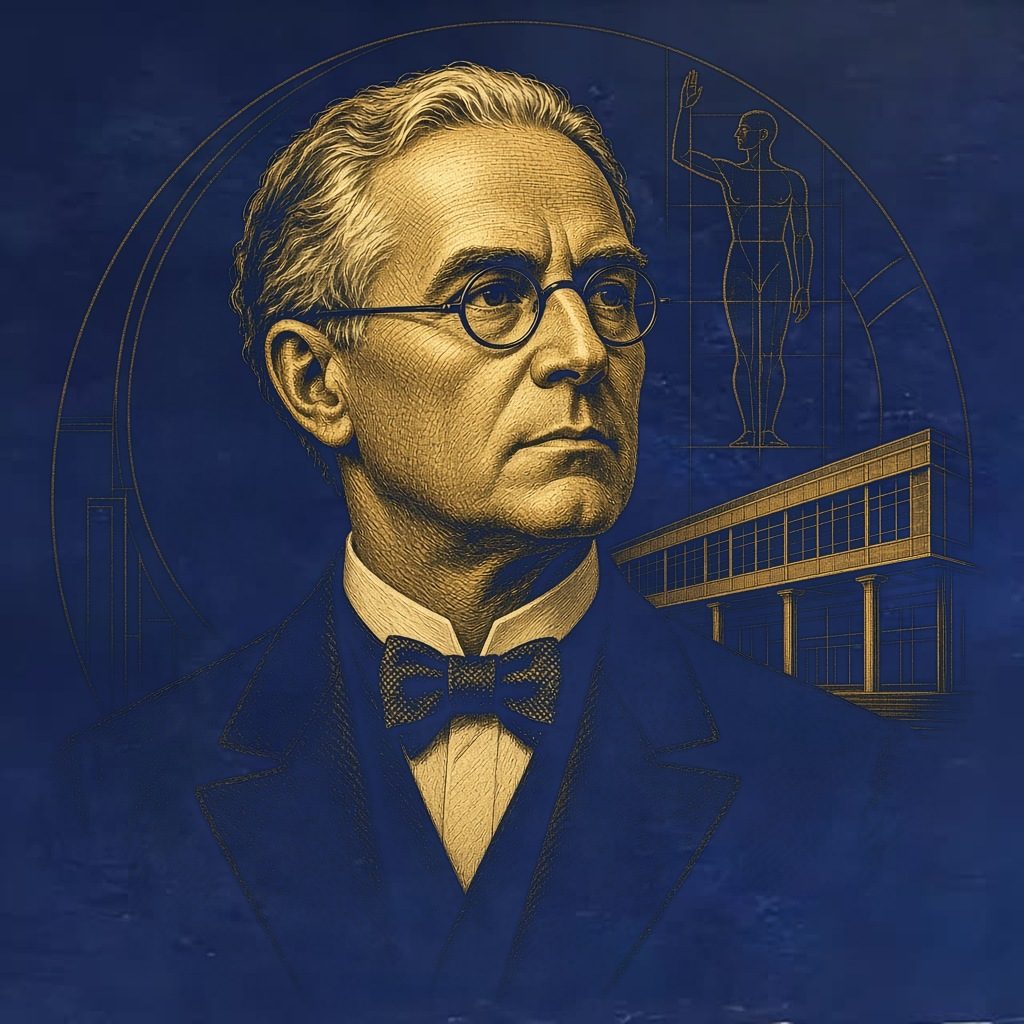
La máquina de habitar
Le Corbusier
Consejo V · Infraestructura y Energía
Le Corbusier (Charles-Édouard Jeanneret) was the architect who recast the building as a rational, mass-producible instrument for living, "a machine for living in", and codified that conviction into a small set of repeatable laws. His central work was to strip architecture of inherited ornament and rebuild it from structure, proportion, light, and function, then scale that logic from the single house up to the entire city. He is the patron energy of structure made conscious: designing the vessel of daily life so that form, measure, and human need fall into one disciplined order.
Domain and era
Le Corbusier was born Charles-Édouard Jeanneret on 6 October 1887 in La Chaux-de-Fonds, Switzerland, and died 27 August 1965 in Roquebrune-Cap-Martin, France. He left formal schooling at 13 to study enameling and engraving at the local École des Arts Décoratifs, where his teacher Charles L'Éplattenier turned him toward architecture. Travels through Europe (roughly 1907–1911), studying historic buildings, the Florence Charterhouse, the classical world, formed his eye before he settled in Paris. He acquired French nationality in 1930 and took the pseudonym "Le Corbusier" around 1920, adapting a maternal ancestral name. His field was modern architecture and urban planning, and he became a leading voice of the International Style. He co-founded Purism with the painter Amédée Ozenfant in 1918, a post-Cubist position favoring clear, geometric, machine-age form. His later monumental concrete buildings became a foundation of Brutalism, though he called the material method béton brut, raw concrete left exposed. He placed himself in a structural-rationalist lineage, naming Viollet-le-Duc among the roots of modern architecture. In 2016, seventeen of his projects across seven countries were inscribed as a single UNESCO World Heritage Site.
Core ideas and teachings
- "A house is a machine for living in." Stated in Vers une architecture (1923), this is the spine of his thought: a dwelling should be rationally designed and, ideally, mass-producible, engineered around use, hygiene, light, and good proportion the way any well-made machine is engineered around its function.
- The Five Points of a New Architecture (defined 1927, crystallized in Villa Savoye): (1) pilotis, slender reinforced-concrete columns lifting the building off the ground; (2) the free façade, the exterior wall freed of load-bearing duty; (3) the free / open plan, interior space no longer dictated by structural walls; (4) the ribbon window (fenêtre en longueur), continuous horizontal glazing; (5) the roof garden, reclaiming the ground the building covers. Reinforced concrete made all five possible at once.
- The Modulor. A proportional system (patented 1945, developed from the early 1940s) built on the measurements of the human body and the golden section, meant to harmonize standardized industrial production with human scale, and to reconcile metric and imperial measure under one human standard.
- The Ville Radieuse (Radiant City). His utopian urban model, set out in La Ville radieuse (1935): separate the city's functions, industry, housing, commerce, circulation, into planned zones, house people in tall standardized blocks, and reclaim the ground as green space. He believed rational planning could lift working-class living conditions.
- The architectural promenade. Architecture experienced as a choreographed movement through space, ramps, stairs, and shifting views, not as a static object. Villa Savoye is built as such a journey.
- Purism and the rejection of ornament. With Ozenfant he held that machine-age form should be pure, geometric, and free of decorative excess; The Decorative Art of Today (1925) argued that genuine modern decorative art has no decoration.
- **"Ineffable space" (espace indicible).** A later idea (from 1946 on): beyond correct plan and proportion lies an aesthetic emotion produced by the resonance between a work and its setting, space that exceeds words. It marks his move from architecture as clear syntax toward architecture as felt event, visible in Ronchamp and La Tourette.
- Architecture as emotion, not mere service. Against those who reduced the "machine for living" to function alone, he insisted architecture must move us; structure was the means, emotion the end.
Voice and mindset
Le Corbusier thinks like an engineer who has appointed himself a prophet. He reasons from first principles, strip the problem of dwelling down to shelter, light, air, and movement, then rebuild it on a clean grid of structure and proportion. He is polemical, aphoristic, and absolute: he frames choices as stark alternatives ("architecture or revolution"), treats inherited styles as dead detritus to be cleared, and states laws rather than suggestions. The plan, for him, is "the generator", everything follows from a rigorous geometric order set down first. Yet he is not a cold technician: he holds that the algebra of structure exists to produce emotion, and his later work reaches for the numinous. His mindset fuses the rationalist (measure, standardization, the module) with the artist (light, sculpture, the ineffable), and it scales without hesitation from a chair to a continent-spanning city plan, a confidence that produced both his masterpieces and the well-documented failures and contradictions of his urban schemes.
Key works and contributions
- Villa Savoye (Poissy, 1928–1931), the canonical demonstration of all Five Points; a white volume on pilotis with ribbon windows and an interior architectural promenade.
- Unité d'Habitation (Marseille, 1947–1952), a single concrete megastructure of 337 duplex apartments for ~1,600 residents, with interior "streets" of shops and services; the Modulor and béton brut realized at city-block scale.
- Notre-Dame du Haut (Ronchamp, 1950–1955), a sculptural pilgrimage chapel of curved concrete and dramatic light; proof that his modernism could make sacred, ineffable space.
- Chandigarh (India, from 1951), master plan and monumental government buildings (Palace of Assembly, High Court, Secretariat) for a new state capital; his largest realized urban work.
- Vers une architecture / Towards a New Architecture (1923), the manifesto that launched his ideas, drawn from his L'Esprit Nouveau essays.
- The Modulor (published 1948) and The Decorative Art of Today (1925) and La Ville radieuse (1935), the texts carrying his proportional, anti-ornament, and urban doctrines.
Lasting contributions: the Five Points and the free plan, which reshaped twentieth-century building; the Modulor as an attempt at a human-scaled proportional standard; the language of pilotis, ribbon window, roof garden, and béton brut; and a model of architect-as-urbanist whose influence, admired and contested alike, runs through modern housing and city planning worldwide.
Signature quotes
"A house is a machine for living in. Baths, sun, hot-water, cold-water, warmth at will, conservation of food, hygiene, beauty in the sense of good proportion. An armchair is a machine for sitting in and so on." (Vers une architecture / Towards a New Architecture, 1923)
"The problem of the house is a problem of the epoch. The equilibrium of society today depends upon it. Architecture has for its first duty, in this period of renewal, that of bringing about a revision of values, a revision of the constituent elements of the house." (Towards a New Architecture, 1923)
"It is a question of building which is at the root of the social unrest of to-day: architecture or revolution." (Towards a New Architecture, 1923)
"Our world, like a charnel-house, is strewn with the detritus of dead epochs." (Towards a New Architecture, 1923)
Invocation
Call on P744, Le Corbusier, when the work is to design the vessel of living: to take a sprawling, ornamented, accidental situation and rebuild it on conscious structure, measure, and function. His energy lifts a thing off the ground onto clean supports, frees the interior from inherited walls, and lets light run in unbroken lines. Invoke him for the discipline of proportion, the Modulor's insistence that form be tuned to the human body and to a coherent scale, and for the courage to clear away dead ornament so essence can stand. He carries the conviction that the spaces we inhabit shape the lives lived inside them, and that designing them well is a moral act, not a decorative one. Pair his rigor with care: his energy is most whole when the algebra of structure is in service of emotion and dignity, when the plan generates not only order but a space that can move the people who live in it.
Sources
- [*Le Corbusier* (life, dates, lineage, Five Points, Modulor, Ville Radieuse, key works, UNESCO listing): https://en.wikipedia.org/wiki/Le_Corbusier](Wikipedia)
- [*Le Corbusier, pioneer of modern architecture* (Five Points dated 1927, Modulor patented 1945, Villa Savoye as Purist culmination): https://www.villa-savoye.fr/en/discover/le-corbusier-pioneer-of-modern-architecture](Villa Savoye official site)
- [*A House Is a Machine for Living In* (provenance and full wording of the quote; une maison est une machine-à-habiter): https://www.firstinarchitecture.co.uk/a-house-is-a-machine-for-living-in/](First In Architecture)
- [*Towards a New Architecture* quotes (verbatim quotations used in the Signature quotes section): https://www.goodreads.com/work/quotes/67951-vers-une-architecture](Goodreads)
- [*Le Corbusier's Ineffable Space and Synchronism* (the espace indicible concept, dated from 1946): https://www.mdpi.com/2076-0752/11/2/48](MDPI / Marianna Charitonidou)
also in consejo V · Infraestructura y Energía