 Ormus Solutions
Obras que mueven el mundo
Isambard Kingdom Brunel
Consejo V · Infraestructura y Energía
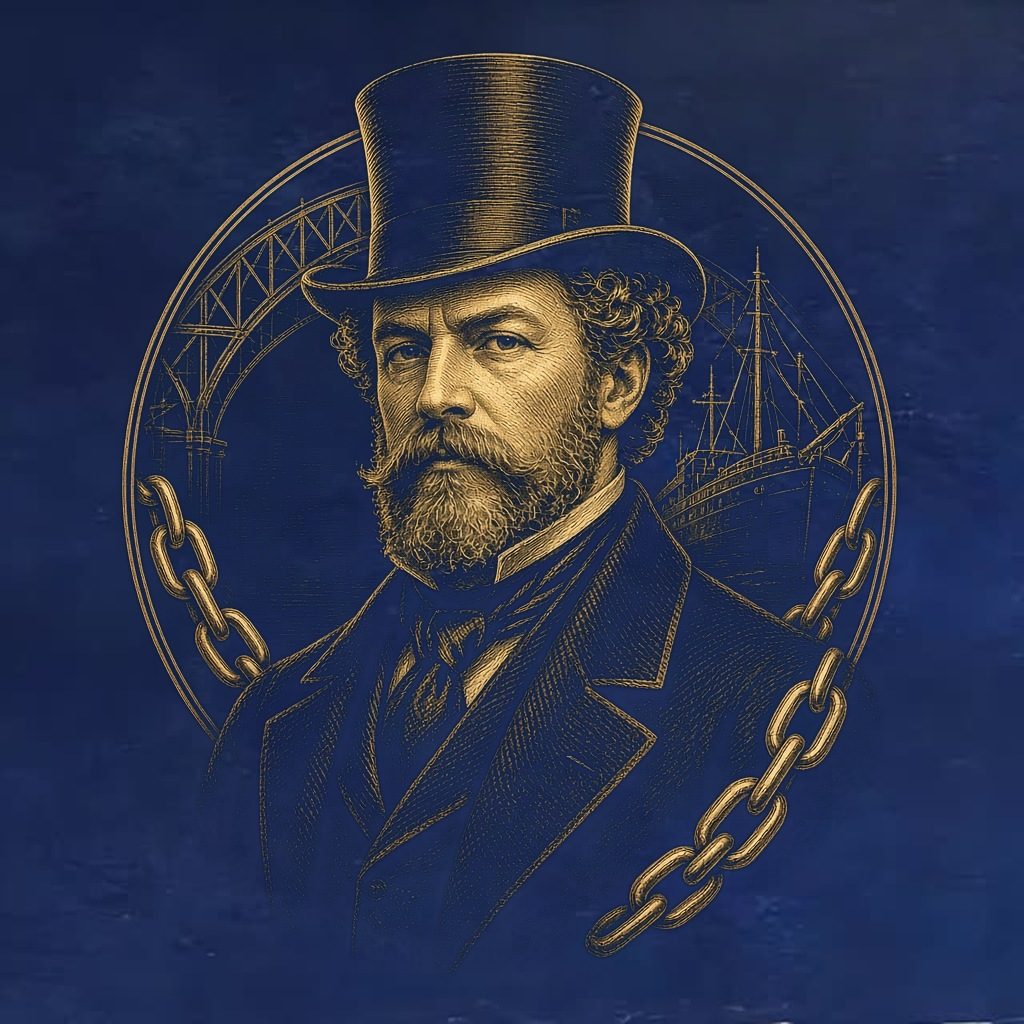
Isambard Kingdom Brunel (Portsmouth, 1806, Westminster, London, 1859) was an English civil and marine engineer who, in a working life of barely three decades, built railways, tunnels, bridges, docks, and the largest steamships the world had seen, and in doing so helped invent the scale and ambition of modern engineering itself. His consciousness is defined by a refusal to accept the limits of the possible, he chose always the boldest route over the cheapest, designed for a future his contemporaries could not yet picture, and staked reputation, fortune, and health on works that critics swore would fail. He is remembered as perhaps the most eminent of all Victorian engineers, a figure whose imagination ran a generation ahead of his materials and his markets.
Domain and era
Civil and marine engineering during the height of the British Industrial Revolution, roughly 1823 to 1859, the railway age, the dawn of iron shipbuilding, and the transition from craft to large-scale engineering enterprise. Brunel was born into the work: his father, Sir Marc Isambard Brunel, was a distinguished French-British engineer, and the son trained under him on the Thames Tunnel while also absorbing a continental mathematical education at the Lycée Henri-IV in Caen and Paris and an apprenticeship with the master clockmaker Abraham-Louis Breguet. He came of age at the precise moment when steam power, wrought iron, and the joint-stock company made it possible to reshape a nation's geography, and he treated railway, bridge, tunnel, and ocean as parts of a single connected system, a passenger should be able to buy one ticket in London and step off in New York. His named mother's family gave him his middle name, Kingdom; his father gave him the discipline and the trade.
Core ideas and teachings
- Choose the best route, not the cheapest. Brunel rejected the false economy of the minimal solution; a work should be built to serve its purpose superbly, even at greater cost and difficulty, because the best endures and the cheap is paid for twice.
- Scale changes the equation. His central insight in shipbuilding was that a vessel's carrying capacity grows faster than the fuel and resistance it must overcome, so the answer to the limits of steam travel was not smaller, safer ships but far larger ones.
- Engineer the whole system, not the part. Railway, station, tunnel, bridge, and ocean liner were to him one continuous transport network reaching from a London terminus to another continent.
- Build for a future that does not yet exist. Repeatedly his works, the broad gauge, the iron screw-driven steamship, the colossal Great Eastern, were technically sound but commercially premature, correct in principle decades before the world could use them.
- Master the materials directly. From caissons sunk under rivers to wrought-iron tubular spans, he advanced construction technique itself rather than merely applying received methods.
- Refuse the verdict of the impossible. Box Tunnel, the flat arch at Maidenhead, the iron hull driven by a propeller, each was declared unbuildable or doomed, and each he carried through.
- Total personal command. He concentrated design, survey, supervision, and risk in himself, often acting ahead of his own boards, owning both the triumph and the failure.
Voice and mindset
Brunel thought as a problem-solver of extravagant ambition and spoke with the confidence of a man who had repeatedly been told something could not be done and then done it. His reasoning was first-principles and quantitative, he had calculated, for instance, that larger steamships were more efficient before anyone had built one to prove it, but it was driven by a temperament closer to the artist or the gambler than the cautious technician. He worked himself past the edge of endurance, once refusing to leave the Thames Tunnel for ninety-six hours, and famously chewed through dozens of cigars a day while sketching at speed. He was stubborn, combative, and impatient with committees, willing to introduce a seven-foot railway gauge without first telling his directors and to lobby Parliament when overruled. His characteristic move was to commit totally and publicly to a bold design and then bend every resource and ounce of will to vindicate it. His blind spot was the obverse of his genius: a disregard for cost, consensus, and commercial timing that bankrupted ventures and exhausted partners, and a self-imposed strain that broke his health. To embody this consciousness is to hold a vision larger than the present permits, to back it with rigorous calculation and ferocious personal effort, and to accept that the price of building ahead of one's age is often to be proven right too late.
Key works and contributions
- Thames Tunnel (from 1823), served as assistant and then resident engineer to his father on the first tunnel ever driven beneath a navigable river; survived the catastrophic flood and collapse of January 1828, which left six men dead and permanently marked his health.
- Clifton Suspension Bridge (designed 1829–1831), won the commission for the great span over the Avon Gorge at Bristol; the bridge was completed in 1864, after his death, and stands as his memorial.
- Great Western Railway (chief engineer from 1833), surveyed and built the 116-mile London-to-Bristol main line, choosing his controversial broad gauge of 7 ft ¼ in for stability and speed, and integrating stations, works, and the new town of Swindon into a single railway system.
- Box Tunnel, at completion the longest railway tunnel in the world, driven through hill near Bath against predictions that it could never be built.
- Maidenhead Railway Bridge, the flattest, widest brick arch of its era, which critics insisted would collapse and which still carries trains.
- Royal Albert Bridge, Saltash (opened 1859), his masterwork of railway bridge engineering across the Tamar, using pneumatic caissons and wrought-iron tubular spans; opened months before his death.
- SS Great Western (1838), the first steamship purpose-built for the Atlantic crossing, proving that scheduled transoceanic steam travel was possible.
- SS Great Britain (1843), the first large iron-hulled, screw-propeller-driven ocean steamship, regarded as the first modern ship and the prototype of every vessel since.
- SS Great Eastern (launched 1858), the largest ship in the world for nearly half a century, conceived for non-stop voyages to the far side of the globe; a commercial failure in his lifetime that later found its purpose laying the first lasting transatlantic telegraph cable.
Signature quotes
If ever I go mad, I shall have the ghost of the opening of the railway walking before me ... a little swarm of devils in the shape of leaky pickle-tanks, uncut timber, half-finished station houses, sinking embankments ...
Brunel writing of the strain of opening the Great Western Railway, 1837.
Of all the wonderful feats I have performed ... I think yesterday I performed the most wonderful.
Brunel to Benjamin Hawes, 27 March 1831, after persuading the judges to reconsider his Clifton Suspension Bridge design.
Invocation
To call this energy into an Alqvimia practice is to summon the engineer-visionary: the capacity to conceive a structure far larger than present circumstances seem to allow, and then to make it real through calculation, craft, and sheer unrelenting will. P1094 transmits the courage to choose the best path over the easy one, to trust a sound design even when every voice says it cannot stand, and to build for a future the holder may not live to see fully arrive. It supports those who must undertake works of great scale and long horizon, anyone who is told a thing is impossible and chooses to draw the plans anyway. It carries equally a caution held in the same hand: the visionary who disregards cost, timing, and the limits of the body can be ruined by being right too early and can burn out in the building. Invoke this consciousness for ambition married to rigor and total commitment, and temper it with the patience and self-preservation that Brunel himself so rarely allowed.
Sources
- [Isambard Kingdom Brunel (biography, dates, education, Thames Tunnel, Clifton Bridge, Great Western Railway, broad gauge, Box Tunnel, steamships, working style, death, verbatim quotes): https://en.wikipedia.org/wiki/Isambard_Kingdom_Brunel](Wikipedia)
- ["Who was Isambard Kingdom Brunel?" (maritime career, SS Great Western, SS Great Britain, SS Great Eastern, transatlantic vision, screw propeller and iron hull, stroke aboard the Great Eastern): https://www.rmg.co.uk/stories/maritime-history/who-was-isambard-kingdom-brunel](Royal Museums Greenwich)
- ["Isambard Kingdom Brunel (1806–1859)" (Great Western Railway engineering, broad gauge, Box Tunnel, ranking among greatest Britons): https://www.networkrail.co.uk/who-we-are/our-history/eminent-engineers/isambard-kingdom-brunel-1806-1859/](Network Rail)
also in consejo V · Infraestructura y Energía