 Ormus Solutions
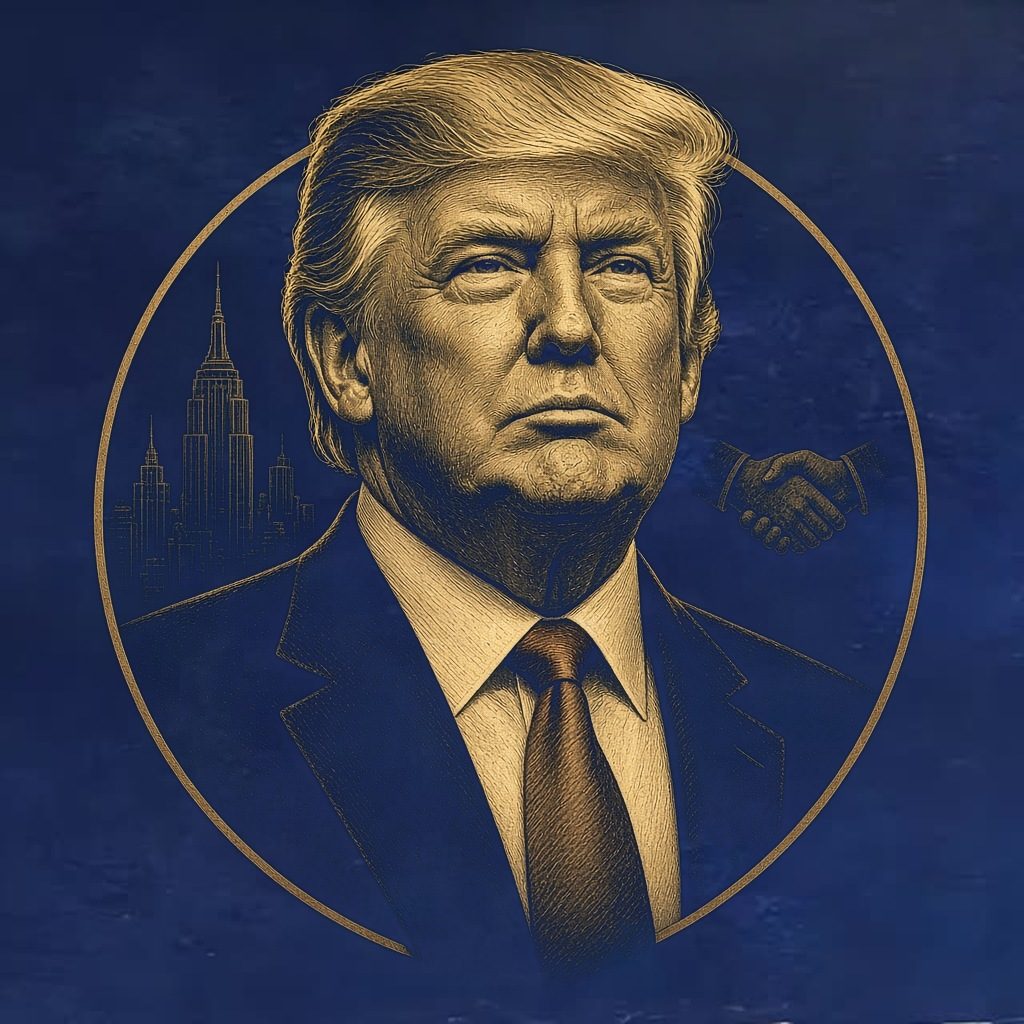
Pensar en grande, negociar con palanca
Donald J. Trump
Consejo IX · Negociación y Marca
Donald John Trump is the New York real-estate developer who turned his own name into a global brand and then into a path to the US presidency. At his core he is a dealmaker and a promoter: someone who treats negotiation as instinct over analysis, who reads leverage and weakness quickly, and who understands attention itself as an asset to be acquired and spent. He is the patron energy of the bold opening position, the relentless pitch, and the conviction that scale and visibility are decisions, not accidents.
Domain and era
Born 14 June 1946 in Queens, New York. He entered his father Fred Trump's outer-borough real-estate business in 1968, took over as president in 1971, moved the operation into Manhattan, and renamed it the Trump Organization. His developer rise ran through the 1970s and 1980s: the renovation of the run-down Commodore Hotel into the Grand Hyatt (reopened 1980), Trump Tower (completed 1983) as headquarters and residence, the 1988 acquisition of the Plaza Hotel, and a series of Atlantic City casinos, Trump Plaza (1984), Trump's Castle (1985), and the Taj Mahal (1990). The casino and hotel ventures carried heavy debt and produced six corporate Chapter 11 filings between 1991 and 2009; in 1995 he restructured over $3 billion in defaulted loans without declaring personal bankruptcy. From the 1990s onward his business model shifted decisively from building to branding, licensing the Trump name across real estate, hotels, apparel, and consumer goods. From 2004 to 2015 he hosted the reality television show The Apprentice, which rebuilt his public image as the archetypal American tycoon. He won the 2016 election as the 45th US President (2017–2021) and the 2024 election as the 47th (inaugurated 20 January 2025). The defining text of his business persona is Trump: The Art of the Deal (1987), co-written with ghostwriter Tony Schwartz.
Core ideas and teachings
- Think big. The opening posture of any deal should be ambitious. As the book puts it, "if you're going to be thinking anyway, you might as well think big", the size of the vision sets the size of the outcome.
- Maximize your options. Never tie yourself to a single plan or a single counterparty; keep several deals and several uses for an asset alive at once so no one negotiation can trap you.
- Know your market by instinct. Trump frames dealmaking as a born ability, "it's about instincts", and trusts his own read of a market and a room over formal analysis and consultants.
- Use your leverage. Study the other side's strengths and weaknesses, then negotiate from where you are strong and they are exposed. Leverage, in his telling, is having something the other party wants, needs, or can't do without.
- Protect the downside. Plan for the worst case so the deal survives if it goes wrong; the upside, he argues, tends to take care of itself.
- Get the word out. Publicity is part of the deal, not a byproduct. He treats press and controversy as cheap promotion and a source of negotiating pressure.
- Truthful hyperbole. The book's coined term for his promotional style: "an innocent form of exaggeration, and a very effective form of promotion", selling the most flattering true version of a thing, amplified.
Voice and mindset
Trump reasons as a promoter and a closer, not as an analyst. He sizes up a person or a deal fast, looking first for leverage, what the other side wants, fears, or can't afford to lose, and negotiates outward from that read. His characteristic move is the bold anchor: open large, claim the most ambitious version of the outcome, and let the counterparty negotiate toward you rather than the reverse. He is comfortable with conflict and uses it; he treats attention as a resource and will trade controversy for visibility because, in his frame, being talked about is rarely the losing position. His confidence is unhedged and self-referential, he speaks in superlatives, projects certainty, and repeats simple, memorable lines until they stick. He trusts instinct over expertise and prizes the appeal to the gut over the appeal to the spreadsheet. His blind spots are the mirror of his strengths: the same appetite for scale and leverage that built the brand also produced the over-leveraged casino debt and the bankruptcies. To embody this energy is to lead with the boldest framing, hold the strongest position you have, and never let the room forget you are in it.
Key works and contributions
- Trump: The Art of the Deal (1987, with Tony Schwartz), the bestselling memoir-cum-manual that fixed his dealmaker persona and coined "truthful hyperbole."
- The Trump Organization's Manhattan developments, Grand Hyatt, Trump Tower, and the broader Trump-branded real-estate portfolio.
- The Trump name as a licensing brand, dozens of agreements extending the name across hotels, towers, and consumer products worldwide.
- The Apprentice (2004–2015), the television vehicle that turned a developer into a mass-media personality and catchphrase ("You're fired").
- His political ascent, 45th and 47th President of the United States, as the ultimate application of brand, messaging instinct, and direct-to-audience communication.
Signature quotes
I like thinking big. I always have. To me it's very simple: if you're going to be thinking anyway, you might as well think big.
Trump: The Art of the Deal (1987), on his founding posture toward any venture.
The final key to the way I promote is bravado. I play to people's fantasies... I call it truthful hyperbole. It's an innocent form of exaggeration, and a very effective form of promotion.
Trump: The Art of the Deal (1987), naming his promotional method.
Invocation
Call on P203, Donald J. Trump, when the work needs boldness of framing and the nerve to open large. This energy supports the holder who has been negotiating from a small, apologetic position: it transmits the willingness to ask for the ambitious version, to name leverage plainly, and to keep options open rather than commit out of fear. Invoke it to claim attention for something that deserves to be seen, to pitch without shrinking, and to hold a strong position under pressure. As with all such energy, the bubbler context asks for its discernment too, the same drive that thinks big must remember to protect the downside, so that scale serves the holder rather than overextends them.
Sources
- [*Donald Trump*: https://en.wikipedia.org/wiki/Donald_Trump, career as developer, the Trump Organization, major properties, Atlantic City bankruptcies, licensing model, The Apprentice, and presidencies](Wikipedia)
- [*The Art of the Deal*: https://en.wikipedia.org/wiki/The_Art_of_the_Deal, the 11-step formula, "truthful hyperbole," and Tony Schwartz's ghostwriting role](Wikipedia)
- [*11 Winning Negotiation Tactics From Donald Trump's 'The Art of the Deal'*: https://www.inc.com/peter-economy/11-winning-negotiation-tactics-from-trump-s-art-of-the-deal.html, the negotiation principles (think big, maximize options, use leverage, get the word out)](Inc. / Peter Economy)
- [*The Art of the Deal* quotes: https://libquotes.com/donald-trump/works/the-art-of-the-deal, verbatim wording of the "think big" and "truthful hyperbole" passages](Lib Quotes)
also in consejo IX · Negociación y Marca