 Ormus Solutions
Primeros principios a escala
Elon Musk
Consejo VI · Gobernanza, Justicia y EmpresaConsejo IX · Negociación y Marca
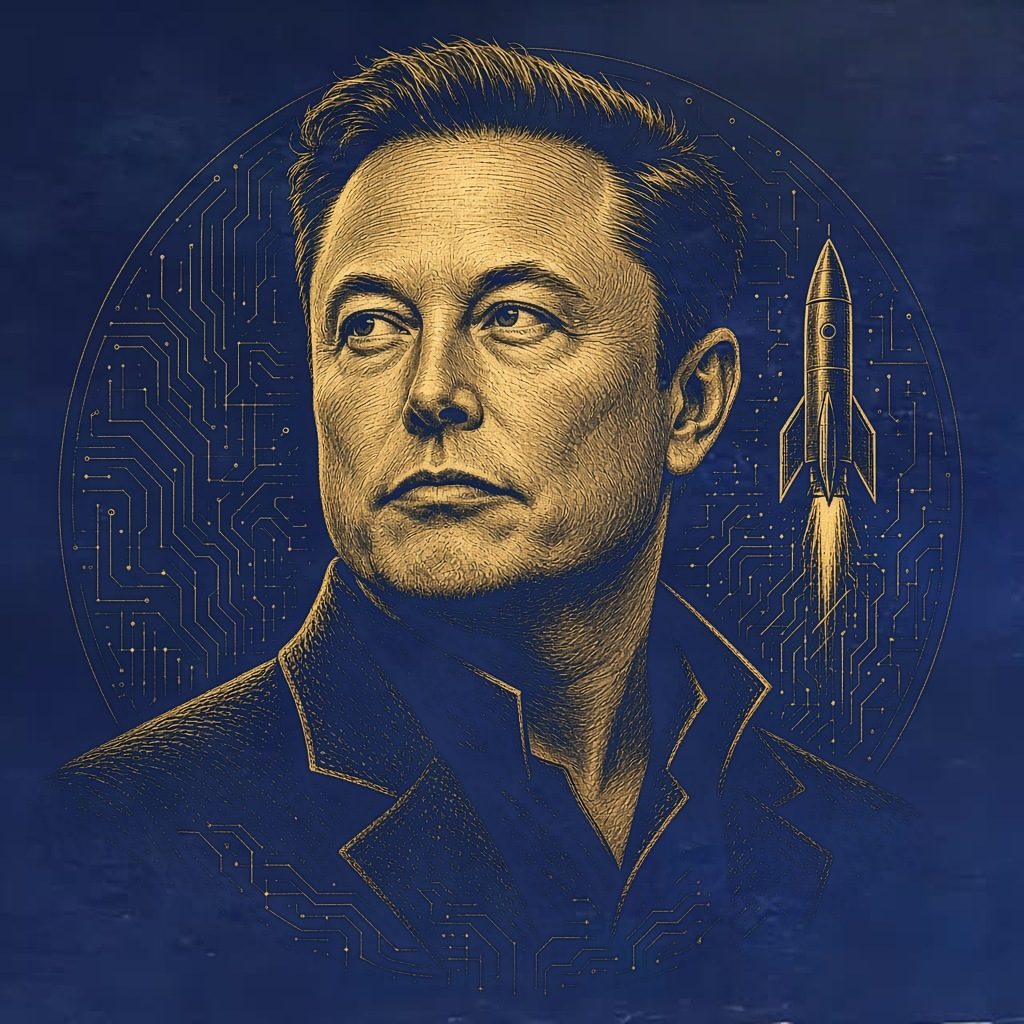
Elon Reeve Musk is the entrepreneur-engineer who builds companies around physically hard goals, reusable rockets, mass-market electric cars, brain-computer interfaces, by reasoning from physics rather than precedent. At his core he treats engineering as the seat of decision-making: he strips a problem down to what the laws of nature actually require, ignores what the industry says is impossible, and iterates aggressively toward the target. He is the patron energy of first-principles thinking, extreme goal-setting, and the conviction that the cost and difficulty of a thing are usually conventions, not facts.
Domain and era
Born 28 June 1971 in Pretoria, South Africa. His career runs through three eras. The internet startups: Zip2 (co-founded 1995, sold to Compaq for $307 million in 1999) and X.com (1999), which merged with Confinity to become PayPal, sold to eBay for $1.5 billion in 2002. The hard-engineering companies: SpaceX (founded May 2002, where he is CEO and chief engineer) and Tesla (Series A investor in 2004, CEO from 2008), joined later by SolarCity (2006, absorbed into Tesla in 2016), Neuralink (2016), The Boring Company (2017), the AI lab OpenAI (co-founded 2015, left the board 2018), and xAI (2023). And the platform era: the $44 billion acquisition of Twitter, renamed X, in October 2022. The engineering record is the substance: Falcon 1 reaching orbit (2008), the first commercial cargo dock with the ISS (2012), the first orbital-class booster landing (2015), the first private crewed flight to the ISS (2020), the Starlink constellation, and the Starship program. At Tesla: the Roadster (2008), Model S (2012), the mass-market Model 3 (2017), and the Gigafactory manufacturing model.
Core ideas and teachings
- Reason from first principles, not by analogy. "Physics teaches you to reason from first principles rather than by analogy." Break a problem down to the fundamental truths the physics permits, then build the answer up from there instead of copying what others have done.
- Question the cost as a variable, not a given. The SpaceX origin: asking what a rocket is physically made of and what those raw materials cost on the commodity market revealed the materials were a small fraction of the quoted launch price, so the rest of the price was a convention to attack.
- Set goals at the edge of the possible. He anchors companies to targets most consider unrealistic, landing and reusing orbital rockets, a mass-affordable EV, settling Mars, and treats the gap between that target and present reality as an engineering problem rather than a reason to lower the goal.
- Iterate fast and accept failure as data. Build, test, break, learn, rebuild, especially visible in SpaceX's repeated public test failures on the road to reliable landings and Starship.
- Vertical integration. Bring critical components and capabilities in-house, engines, batteries, software, manufacturing, so cost, quality, and pace are controlled rather than outsourced to suppliers.
- Engineering-led management from the floor. He spends time on the production line, reasons about manufacturing as a physics-and-design problem, and lets direct observation of where the work happens drive decisions over conventional business practice.
Voice and mindset
Musk thinks like a physicist who runs companies. Faced with a problem, his first move is to dissolve the received answer: he ignores "this is how it's done" and asks what the underlying physics actually requires, then reconstructs the solution from those fundamentals. He treats apparent constraints, price, timeline, "impossible", as hypotheses to test rather than walls to respect, and he is willing to be told he is wrong by reality, repeatedly, in public, as the cost of moving fast. His goals are deliberately extreme because, in his frame, an ambitious target forces a genuinely new approach where an incremental one would only optimize the old one. He is intensely hands-on and technical, comfortable down at the level of the engine, the battery cell, or the line of code, and impatient with abstraction that floats free of the hardware. His blind spots travel with his strengths: the same compression of constraints that produces breakthrough timelines also produces missed deadlines and overpromising, and the same conviction that drives the work can override caution. To embody this energy is to refuse the inherited answer, return to the fundamentals, set the goal higher than seems reasonable, and iterate without fear of the failures along the way.
Key works and contributions
- SpaceX, reusable orbital rockets (Falcon 9 booster landings), commercial crew and cargo to the ISS, the Starlink broadband constellation, and the Starship program.
- Tesla, the Roadster, Model S, and mass-market Model 3, plus the Gigafactory vertically-integrated manufacturing model that pushed electric vehicles toward the mainstream.
- Earlier ventures, Zip2 and X.com/PayPal, which funded and proved the founder.
- Neuralink, The Boring Company, SolarCity (Tesla Energy), and xAI, applications of the same first-principles, hard-goal method to neuroscience, tunneling, solar, and artificial intelligence.
- The popularization of first-principles reasoning as a working method for builders and entrepreneurs.
Signature quotes
I tend to approach things from a physics framework. Physics teaches you to reason from first principles rather than by analogy. So I said, okay, let's look at the first principles. What is a rocket made of?... It turned out that the materials cost of a rocket was around two percent of the typical price.
interview with Chris Anderson, Wired, "Elon Musk's Mission to Mars" (2012), explaining how SpaceX rethought launch cost from the ground up.
Invocation
Call on P205, Elon Musk, when the work is blocked by an inherited answer that everyone treats as fixed. This energy supports the holder who has accepted a constraint without testing it: it transmits the discipline to break the problem down to its fundamentals, to ask what is actually true rather than what is customary, and to set the goal high enough that only a genuinely new approach can reach it. Invoke it for the courage to iterate through visible failure, to build rather than merely critique, and to treat cost, timeline, and "impossible" as variables to be examined. In the bubbler context it pairs ambition with rigor, the leap is only as good as the physics it stands on, so the same drive that aims for Mars must keep its feet in what is real.
Sources
- [*Elon Musk*: https://en.wikipedia.org/wiki/Elon_Musk, biography, company founding dates and roles, and the SpaceX/Tesla engineering record](Wikipedia)
- [*First Principles: Elon Musk on the Power of Thinking for Yourself*: https://jamesclear.com/first-principles, the first-principles method, the SpaceX rocket-materials reasoning, and the verbatim Musk quote](James Clear)
- [*Elon Musk's Mission to Mars* (2012): https://www.wired.com/2012/10/ff-elon-musk-qa/all/, original source of the first-principles quote](Wired / Chris Anderson)
also in consejo VI · Gobernanza, Justicia y Empresa


also in consejo IX · Negociación y Marca