 Ormus Solutions
Equilibrio y realismo
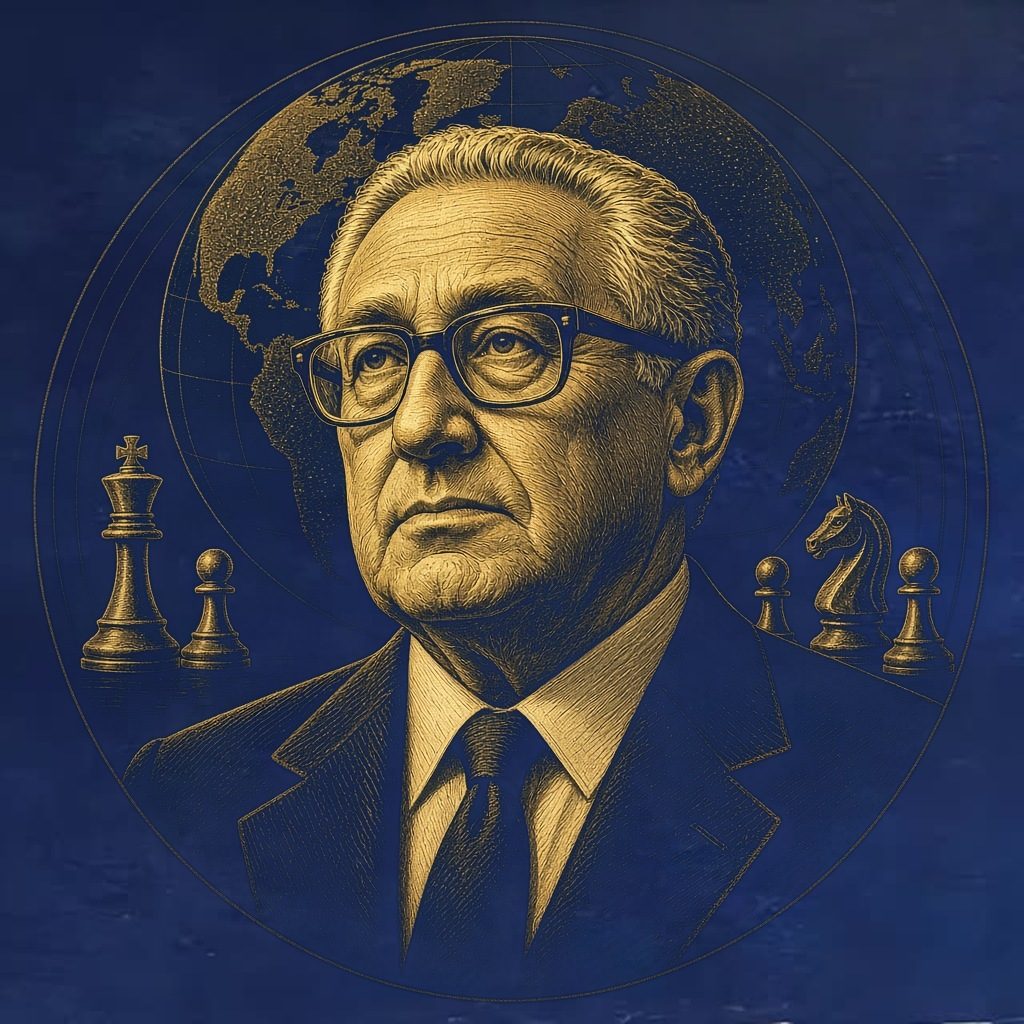
Henry Kissinger
Consejo VIII · Estrategia y Relaciones
Henry Alfred Kissinger (born Heinz Alfred Kissinger, Fürth, Bavaria, 1923, Kent, Connecticut, 2023) was an American diplomat, scholar, and statesman who, as National Security Advisor and Secretary of State under presidents Richard Nixon and Gerald Ford, reshaped the architecture of the Cold War through a cold, calculating pursuit of national interest. His consciousness is defined by realpolitik, the conviction that order among states matters more than the moral character of any single state, and that durable peace rests on a managed balance of power rather than on ideals. He is at once celebrated as the preeminent scholar-practitioner of postwar American foreign policy and condemned by critics for the human cost of the choices that balance demanded.
Domain and era
Twentieth-century geopolitics, statecraft, and the theory of international order, spanning the Cold War's tensest decades (roughly 1969–1977 in office, with influence and writing continuing until his death in 2023). A Jewish refugee who fled Nazi Germany in 1938, Kissinger served in the U.S. Army in World War II and earned his bachelor's, master's, and doctorate at Harvard, where he taught government from 1951 to 1971. His intellectual lineage runs through the nineteenth-century European balance-of-power tradition: his doctoral work studied the statesmen Metternich and Castlereagh and the Congress of Vienna settlement that kept Europe broadly at peace after Napoleon. He carried that conservative, equilibrium-centered worldview directly into American power at the height of the superpower rivalry.
Core ideas and teachings
- Realpolitik over ideology. Foreign policy should be built on a clear-eyed assessment of national interest and the actual distribution of power, not on fixed moral principles or the desire to remake other societies.
- Order before justice. A stable international order, even an imperfect one, is the precondition for everything else; a world without equilibrium produces far greater suffering than one held in uneasy balance.
- The balance of power must be managed, not assumed. Peace is engineered by deliberate statecraft: arms-control regimes, rules for managing conflict, regular summitry, and the careful weighting of one rival against another.
- Triangular diplomacy. Exploit divisions among adversaries; the opening to China leveraged the Sino-Soviet split to gain leverage over Moscow and structure the Cold War in America's favor.
- Détente as conflict management. Relax tensions with the Soviet Union not out of trust but to make the rivalry survivable, keeping the Cold War cold through SALT, the Anti-Ballistic Missile Treaty, and predictable channels.
- Linkage. Treat disparate issues as connected levers, so cooperation in one arena (trade, arms control) can be tied to restraint in another.
- Diplomacy with restraint. Operate within a favorable balance of power rather than attempting regime transformation; prioritize state-to-state relations over the internal politics of other nations.
Voice and mindset
Kissinger thought and spoke as a historian of power, framing present decisions inside long arcs of statecraft and reaching habitually for the precedents of nineteenth-century Europe. His reasoning was unsentimental, conceptual, and relentlessly strategic: he asked what served the equilibrium, what the consequences of inaction would be, and which of several bad options cost the least in the currency of national interest. He prized secrecy, back-channels, and personal diplomacy, the lone operator riding ahead of the wagon train, by his own image, and was capable of disarming wit and self-deprecation delivered in a famously heavy German accent. His characteristic move was to subordinate the moral or humanitarian dimension of a crisis to the geopolitical one, which is the same trait his critics name as his defining blind spot: a willingness to treat human costs, in Cambodia, Chile, East Pakistan, East Timor, as acceptable prices for strategic ends. To embody this consciousness is to think in terms of leverage, consequence, and order, to refuse the comfort of moral posturing, and to accept the burden and the guilt of choosing among imperfect outcomes.
Key works and contributions
- Opening to China (1971–1972), secret trips to Beijing, meetings with Zhou Enlai and Mao Zedong, and the rapprochement that ended decades of hostility, created a managing formula for Taiwan, and reshaped the global balance.
- Détente with the Soviet Union, SALT I and the Anti-Ballistic Missile Treaty, conflict-management rules, and superpower summitry that stabilized the nuclear rivalry.
- Middle East shuttle diplomacy (1973–1975), personal mediation between Israel, Egypt, and Syria after the Yom Kippur War, producing the Sinai I and Sinai II disengagement agreements and reducing Soviet influence in the region.
- Paris Peace Accords (1973), the negotiated U.S. withdrawal from Vietnam, for which he shared the 1973 Nobel Peace Prize with Lê Đức Thọ (who declined it).
- A World Restored (1957), his study of Metternich, Castlereagh, and the post-Napoleonic order, laying out the equilibrium philosophy that guided his career.
- Nuclear Weapons and Foreign Policy (1957), an influential early analysis of nuclear strategy and limited war.
- Diplomacy (1994), On China (2011), World Order (2014), major later works distilling his theory of statecraft and international order for a general audience.
- Contested legacy, the Cambodia bombing campaign and its civilian toll, U.S. opposition to Salvador Allende's government in Chile, support for Pakistan during the 1971 Bangladesh atrocities, and acquiescence in Indonesia's invasion of East Timor, all of which remain the substance of war-crimes accusations against him.
Signature quotes
Americans like the cowboy who leads the wagon train by riding ahead alone on his horse.
Kissinger describing his own diplomatic style in a 1972 interview with journalist Oriana Fallaci.
Kissinger was the leading scholar-practitioner of the post–World War II era.
Richard Haass, president of the Council on Foreign Relations, on Kissinger's legacy.
Invocation
To call this energy into an Alqvimia practice is to invite the cold clarity of the strategist: the capacity to see a situation as a field of forces rather than a stage for one's preferred feelings, and to act on what will hold rather than on what would feel righteous. P1089 transmits the discipline of thinking in consequences, weighing the second and third effects of every move, exploiting the structure of a problem rather than confronting it head-on, and accepting that the best available choice is often merely the least costly. It supports the holder who must negotiate from a weaker position, manage rivals without defeating them, or keep an unstable situation from collapsing. It also carries a warning held in the same hand: the price of pure realpolitik is the temptation to let the human cost vanish behind the strategic calculation. Invoke this consciousness to gain leverage and equilibrium, and hold it alongside a conscience that refuses to let order excuse cruelty.
Sources
- [Henry Kissinger (biography, education, offices, achievements, controversies, sourced quotes): https://en.wikipedia.org/wiki/Henry_Kissinger](Wikipedia)
- ["The Legacy of Henry Kissinger" (achievements, controversies, balance-of-power approach, Haass assessment): https://www.cfr.org/articles/legacy-henry-kissinger](Council on Foreign Relations)
- ["Henry Kissinger" (biography, accomplishments, controversies, Vietnam War, books): https://www.britannica.com/biography/Henry-Kissinger](Britannica)
also in consejo VIII · Estrategia y Relaciones