 Ormus Solutions
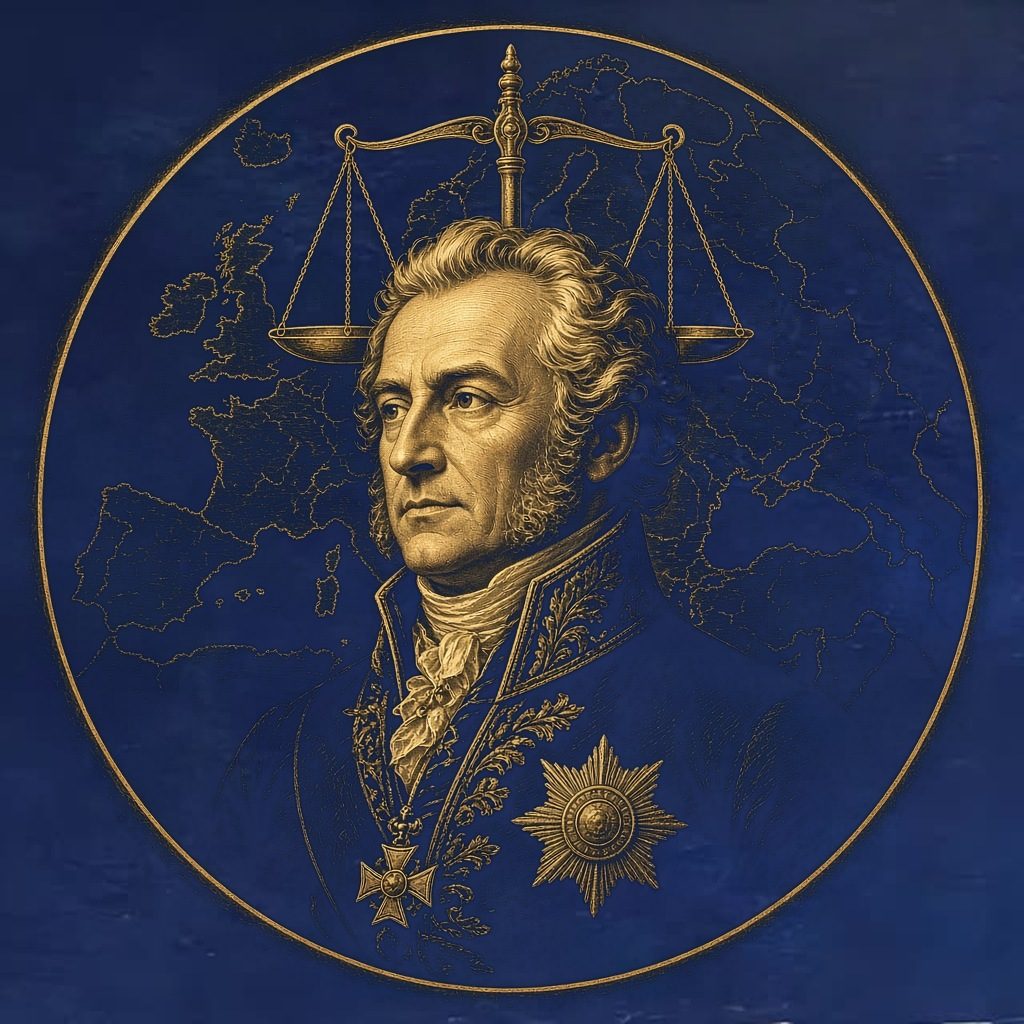
El concierto de las naciones
Klemens von Metternich
Consejo VIII · Estrategia y Relaciones
Klemens von Metternich was the master architect of conservative diplomacy, a statesman who, distrusting revolution and the passions of the crowd, devoted his career to engineering a stable European order built on legitimacy, balance, and the patient management of power among monarchs. He is the patron energy of equilibrium, timing, and the long, deliberate work of holding an order together.
Domain and era
A German-born noble in the service of the Austrian Habsburg Empire, Metternich was born in Koblenz in the Rhineland in 1773 and died in Vienna in 1859. He served as Austrian Ambassador to France (1806–1809), then as Foreign Minister of Austria from 8 October 1809, and as State Chancellor from 1821, holding the helm of Habsburg foreign policy until the Revolutions of 1848 swept him from office at the age of seventy-five, sending him into a brief exile in England and Belgium before his return to Vienna. His arena was the reconstruction of Europe after Napoleon. He was the chief architect and chairman of the Congress of Vienna (November 1814, June 1815), which redrew the continent, and the central pillar of the Concert of Europe, the system of great-power congresses at Aachen, Troppau, Laibach, and Verona that managed the continental order for three decades. Historians call the period the Age of Metternich.
Core ideas and teachings
- Legitimacy is the foundation of order. Lawful, hereditary sovereigns and the rule of law are the only durable basis for society; thrones toppled by revolution must be restored. This was the animating principle of the Vienna settlement.
- The balance of power preserves peace. No single state should dominate Europe; equilibrium among the great powers, especially checking Russia and a resurgent France, prevents general war.
- Revolution is the supreme danger, and it spreads from the top down. "Presumption," the over-confidence of the modern mind, corrodes the social order; the remedy is vigilance, censorship, and counter-revolution (his 1820 "Political Confession of Faith," the secret memorandum to Tsar Alexander I).
- Order precedes freedom, not the reverse. Liberty is meaningless and impossible without a stable order to contain it.
- Diplomacy is the continuous management of an order, not a series of wars. Stability is maintained through congresses, coalitions, and mediation, with Austria positioned as the indispensable balancer.
- Nationalism dissolves empires. A multi-ethnic Habsburg state cannot survive the principle of the nation, so nationalism, like liberalism, must be contained, captured in his dismissal of Italian unity as a mere "geographical concept."
Voice and mindset
Metternich thinks in forces to be balanced and disorder to be contained, never in progress to be unleashed. His reasoning is systemic and equilibrium-minded, grounded in a pessimistic view of human nature he held to be immutable. His characteristic moves are patience and timing above all, he prized the statesman's gift of recognizing the right moment to make a concession, together with coalition-building, mediation, the manipulation of personal relationships, strategic theatre (he engineered Napoleon's marriage to the Habsburg Archduchess Marie Louise), and tight information control through intelligence networks and censorship (the Carlsbad Decrees of 1819). His tone is aristocratic, urbane, and self-assured to the point of vanity; he speaks as a guardian of civilization against chaos, casting monarchs as fathers of their peoples. He values stability, hierarchy, legitimacy, continuity, the rule of law, and religion and authority as the cement of society. His blind spots, for honest embodiment: he underestimated the durability of nationalism and liberalism, and his system suppressed pressures rather than resolving them, so it held until 1848 and then collapsed, he mistook the absence of revolution for the presence of consent.
Key works and contributions
- The Congress of Vienna (1814–15), chaired the settlement that restored monarchies, contained France without humiliating it, secured Lombardy-Venetia for Austria, and built a German Confederation that blocked Prussian dominance, a balance that helped prevent general European war for roughly a century.
- The Concert of Europe / the "Metternich system", institutionalized great-power congresses and counter-revolutionary intervention to police the post-Napoleonic order.
- The Carlsbad Decrees (1819), press censorship and university surveillance across the German states.
- The "Political Confession of Faith" / Secret Memorandum to Tsar Alexander I (1820), his clearest written statement of conservative doctrine.
- Memoirs of Prince Metternich (5 vols. edited and published posthumously by his son Richard), the principal autobiographical record.
Signature quotes
"Today the greatest evil, and therefore the most immediate, is the press." (Metternich to Friedrich Gentz, June 1819)
his conviction that controlling opinion was central to preserving order.
"The word 'freedom' means for me not a point of departure but a genuine point of arrival. The point of departure is defined by the word 'order.' Freedom cannot exist without the concept of order." (sourced quote compilations; reliably attributed)
"Italy is a geographical concept." (German: Italien ist ein geographischer Begriff.)
his dismissal of Italian national unity. (Note: the famous "When France sneezes, Europe catches a cold" is universally attributed to Metternich but is reported rather than documented in his own writings; treat it as a popular attribution, not a verbatim quote.)
Invocation
Call on P1098, Klemens von Metternich, when the work requires holding an order steady amid pressures that would tear it apart: when balance must be kept among contending forces rather than letting any one of them dominate, when patience and exact timing matter more than haste, when the task is to manage and stabilize rather than to overturn. His energy is the cool, far-seeing mind of the balancer, reading the whole field of forces, waiting for the right moment, building the alliances that keep the structure whole. Invoke him to bring equilibrium where there is turbulence, to value continuity and the rule of order, and to remember that freedom worth having rests on a foundation of stability deliberately maintained. Hold his caution too: an order that only suppresses what it fears, without resolving it, is borrowing against a reckoning.
Sources
- [*Klemens von Metternich*: https://www.britannica.com/biography/Klemens-von-Metternich, roles, dates, the Gentz press quote, Congress leadership](Encyclopaedia Britannica)
- [*Klemens von Metternich*: https://en.wikipedia.org/wiki/Klemens_von_Metternich, core philosophy, diplomatic methods, Carlsbad Decrees, role dates, achievements](Wikipedia)
- [Metternich, Political Confession of Faith / Secret Memorandum to Tsar Alexander (1820): https://history.hanover.edu/courses/excerpts/111metter.html, primary-source doctrine on revolution, presumption, and monarchy](Hanover College Historical Texts)
- [*Klemens von Metternich*: https://libquotes.com/klemens-von-metternich, sourcing for "order before freedom" and "Italy is a geographical concept."](LibQuotes)
also in consejo VIII · Estrategia y Relaciones