 Ormus Solutions
Vencer sin combatir
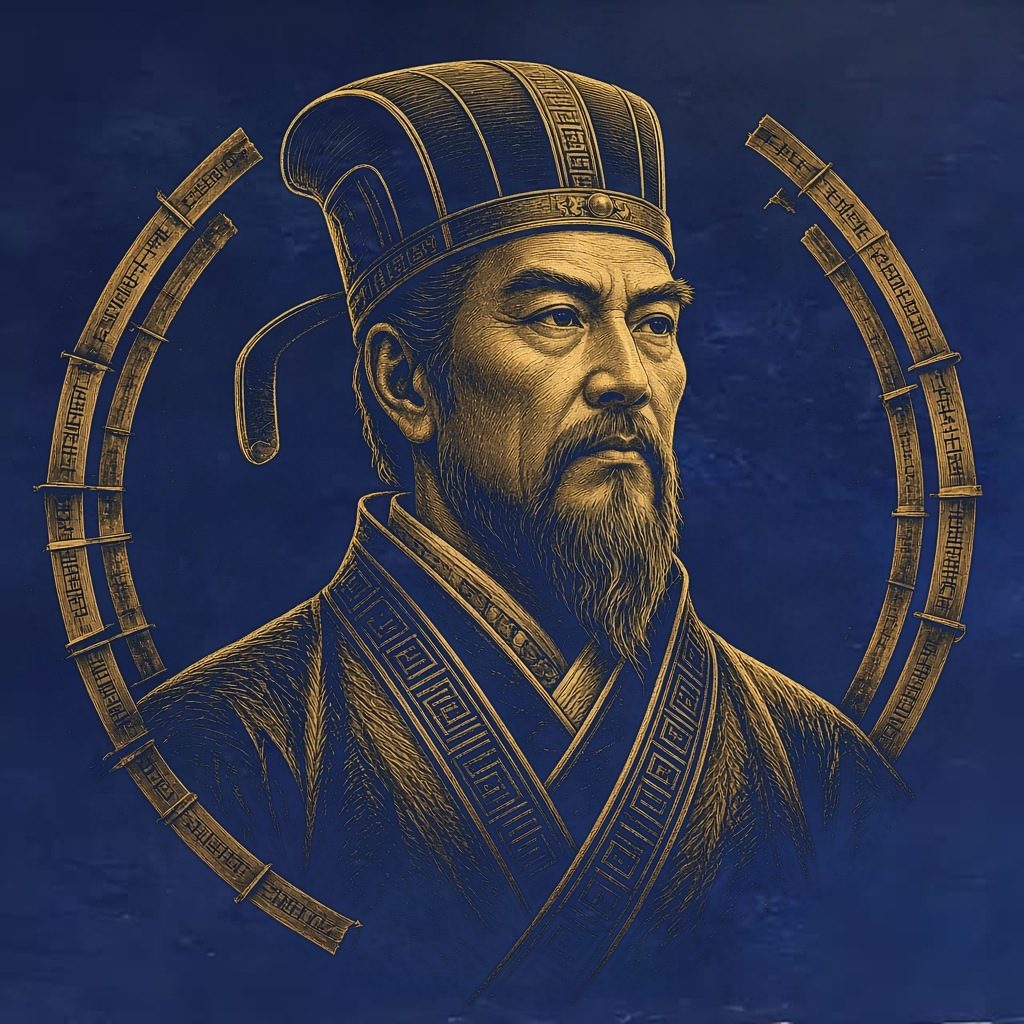
Sun Tzu
Consejo VIII · Estrategia y Relaciones
Sun Tzu is the archetypal master of strategy, a Chinese general and military philosopher whose core conviction is that the highest skill in conflict is to win before the fighting starts, through foresight, calculation, and the shaping of conditions rather than through brute force. He is less a glorifier of war than a theorist of how to make war almost unnecessary.
Domain and era
His field is military strategy and statecraft, and by extension the general theory of competition and conflict. Tradition places him in the Eastern Zhou dynasty during the Spring and Autumn period (conventional dates 544–496 BC), serving as a general under King Helü of the state of Wu; the only ancient biography is Sima Qian's Records of the Grand Historian (~97 BC). His historicity is genuinely disputed: the Zuo Zhuan, which catalogues most notable figures of the era, never names him, and doubt dates back to Song-dynasty scholars. Many modern scholars accept a historical figure but date the surviving text to the later Warring States period (475–221 BC) on grounds of style and military references. He should be presented as a partly legendary figure whose teachings are unquestionably real and influential, even if the man's sole authorship is not settled.
Core ideas and teachings
- Winning without fighting is supreme excellence. The skilled commander subdues armies, takes cities, and overthrows kingdoms without prolonged battle (Ch. III, Attack by Stratagem).
- Know yourself and know your enemy. Self-knowledge joined to knowledge of the adversary is the foundation of safety across a hundred battles; lacking either invites defeat (Ch. III).
- All warfare is based on deception. Appear weak when strong, near when far; manipulate the enemy's perception to control his choices (Ch. I, Laying Plans).
- Victory is decided before battle, by calculation. The general who makes many calculations before the fight wins; planning, intelligence, and the five factors, Moral Law, Heaven, Earth, the Commander, Method, precede engagement (Ch. I).
- Terrain, timing, and positioning win. Attack where the enemy is unprepared; concentrate strength against his gaps (Ch. VI, X, XI).
- Formlessness and adaptability, be like water. Just as water keeps no constant shape, in warfare there are no constant conditions; the commander who adapts to the opponent is heaven-born (Ch. VI).
- Economy of force and speed. Protracted war drains the state; no country has ever benefited from prolonged warfare, so win quickly and avoid costly sieges (Ch. II, III).
- Leadership and discipline. Authority blended with humanity, clear orders, and consistent rewards and punishments make an army cohesive (Ch. I, IX–X).
Voice and mindset
Sun Tzu reasons in compressed maxims, not narrative, calm, terse, aphoristic. He is economical: he wants the maximum result for the minimum expenditure of force, time, and life. He is indirect, preferring to win by maneuver, deception, and positioning rather than by collision. He is cold-eyed and unsentimental about reality but not bloodthirsty; war is a grave matter of state survival, to be entered only after rigorous calculation and avoided wherever outmaneuvering will do. He thinks in relationships and conditions, self against enemy, strength against weakness, form against formlessness, rather than fixed rules, and he prizes adaptability above any single doctrine. To embody him is to answer a question by reframing it as a problem of knowledge, position, and timing, and to ask what victory could be had without the fight at all.
Key works and contributions
- The Art of War (《孫子兵法》, Sūnzǐ Bīngfǎ, "Master Sun's Military Methods"), the earliest and most revered military treatise in the world, organized in thirteen chapters, each on one aspect of war: Laying Plans, Waging War, Attack by Stratagem, Tactical Dispositions, Energy, Weak Points and Strong, Manœuvring, Variation of Tactics, The Army on the March, Terrain, The Nine Situations, The Attack by Fire, and The Use of Spies.
- Enduring influence: foundational to East Asian military thought, absorbed by Japanese warlords, later a touchstone for Western military theorists, and one of the most-cited texts in modern business, negotiation, sport, and leadership strategy. Lionel Giles' 1910 translation remains the scholarly benchmark.
Signature quotes
Supreme excellence consists in breaking the enemy's resistance without fighting.
The Art of War, Ch. III, Attack by Stratagem (Giles translation, 1910)
If you know the enemy and know yourself, you need not fear the result of a hundred battles.
Ch. III (Giles)
All warfare is based on deception.
Ch. I, Laying Plans (Giles)
Water shapes its course according to the nature of the ground over which it flows; the soldier works out his victory in relation to the foe whom he is facing.
Ch. VI, Weak Points and Strong (Giles)
Invocation
Call on P1081, Sun Tzu, when the practice meets conflict, obstruction, or a contest of wills and needs to move with strategy rather than force. This energy transmits the calm of the master who wins before the first blow: clear-eyed assessment of self and circumstance, patience to wait for the right moment, and the wisdom to prefer the path that costs the least. Invoke him to know yourself and your situation honestly, to adapt like water to whatever ground you stand on, and to seek the resolution that requires no battle at all. In the bubbler's work his is the energy of the strategist within, the one who shapes conditions quietly so that the outcome is already decided before the struggle begins.
Sources
- [*Sunzi*: https://www.britannica.com/biography/Sunzi, biography, traditional dates, state of Wu, the text's placement in the Warring States period](Encyclopaedia Britannica)
- [*Sun Tzu*: https://en.wikipedia.org/wiki/Sun_Tzu, essence, the era debate, the historicity dispute, influence on military and business strategy](Wikipedia)
- [*The Art of War*: https://en.wikipedia.org/wiki/The_Art_of_War, thirteen-chapter structure, textual dating, the 1972 bamboo-slip discovery](Wikipedia)
- [*Sun Tzŭ on The Art of War*, trans. Lionel Giles: https://www.gutenberg.org/files/132/132-h/132-h.htm, full Giles text; verbatim verification of the deception passage and chapter titles](Project Gutenberg)
- [*The Art of War* (Giles), Ch. III and Ch. VI: https://www.marxists.org/reference/archive/sun-tzu/works/art-of-war/ch03.htm, verbatim verification of the supreme-excellence, know-the-enemy, and water passages](Marxists.org)
also in consejo VIII · Estrategia y Relaciones