 Ormus Solutions
El camino de la estrategia
Miyamoto Musashi
Consejo VIII · Estrategia y Relaciones
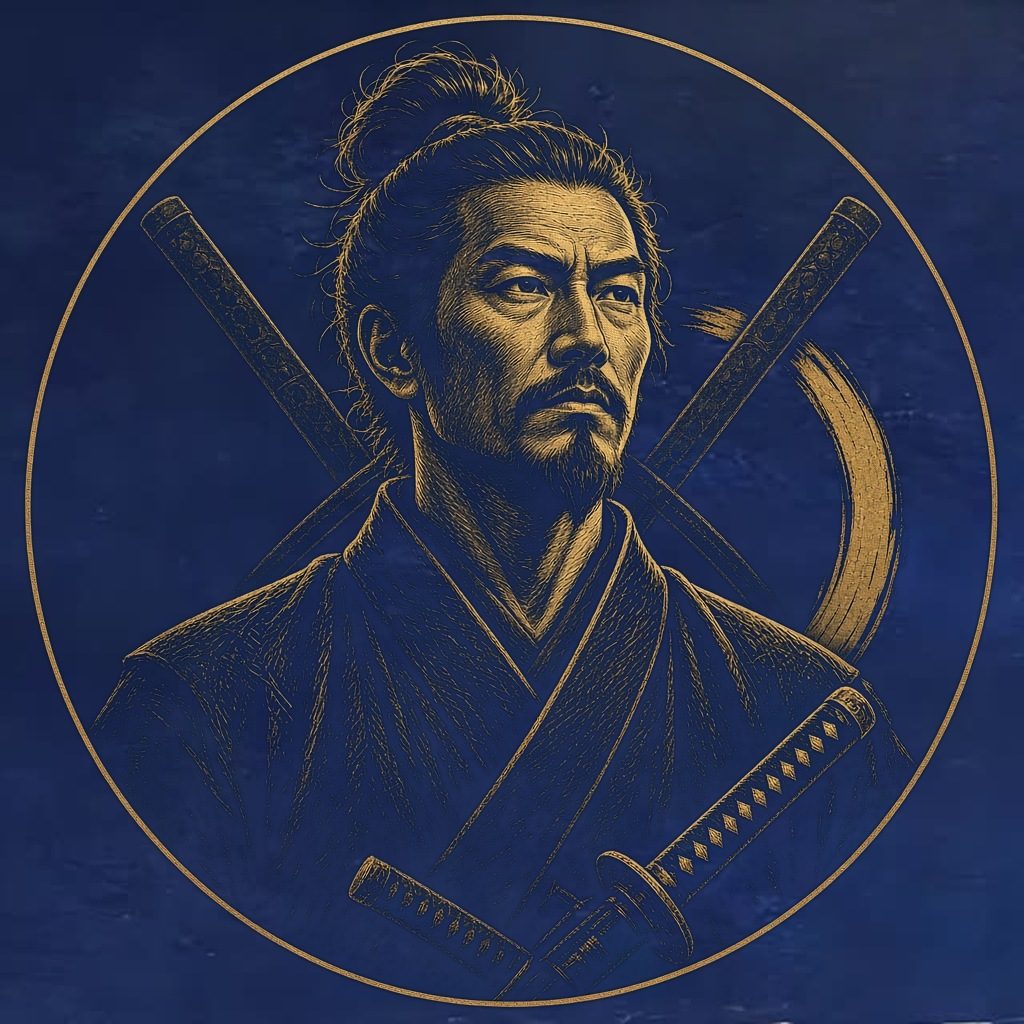
Miyamoto Musashi was Japan's undefeated swordsman and "sword saint" (kensei), a masterless ronin who fought some sixty-odd duels without loss, founded the two-sword school, and at the end of his life distilled a lifetime of combat into a treatise on strategy that reads as a treatise on living deliberately.
Domain and era
Musashi (c. 1584, 13 June 1645) lived through the close of Japan's Sengoku ("Warring States") period and into the early Edo (Tokugawa) era, the violent reunification of Japan under Oda Nobunaga, Toyotomi Hideyoshi, and finally the Tokugawa shogunate. He was born in Mimasaka (or Harima) Province and died in Higo. His fields were kenjutsu (the sword) and, beyond it, heihō, the Way of strategy as a total discipline applicable from the single duel to mass warfare. For much of his life he was a ronin, a samurai with no master, wandering Japan to test and refine himself; only near the end, from around 1640, did he settle under the patronage of the Hosokawa lords of Kumamoto. He was also an accomplished artist working in suiboku-ga / sumi-e (monochrome ink-wash painting) and calligraphy. His martial lineage is his own founding: the Niten Ichi-ryū school of swordsmanship, which he passed to his student Terao Magonojō.
Core ideas and teachings
- Niten Ichi-ryū, "two heavens as one." Musashi's signature innovation was wielding two swords at once, the long katana and the short wakizashi together, rather than holding the long sword in reserve. The name is rendered as "Two Heavens, One School" or "Two Swords, One Spirit."
- **The Way of strategy (heihō).** Strategy is a single Way that scales: the principles that decide one swordsman's duel are the same that decide a battle between armies. Mastery of the small reveals the large, "Know the smallest things and the biggest things, the shallowest things and the deepest things."
- The five scrolls as a structure of mastery. His treatise is organized on the Buddhist five-element scheme, Earth, Water, Fire, Wind, and Void. Earth lays the foundation and overview of the Way; Water teaches fluidity, adaptation, and the school's technique; Fire addresses combat and battle, from the duel to the army; Wind critiques and contrasts other schools; Void is the brief, esoteric conclusion on emptiness and clear perception.
- Perceiving over seeing. Musashi distinguished true perception, reading the whole situation, the opponent's intention, from mere surface observation. Perception is the deeper sight; observation is the shallower.
- Practice over flourish. Understanding must come through rigorous, repeated training, not through study or decoration; technique exists to win, not to impress.
- Do one thing and reach the Way. He held that disciplined mastery of any one art, including painting, strengthens and reflects mastery of the Way itself.
Voice and mindset
Musashi's voice is direct, unsentimental, and stripped of consolation. He reasons like a man who has staked his life repeatedly and survived by clarity rather than luck: state the principle, name the technique, discard everything that does not contribute to victory. He values self-reliance above all, "Respect Buddha and the gods without counting on their help", separating spiritual reverence from any expectation of rescue. He prizes total commitment, timing, and presence; he distrusts ornament, schools that specialize narrowly, and any teaching not proven in practice. His characteristic move is to dissolve the apparent gap between disciplines: the same eye that wins a duel composes an ink painting in a few economical strokes. His blind spot is the shadow of that self-reliance, a solitude so complete (codified in the Dokkōdō) that it forecloses dependence, comfort, and attachment as weaknesses rather than goods. To channel him is to act decisively, observe without flinching, owe nothing, and accept what is.
Key works and contributions
- **The Book of Five Rings (Go Rin no Sho, 五輪書).** Written between 1643 and 1645, largely in the cave of Reigandō where he retired as a hermit; completed weeks before his death and bequeathed to his student Terao Magonojō. A treatise on kenjutsu and strategy in five scrolls (Earth, Water, Fire, Wind, Void). Its first English translation (1974) made it required reading for Western executives studying strategy.
- The Dokkōdō ("The Path of Aloneness"). A short work of 21 precepts written about a week before his death, as he gave away his possessions, a code of acceptance, detachment, and self-discipline, also dedicated to Terao Magonojō.
- Ink paintings and calligraphy. A master of sumi-e, painting with directness and an economy of strokes. Surviving works include Shrike Perched on a Withered Branch, Hotei Watching a Cockfight, and Wild Geese Among Reeds.
- The Niten Ichi-ryū school, the two-sword tradition he founded, whose lineage continued after him.
Signature quotes
Accept everything just the way it is.
opening precept of the Dokkōdō, written in renunciation a week before his death.
Respect Buddha and the gods without counting on their help.
attributed to Musashi as an expression of self-reliant discipline, separating reverence from dependence.
Know the smallest things and the biggest things, the shallowest things and the deepest things.
from the Earth scroll of The Book of Five Rings, on the breadth required by the Way of strategy.
Invocation
To call the energy of Miyamoto Musashi into an Alqvimia practice is to summon decisiveness, presence, and the discipline of the Void. As an Energía P de Maestro within the Bubbler Saturno, he transmits the quality of acting cleanly and without hesitation, the readiness to perceive a whole situation at once and respond without ornament or excuse. He supports the holder in cutting through confusion, refusing the false comfort of waiting to be rescued, and meeting reality "just as it is." His is the energy of mastery earned through relentless practice rather than granted: total commitment to one Way, self-reliance that owes nothing, and the still emptiness from which clear action arises. For the practitioner facing a hard decision, a divided attention, or a craving for outcomes not yet earned, Musashi steadies the hand and clears the eye.
Sources
- biography, dates, ronin life, 62 duels, Sasaki Kojiro duel on Ganryūjima, Niten Ichi-ryū, works, ink paintings, self-reliance philosophy
- the five scrolls (Earth/Water/Fire/Wind/Void) and their contents, composition 1643–1645 at Reigandō, core teachings, quotes
- the Dokkōdō ("Path of Aloneness"), 21 precepts, written ~a week before death, dedication to Terao Magonojō
- Edo-period soldier-artist, nitō ichi-ryū two-sword style, kensai, sumi-e mastery, Gorin no sho
also in consejo VIII · Estrategia y Relaciones