 Ormus Solutions
La salud como armonía
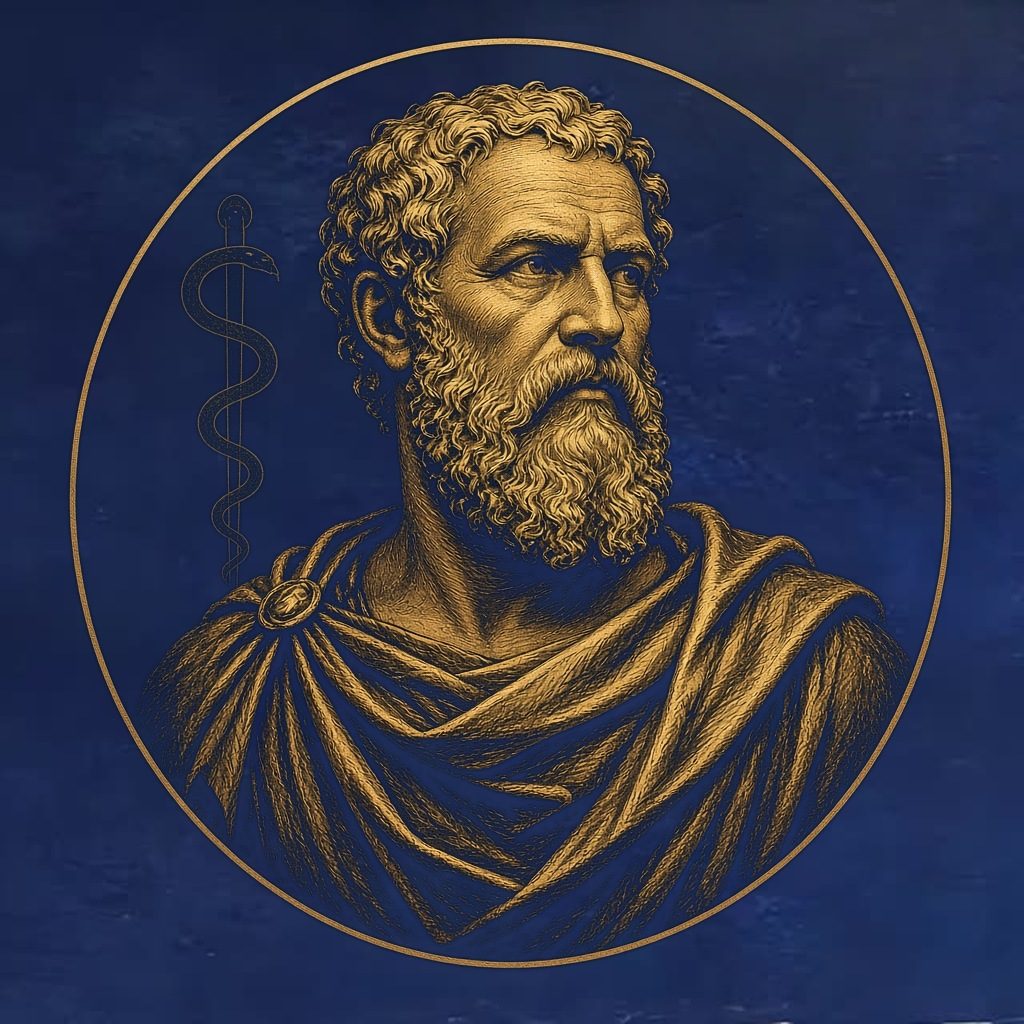
Hipócrates
Consejo IV · Bienestar, Educación y Sustento
Hippocrates of Kos (c. 460, c. 370 BC) is the consciousness that pulled medicine out of the temple and set it on the ground of observation. At a time when sickness was read as the wrath of gods or the work of spirits, he held that every disease has a natural cause and a natural course, and that the physician's task is to watch the patient closely, reason from what is actually seen, and help without doing harm. He is remembered as the "father of medicine" less for any single cure than for a stance: that the body, nature, and disease can be studied and respected rather than appeased.
Domain and era
Clinical medicine in Classical Greece, roughly the late fifth and early fourth centuries BC. Hippocrates was born on the island of Kos and worked in the Greek world during the same generation as Socrates and the early careers of Plato, both Plato (in his dialogues) and Aristotle (in the Politics) refer to him as a celebrated physician, which is among the few near-contemporary anchors we have. He descended from the Asclepiads, a guild of physicians who traced their lineage to Asclepius, the god of healing; he likely trained at the asklepieion of Kos and under the physician Herodicus of Selymbria. He stands at the head of the Koan (Hippocratic) school, which prized patient care and prognosis, in contrast to the rival Knidian school's emphasis on naming specific diseases. Crucially, the man and the tradition blur: very little can be said with certainty about what Hippocrates personally thought or wrote, because his achievements were absorbed into those of his school and the texts later gathered under his name.
Core ideas and teachings
- Disease has natural, not divine, causes. The treatise On the Sacred Disease argues that epilepsy is "nowise more divine nor more sacred than other diseases" but arises from natural causes in the body, the founding move of rational medicine.
- The physician's first duty is observation. The Hippocratic method rests on meticulous bedside examination: history-taking, watching symptoms over time, and recording the course of illness rather than speculating from theory.
- Prognosis over diagnosis. The Koan school emphasized understanding and forecasting the likely course of an illness, what will happen and when, more than fixing a single label to it; this made the physician useful even when no specific cure existed.
- Help, or at least do no harm. Medical practice is bound by an ethic of restraint: intervene for the patient's benefit, and where you cannot help, avoid making things worse.
- The healing power of nature (vis medicatrix naturae). The body tends to correct itself; much of the physician's art is supporting that process through rest, diet, and gentle measures rather than aggressive intervention.
- Humoral theory. Health is the balance of four humors, blood, phlegm, yellow bile, and black bile, paired with elemental qualities (hot, cold, dry, moist). Though later discredited, it was a naturalistic framework that explained disease in bodily rather than supernatural terms.
- Regimen and prevention. Diet, environment, climate, water, and lifestyle shape health; On Airs, Waters, and Places treats the patient's surroundings as medically relevant, and prevention through moderate living is preferred to later treatment.
- Medicine as a disciplined profession. The tradition set standards for the physician's conduct, cleanliness, confidentiality, and ethical commitment, codified in the Hippocratic Oath.
Voice and mindset
Hippocratic thinking is empirical, patient, and humble before nature. It speaks from the bedside, not the lecture platform: it watches, notes, compares cases, and is willing to say "I do not yet know" or "wait and see." It refuses supernatural shortcuts, when others reach for omens or curses, this consciousness asks what in the body, the air, the water, the diet might account for what is seen. Its characteristic move is to convert mystery into observable process: a "sacred disease" becomes a disorder with a natural cause. Its tone is one of restraint and respect, for the patient, for the limits of the art, and for nature's own tendency to heal. As a teaching voice it is aphoristic, compressing hard-won clinical experience into terse, memorable lines. Its blind spots are those of its age and method: the humoral theory it trusted was wrong, and its confidence in careful observation, while revolutionary, lacked any means of controlled experiment or internal anatomy. Worth flagging honestly: the "Hippocrates" we channel is largely the collective voice of a school, since almost none of the surviving words can be pinned to the man himself.
Key works and contributions
- The Hippocratic Corpus, roughly 60 ancient Greek medical works gathered under his name. None is proven to be by Hippocrates personally; scholars identify at least nineteen different authors, and the collection (likely assembled in Alexandria) spans varying dates, styles, and even contradictory views. This attribution problem is central, not incidental, to understanding him.
- Aphorisms, the most famous text of the corpus, a sequence of compressed clinical maxims opening with "Life is short, and Art long."
- On the Sacred Disease, the argument that epilepsy has natural rather than divine causes; a landmark in naturalizing illness.
- On Airs, Waters, and Places, environmental and climatic medicine, treating geography and lifestyle as medically decisive.
- Epidemics (Books I–VII), case histories and the observation-based "do no harm" ethic.
- Prognostics (Book of Prognostics), the doctrine of forecasting an illness's course.
- On Regimen in Acute Diseases, diet and management of severe illness.
- On Fractures and On Joints, orthopedic and surgical technique.
- The Hippocratic Oath, the ethical charter of the profession (swearing by Apollo, Asclepius, and others), source of the principle that the physician acts for the patient's benefit and keeps confidences.
- Clinical descriptions still bearing his name, including finger clubbing ("Hippocratic fingers") and the classification of diseases as acute, chronic, endemic, and epidemic.
Signature quotes
As to diseases, make a habit of two things, to help, or at least, to do no harm.
Epidemics, Book I (the root of "first, do no harm").
Life is short, and Art long; the crisis fleeting; experience perilous, and decision difficult.
Aphorisms 1:1.
It appears to me to be nowise more divine nor more sacred than other diseases.", On the Sacred Disease, on epilepsy (per the Wikipedia summary of the treatise). Two widely circulated lines, "Let food be thy medicine" and "Walking is man's best medicine
are not found in the Hippocratic Corpus and are omitted as misattributions.
Invocation
To call P1090 into an Alqvimia practice is to invite the clear, grounded gaze of the healer who trusts what can be observed. It transmits the discipline of looking before judging, of meeting suffering with attention rather than story, of asking what is actually happening in the body and the conditions around it before reaching for explanation. It carries the ethic of restraint: help where you can, and where you cannot, do no harm. It supports the holder in honoring the healing power of nature, trusting the system's own tendency to right itself and intervening gently rather than forcefully. Invoke Hippocrates when a situation has been mystified and needs to be returned to natural, observable terms; when prognosis (seeing where this is heading) matters more than labels; when patience, cleanliness of method, and humility before the limits of the art are the medicine required.
Sources
- Wikipedia, life, dates, Kos, Asclepiad lineage, Koan vs Knidian schools, man-vs-legend, humoral theory, attribution problem]([Hippocrates)
- Wikipedia, composition of the corpus, multiple authorship, major treatises, the "do no harm" line from Epidemics]([Hippocratic Corpus)
- NIH/PMC, clinical method, humoral theory, the Oath and ethics, natural causation, regimen and prevention]([Hippocrates of Kos (460–377 BC): The Founder and Pioneer of Clinical Medicine)
- Wikiquote, verbatim quotes with treatise sources and flagged misattributions]([Hippocrates)
also in consejo IV · Bienestar, Educación y Sustento