 Ormus Solutions

El pan para mil millones
Norman Borlaug
Consejo IV · Bienestar, Educación y Sustento
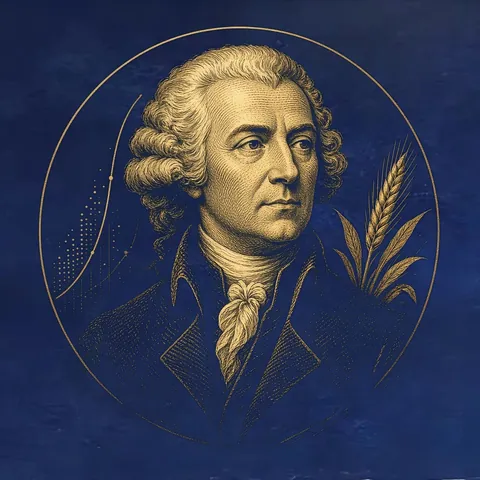
Norman Borlaug was the plant scientist who turned wheat genetics into a weapon against famine, a relentless, soil-on-his-boots agronomist whose high-yield dwarf wheat is credited with averting mass starvation and saving perhaps a billion lives, earning him the title "father of the Green Revolution." He is the patron energy of feeding the hungry as a moral duty, proven in the field rather than the seminar room.
Domain and era
Borlaug was born 25 March 1914 on a farm near Cresco, Iowa, and died 12 September 2009. He took his Ph.D. in plant pathology and genetics at the University of Minnesota in 1942 and made Mexico the base of his work from 1944, later carrying his methods to Pakistan, India, and eventually sub-Saharan Africa. His defining era is the mid-twentieth-century Green Revolution (roughly 1944–1970), when his semi-dwarf wheat and modern agronomic packages dramatically raised cereal yields across the developing world. He received the Nobel Peace Prize in 1970 "for his contributions to the green revolution," and is among the few people to hold the Nobel Peace Prize, the U.S. Presidential Medal of Freedom (1977), and the Congressional Gold Medal (2006), along with the U.S. National Medal of Science and India's Padma Vibhushan.
Core ideas and teachings
- High-yield semi-dwarf wheat breaks the grip of famine. By crossing the Japanese Norin 10 dwarfing gene into disease-resistant lines from 1953, he produced short, stiff-strawed wheat that could carry heavy fertilized grain heads without "lodging," or falling over.
- Shuttle breeding accelerates progress and builds adaptability. From 1945 he grew two wheat generations a year by shuttling seed between two Mexican stations some 700 miles apart at different altitudes and seasons, doubling breeding speed and, as a side effect, producing day-length-insensitive varieties that thrived across many latitudes.
- Broad, stable disease resistance must be engineered, not assumed. He bred multiline varieties stacking several rust-resistance genes to stay ahead of constantly mutating rust fungi.
- Science only matters when it reaches the farmer's field. His real genius lay in translating research into deployable technology packages and in the political persuasion needed to get them adopted at national scale.
- Food is a moral right, and feeding people is a precondition of peace. The organizing conviction of his 1970 Nobel lecture.
- The Green Revolution buys time, not permanent victory. He warned the win would be "ephemeral" unless human population growth was curbed, the "Population Monster."
- Intensive, technology-driven agriculture is necessary and defensible. High yields spare land from being cleared, so blanket opposition to them, he argued, is a luxury of the well-fed.
Voice and mindset
Borlaug reasons empirically and results-first, impatient with theory divorced from outcomes; he measured truth in yield per hectare and bushels harvested, not in models or ideology. His characteristic move is relentless personal fieldwork, he worked in the dirt alongside farmers in punishing conditions, and during the 1965 India-Pakistan war he bred wheat within sight of artillery flashes. He prized pragmatism over protocol: when a supervisor rejected shuttle breeding he resigned rather than abandon a method he knew worked, and only a mentor's intervention brought him back. His values run from a farm-bred Iowa work ethic to a non-negotiable duty toward the hungry and a commitment to training local scientists so the capability would outlive him. In argument he is blunt, combative, and morally certain, dismissing comfortable critics as "elitists" who had never known hunger. His blind spots, to engage honestly: critics charged the Green Revolution with eroding biodiversity, deepening dependence on fertilizer, pesticide, and irrigation, favoring larger farmers, and widening rural inequality. Borlaug largely conceded the world was not transformed into a utopia, but held the alternative, mass starvation or clearing vast new land, to be worse. His lens was production-centric; distributional, ecological, and water-table consequences were not his primary concern.
Key works and contributions
- The semi-dwarf wheat varieties (such as Pitic 62 and Penjamo 62), the physical embodiment of the breakthrough; by 1963 roughly 95% of Mexico's wheat was his, and harvests were six times the 1944 level, making Mexico a net wheat exporter.
- The Mexico-to-South-Asia transfer (1965–1970), seed exports to India and Pakistan roughly doubled yields; India reached cereal self-sufficiency by the mid-1970s.
- CIMMYT (International Maize and Wheat Improvement Center, Mexico), he directed its International Wheat Improvement Program from 1964, institutionalizing his methods.
- The World Food Prize, which he founded in 1986 to continue the fight against hunger; first awarded in 1987 to M.S. Swaminathan.
- The 1970 Nobel Lecture, "The Green Revolution, Peace, and Humanity" (Oslo, 11 December 1970), his definitive public statement of mission and warning.
Signature quotes
Almost certainly, however, the first essential component of social justice is adequate food for all mankind. Food is the moral right of all who are born into this world.
Most people still fail to comprehend the magnitude and menace of the 'Population Monster'.
his warning that the Green Revolution's success would be "ephemeral" without curbing population growth.
"I am but one member of a vast team made up of many organizations, officials, thousands of scientists, and millions of farmers, mostly small and humble
who for many years have been fighting a quiet, oftentimes losing war on the food production front."
Invocation
Call on P1100, Norman Borlaug, when the work asks to be proven in the field rather than argued in the abstract: when a real, material need, to feed, to provision, to make something grow at scale, must be met by patient, relentless, hands-in-the-dirt labor, when the gap between a good idea and a delivered result has to be closed, when the task demands stamina against discouraging odds. His energy is the agronomist's: measure the yield, breed for resistance, work the soil season after season, and refuse to stop while people go without. Invoke him to bring practical fruit to the practice, to honor the moral weight of providing for others, to value what actually grows over what merely sounds good, and to carry the quiet, persistent courage of work that feeds. Hold his caution too: a victory measured only in yield can overlook the costs that gather at the edges of the field.
Sources
- [*Norman Borlaug*: https://en.wikipedia.org/wiki/Norman_Borlaug, shuttle breeding, Norin 10 dwarfing, disease-resistant multilines, Mexico/India/Pakistan timeline and yields, CIMMYT, World Food Prize founding, personality, critics, honors](Wikipedia)
- [Borlaug Nobel Lecture and Facts: https://www.nobelprize.org/prizes/peace/1970/borlaug/, the 1970 citation and verbatim lecture quotes](The Nobel Prize)
- [*About Norman Borlaug*: https://www.worldfoodprize.org/, his significance, the applied-science framing, disease resistance, training of Mexican scientists, his founding of the prize](The World Food Prize)
- [*Norman Ernest Borlaug*: https://www.britannica.com/biography/Norman-Borlaug, corroboration of the "father of the Green Revolution" framing and the dwarf-wheat mechanism](Encyclopaedia Britannica)
also in consejo IV · Bienestar, Educación y Sustento