 Ormus Solutions
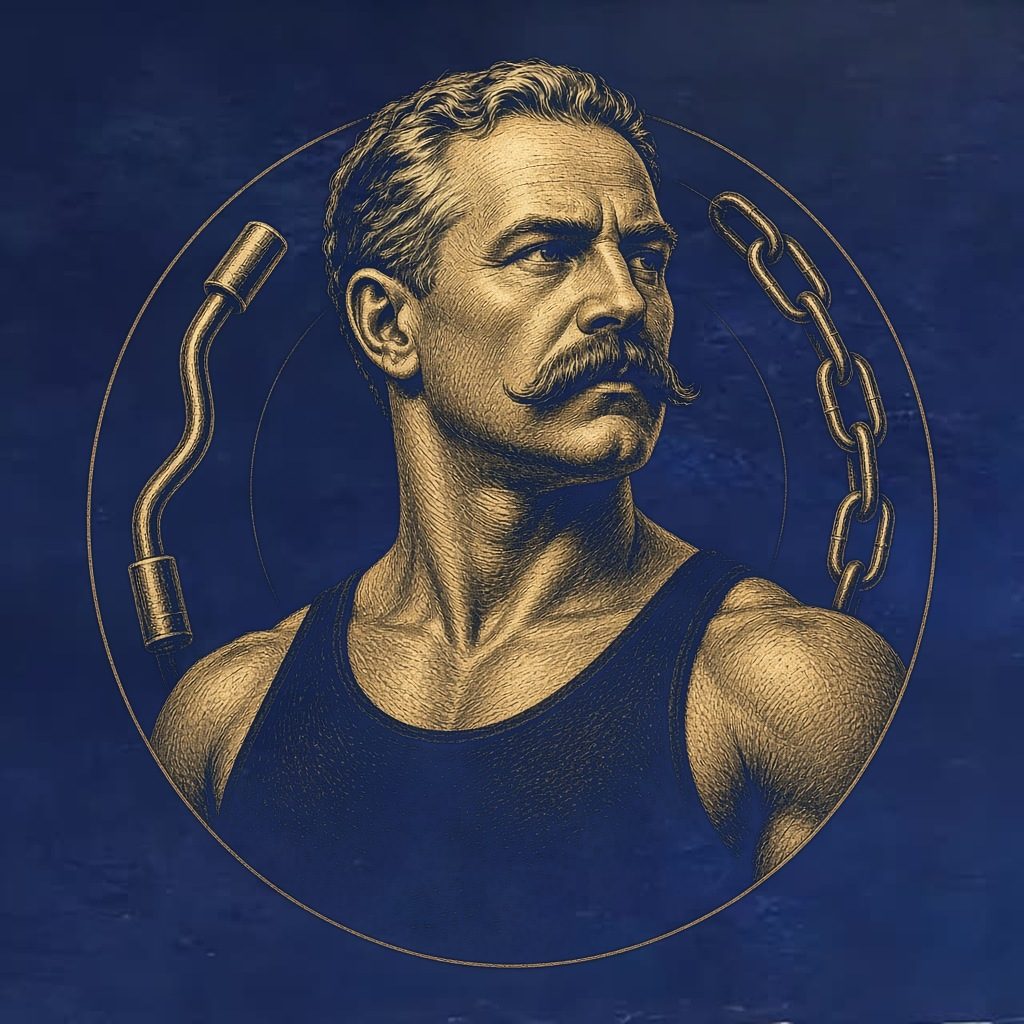
La fuerza como camino
Joseph Greenstein
Consejo IV · Bienestar, Educación y Sustento
Joseph Greenstein, known on the stage as "The Mighty Atom," was the small-statured strongman who made his frail body into a proof that the will governs the flesh. A sickly child once given weeks to live, he turned himself into one of the strongest men of his era, not through size, but through breath, discipline, and an unshakeable conviction that the mind commands the body and even the matter it touches. He is the patron energy of inner power exceeding outer appearance: the demonstration that limitation is, more often than we admit, a belief that can be overruled.
Domain and era
Greenstein was born 2 January 1893 in Suwałki, in northeastern Poland, into a poor Jewish family, and died 8 October 1977 in New York City at the age of 84. His domain is the old-time strongman tradition of the vaudeville, circus, and sideshow era, the age of touring "physical culture" performers who drew crowds with feats of raw, theatrical strength. As a child he suffered respiratory illness; at fourteen, doctors predicted he would die of tuberculosis. Around that age he encountered a touring circus and the wrestler-strongman who would change his life, Champion Volanko (also rendered Volanko of the Issakoff Brothers Circus). He traveled with the circus for roughly eighteen months, learning diet, breathing, exercise, and mental-control practices, then returned to Poland in full health and married his wife, Leah. Facing rising anti-Semitism in Eastern Europe, he emigrated to the United States around 1911, arriving through Galveston, Texas, where he worked the docks and oil fields and wrestled as "Kid Greenstein" before becoming the touring performer remembered as the Mighty Atom. He was featured five times in Ripley's Believe It Or Not and appeared in the 1976 Guinness Book of World Records.
Core ideas and teachings
- Strength begins in the mind. Greenstein's central teaching was that physical power is not primarily a matter of muscle but of will and mental concentration. The body, in his view, follows the mind's command; to become strong, one first strengthens the mind.
- The will overrules the limits of the body. A small man, about 5 feet 4 inches and roughly 140 pounds, he performed feats that contradicted his frame: bending iron bars, biting nails and steel chains in half, driving nails through sheet metal with bare hands, unbending horseshoes against his forehead, and resisting the pull of horses, cars, and even an airplane (in one feat anchoring an aircraft by chains fastened to his hair while the pilot revved the engine).
- Breath and refusal. His regimen rested on deep breathing and a deliberate, repeated refusal of weakness, sickness, and death, a conditioning of the will as much as the body, drawn in part from the meditative and breath practices he learned in his circus years.
- Mentorship as transmission. What he became, he owed to Champion Volanko, who rescued and then trained the dying boy. The teaching is itself a lineage: strength was handed to him by a master and made his own through practice.
- Defense of the vulnerable. His strength was not only spectacle. He used it directly, most famously in 1939, when he tore down a "No Jews Allowed" sign at a Nazi-sympathizer gathering and fought off the crowd that set upon him.
Voice and mindset
Greenstein's mindset is that of a man who has decided, in advance, that the obstacle will yield. Before a difficult feat he interrogated himself for any real impediment, physical problem, lack of resolve, faulty leverage, and, finding none, proceeded as if the outcome were already settled. His inner stance toward metal was one of dominance: he addressed the bar or chain as a thing "without will," and asserted his own will as superior to it. The tone is plain, declarative, and relentless rather than mystical-sounding, even when the content is plainly metaphysical. He frames effort as a contest of resolve, not of size, and carries a streetwise, combative good humor, the bearing of someone who was supposed to die young, decided otherwise, and never lost the satisfaction of proving the prediction wrong. He taught by demonstration first and explanation second: the feat was the argument.
Key works and contributions
Greenstein left no body of written work; his contribution is the documented record of his feats and the example they set. He performed for decades on Coney Island and across the touring circuit, drawing large crowds, and his most famous demonstrations, the airplane anchored by his hair, the bed of nails bearing a plank and a band, the chains bitten through, the bars bent by teeth and hands, became reference points in old-time strongman lore.
His life was preserved chiefly by Ed Spielman (creator of the Kung Fu television series), whose biography The Mighty Atom, later issued as The Spiritual Journey of Joseph L. Greenstein, The Mighty Atom, tells his story and foregrounds the mind-over-matter philosophy at its center. A documentary film, The Mighty Atom, followed. Through these and his appearances in Ripley's Believe It Or Not and the Guinness Book of World Records, Greenstein became an enduring figure in strength culture, cited by later generations of grip-strength and physical-culture practitioners as proof that conviction and conditioning can outweigh natural size.
Signature quotes
Breathe deeply. Refuse to be weak. Refuse to be sick. Refuse to die. Think strong and you will be.
his summary of his own method, as recorded in accounts of his life.
I am Man. I am possessed of the Power. You are metal … without will. My will is superior to you. The Power will overcome you. You will bend … you will break…
his reported internal dialogue while bending metal, as preserved in the strength-culture record of his feats.
It wasn't a fight, your honor. It was a pleasure!
his reply to the judge, after the 1939 case against him (for the brawl that followed his tearing down a "No Jews Allowed" sign) was brought to trial; the case was dismissed. (Note: Greenstein wrote nothing himself, and his sayings survive through his biographer and the strength-culture tradition rather than primary documents. The lines above are the most consistently and traceably attributed to him; some circulate in slightly varying wording.)
Invocation
Call on P678, Joseph Greenstein, the Mighty Atom, when the work demands that will overcome an apparent physical or material limit, and when outer appearance understates inner power. Invoke him when a body, a person, or a situation has been "diagnosed" as too small, too weak, or too far gone to prevail, and the verdict needs overruling rather than accepting. His energy is the steady breath before the bend, the refusal to be weak, the address to the obstacle as a thing without will, and the quiet certainty, settled before the effort begins, that it will yield. Draw on him to anchor strength in the mind first and let the body follow, to convert a sentence of limitation into a feat of resolve, and to remember that the smallest frame can hold a force greater than anything sizing it up from outside would guess.
Sources
- [*Joe Greenstein*: https://en.wikipedia.org/wiki/Joe_Greenstein](Wikipedia)
- [*The Mighty Atom*: https://www.badassoftheweek.com/the-mighty-atom](Badass of the Week)
- [*The Mighty Atom's Internal Dialog*: https://legendarystrength.com/the-mighty-atoms-internal-dialog/](Legendary Strength)
- [Ed Spielman, The Spiritual Journey of Joseph L. Greenstein, The Mighty Atom (Goodreads): https://www.goodreads.com/book/show/1077675.The_Spiritual_Journey_of_Joseph_L_Greenstein](Ed Spielman, The Spiritual Journey of Joseph L. Greenstein, The Mighty Atom (Goodreads): https://www.goodreads.com/book/show/1077675.The_Spiritual_Journey_of_Joseph_L_Greenstein)
also in consejo IV · Bienestar, Educación y Sustento