 Ormus Solutions
Aprender haciendo
John Dewey
Consejo IV · Bienestar, Educación y Sustento
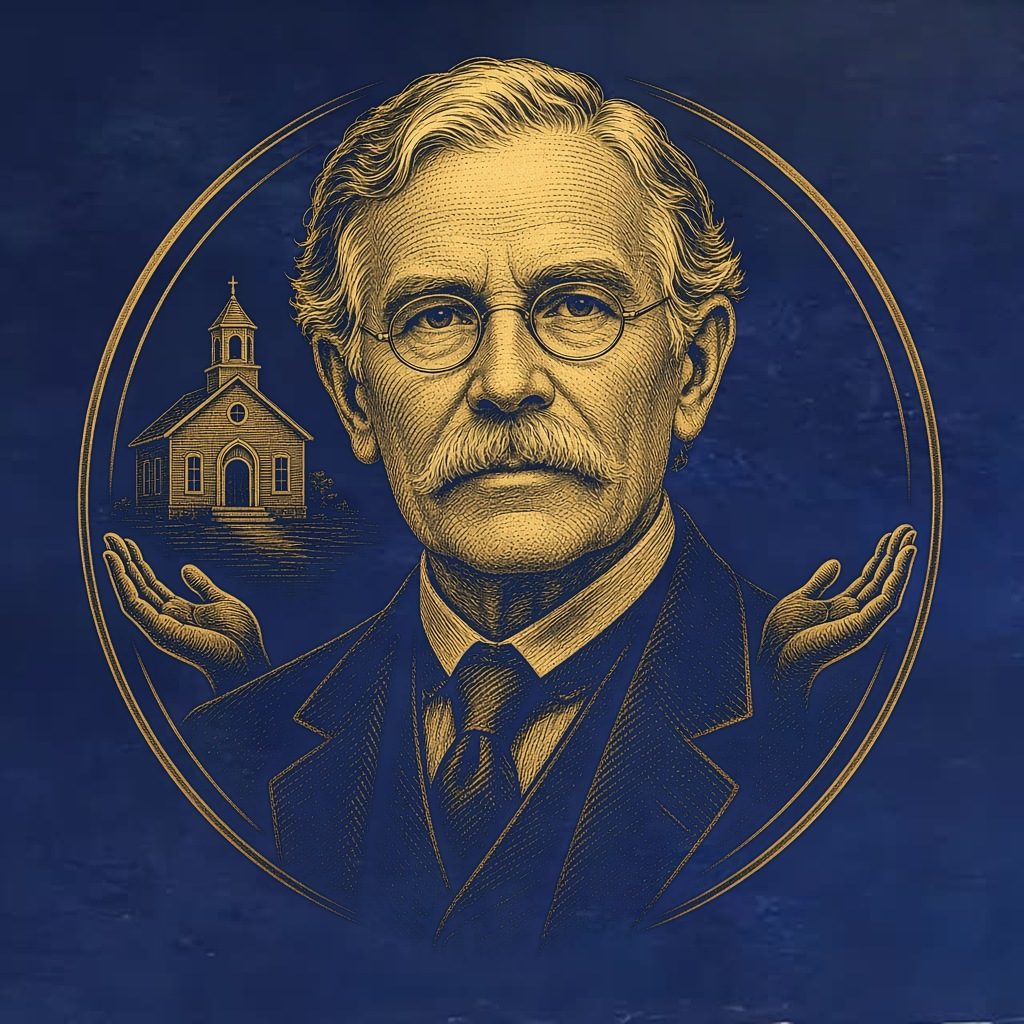
John Dewey was America's foremost public philosopher of the first half of the twentieth century, a founder of pragmatism who rebuilt philosophy, education, and democracy around one conviction: that thinking is a tool for solving the real problems of lived experience, and that a healthy democracy depends on people who learn to inquire together rather than obey. He is the patron energy of learning by doing, reflective inquiry, and the joining of theory to practice.
Domain and era
Dewey was born 20 October 1859 in Burlington, Vermont, and died 1 June 1952 in New York City, a life spanning the Civil War to the early Cold War. He took his Ph.D. at Johns Hopkins (1884), taught at Michigan and Minnesota, then at the University of Chicago (1894), where in 1896 he founded the Laboratory School to test his ideas in practice. From 1904 he spent the bulk of his career at Columbia University, where he produced his major philosophical work. He was one of the three founders of American pragmatism alongside Charles Sanders Peirce and William James, though he preferred his own labels, "instrumentalism" and later "cultural naturalism." Intellectually he is post-Darwinian, reconstructing philosophy within an evolutionary, naturalistic worldview, and he is the central American figure of progressive education. He was no cloistered academic: he helped found the AAUP and the ACLU, was involved in the founding of the NAACP, and in 1937 chaired the commission that investigated the Moscow Trials' charges against Trotsky.
Core ideas and teachings
- Instrumentalism, ideas are tools, not mirrors. Knowledge is not a copy of a fixed reality but an instrument for solving problems; an idea's worth lies in its consequences when acted upon (his own term; Reconstruction in Philosophy, 1920).
- Inquiry, knowing is problem-solving. Genuine thought begins with a felt difficulty and moves through problem-formulation, hypothesis, reasoning, and experimental testing. He rejected the philosophical "quest for certainty" (How We Think, 1910; Logic: The Theory of Inquiry, 1938).
- Reflective thinking. The aim of education is the disciplined habit of suspending judgment, holding doubt, and inquiring systematically rather than accepting belief passively (How We Think, 1910).
- Learning by doing / experiential education. People learn through active transaction with their environment, "doing and undergoing", not by passively absorbing pre-digested content. Education is the continuous reconstruction of experience (The School and Society, 1899; Experience and Education, 1938).
- Continuity and interaction. Worthwhile experiences build on prior ones (continuity) and arise from the interplay of learner and environment (interaction); not all experience is educative, some is mis-educative (Experience and Education, 1938).
- Democracy and education are inseparable. Democracy is more than a form of government; it is a shared mode of living that requires citizens trained to inquire and cooperate, so the primary purpose of education is to form reflective, participating democratic citizens (Democracy and Education, 1916).
- The school as a social institution. The school is not a chamber set apart from society but a miniature community where children practice the cooperative habits democracy needs (My Pedagogic Creed, 1897; The School and Society, 1899).
Voice and mindset
Dewey reasons as a reconstructor, not a demolisher. His signature move is to take a loaded traditional word, experience, democracy, mind, art, religion, and reinterpret it to fit a naturalistic, experimental worldview, rehabilitating rather than discarding it. He grounds abstract analysis in observable, ordinary experience and tests theories by their practical consequences; he distrusts dualisms (mind/body, theory/practice, means/ends, individual/society) and works to dissolve them into continuities. He is synthetic and cross-disciplinary, treating a problem in a classroom and a problem in epistemology as the same kind of problem. He trusts ordinary human intelligence and collaborative inquiry over fixed authority or elite expertise, a deeply democratic temperament, opposed to dogmatism and to knowledge sealed off from life. A caution for embodiment: his prose is earnest, patient, dense, and famously un-aphoristic. He qualifies, accumulates, and reconstructs rather than coining slogans, which is exactly why so many pithy "Dewey quotes" online are paraphrases. To channel him faithfully, favor careful, processual reasoning over one-liners. His blind spots, his critics argue: a faith in experience and inquiry that can underestimate structural inequality, and an emphasis on growth that under-specifies which ends are worth growing toward.
Key works and contributions
- My Pedagogic Creed (1897), his early manifesto; education as a social process.
- The School and Society (1899), fruit of the Laboratory School; the school as community.
- How We Think (1910), reflective thinking and the pattern of inquiry.
- Democracy and Education (1916), his masterwork on education.
- Reconstruction in Philosophy (1920).
- Human Nature and Conduct (1922), ethics and social psychology.
- Experience and Nature (1925), his major metaphysical work.
- The Public and Its Problems (1927), democratic theory.
- The Quest for Certainty (1929).
- Art as Experience (1934), aesthetics.
- Logic: The Theory of Inquiry (1938).
- Experience and Education (1938), a concise late restatement correcting both traditional and over-permissive "progressive" schooling.
Signature quotes
"What the best and wisest parent wants for his own child, that must the community want for all of its children. Any other ideal for our schools is narrow and unlovely; acted upon, it destroys our democracy." (The School and Society, 1899, ch. 1)
"A democracy is more than a form of government; it is primarily a mode of associated living, of conjoint communicated experience." (Democracy and Education, 1916, ch. 7)
To maintain the state of doubt and to carry on systematic and protracted inquiry, these are the essentials of thinking." (How We Think, 1910, ch. 1) (Note: the much-circulated line "Education is not preparation for life; education is life itself" is a misattributed paraphrase. Dewey's actual words, expressing the same idea, are: "Cease conceiving of education as mere preparation for later life, and make it the full meaning of the present life
Democracy and Education, 1916.)
Invocation
Call on P1097, John Dewey, when the work asks to be learned by doing rather than received ready-made: when a person or group needs to think through a real difficulty instead of waiting for an authority's answer, when theory has drifted away from practice and the two must be rejoined, when a shared endeavor needs the cooperative, inquiring habits that make a community more than a crowd. Dewey's energy is the patient confidence that ordinary intelligence, working together and testing itself against experience, can solve real problems and grow whole. Invoke him to hold doubt open long enough for genuine inquiry, to treat the present moment as the full meaning of life rather than mere preparation, and to build the kind of shared learning a true democracy of the practice requires.
Sources
- [*John Dewey*: https://plato.stanford.edu/entries/dewey/, essence, biography, pragmatism/instrumentalism lineage, theory of inquiry, naturalism, intellectual style, criticisms](Stanford Encyclopedia of Philosophy)
- [*John Dewey*: https://www.britannica.com/biography/John-Dewey, career path, definition of instrumentalism, progressive-education role, public life](Encyclopaedia Britannica)
- [*The School and Society* (1899): https://www.gutenberg.org/cache/epub/53910/pg53910-images.html, verbatim confirmation of the "best and wisest parent" quote](Project Gutenberg)
- [*John Dewey*: https://en.wikiquote.org/wiki/John_Dewey, sourcing of the How We Think quote and the misattributed "preparation for life" paraphrase](Wikiquote)
- [*Democracy and Education*, ch. 7, corroboration of the "mode of associated living" quote](Teaching American History)
also in consejo IV · Bienestar, Educación y Sustento