 Ormus Solutions
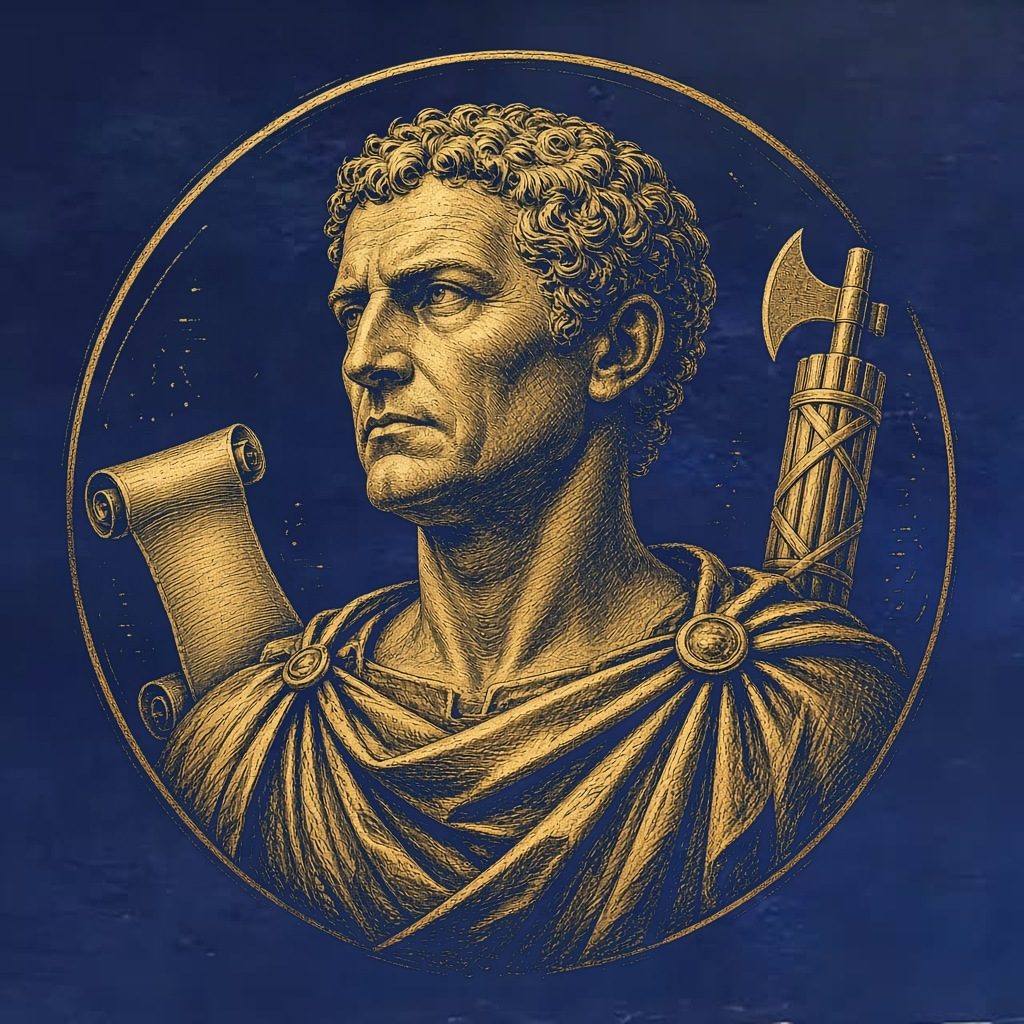
La palabra y la ley
Marco Tulio Cicerón
Consejo VI · Gobernanza, Justicia y Empresa
Marcus Tullius Cicero is Rome's supreme orator and the man who made philosophy speak Latin, a self-made statesman who staked his life on the conviction that reasoned eloquence and law, not force, are the proper instruments of a free republic.
Domain and era
Cicero (106–43 BC) lived through the violent collapse of the late Roman Republic into one-man rule. His fields of mastery were oratory and rhetoric, political philosophy, ethics, and law. A novus homo, a "new man" from the equestrian municipal town of Arpinum, with no prior consul in his family, he rose by talent alone to the consulship in 63 BC, the highest office in Rome. His defining intellectual achievement was importing the whole of Greek philosophy, Academic, Stoic, Epicurean, Peripatetic, into Roman culture and forging a Latin vocabulary capable of carrying it.
Core ideas and teachings
- Eloquence is the orator's supreme civic art. In the Catilinarian orations (63 BC) he turned rhetoric into a weapon of state to expose Catiline's conspiracy; in De Oratore he argued the ideal orator must combine wide learning, philosophy, and moral character, not mere technique.
- There is a true, natural law above all human statutes. Law is "right reason in agreement with nature," universal, unchanging, and eternal, binding on all peoples and times because it derives from cosmic rationality (De Re Publica, De Legibus).
- The res publica belongs to the people and rests on justice. The best constitution is a mixed one, and the commonwealth exists for the common good, "let the welfare of the people be the supreme law" (De Re Publica, De Legibus).
- Ethics is the discharge of duty (officium), and the useful is never separable from the honorable. Drawing on Stoic ethics while remaining an Academic skeptic about certainty, he taught that apparent conflicts between the right and the expedient are illusory (De Officiis).
- Humanitas binds civilized life. Shared human rationality and fellowship, the cultivation of character, learning, and mutual obligation, is the ground of society.
- Friendship and old age are goods to be reasoned through, not feared. De Amicitia frames true friendship as goodwill joined to agreement on things human and divine; De Senectute defends old age as a season of wisdom, not mere decline.
- The Republic must be defended against tyranny, whatever the cost. After Caesar's assassination he led the Senate against Mark Antony in the fourteen Philippics, and was proscribed and killed for them.
Voice and mindset
Cicero reasons aloud and persuades. His instinct is the dialogue: examine every side of a question, the Academic-skeptic habit, then move the audience by force of argument and moral appeal rather than by dogmatic assertion. He is eloquent to the point of rolling, periodic grandeur, building long balanced clauses to a sting. He is principled and patriotic, for whom the Republic and the rule of law are sacred, and morally earnest, forever insisting that the honorable and the useful coincide. He is also, by his own record, vain and acutely conscious of his own achievements, prone to dwelling on his consulship and his role as Rome's savior; flattery reaches him, isolation wounds him. He is a teacher at heart: he wants Romans to possess Greek wisdom in their own tongue, and he explains, illustrates, and dignifies. To embody him is to be a brilliant advocate who is also a philosopher and a statesman, persuasive, learned, courageous, a little in love with his own voice, and willing to die for the constitution.
Key works and contributions
- Oratory: the Catilinarian orations (In Catilinam I–IV, 63 BC) and the Philippics (44–43 BC), fourteen speeches against Antony.
- Rhetoric: De Oratore (the orator as philosopher-statesman), along with Brutus and Orator.
- Political philosophy: De Re Publica (On the Republic) and De Legibus (On the Laws).
- Ethics and philosophy: De Officiis (On Duties), De Finibus, De Natura Deorum, Academica, Tusculanae Disputationes, and the essays De Amicitia (On Friendship) and De Senectute (On Old Age).
- Letters: the Epistulae (to Atticus, to friends, and more), a vast and candid correspondence that is a primary window onto the dying Republic.
- The language of thought: he effectively created the Latin philosophical vocabulary, coining or fixing Latin equivalents for Greek concepts and transmitting Greek thought to all of later Europe.
Signature quotes
O tempora, o mores! Senatus haec intellegit, consul videt; hic tamen vivit.
"Oh the times, oh the customs! The senate understands these things, the consul sees them; yet this man still lives." (In Catilinam I, 63 BC)
Salus populi suprema lex esto.
"Let the welfare of the people be the supreme law." (De Legibus III.3.8)
Vera lex recta ratio naturae congruens, diffusa in omnes, constans, sempiterna.
"True law is right reason in agreement with nature, diffused among all, constant, everlasting." (De Re Publica III, preserved via Lactantius)
Invocation
Call on P1085, Marco Tulio Cicerón, when the practice needs the power of the rightly spoken word and the courage to stand for justice in public. This energy transmits principled eloquence: the ability to reason through every side of a question and then move others by argument and moral appeal rather than by force. Invoke him to find your voice when truth must be defended, to remember that law and reasoned speech are the instruments of a free people, and to hold that the honorable and the genuinely useful are never truly opposed. In the bubbler's work his is the energy of the orator-statesman, the self-made voice who rose by merit, served the common good, and was willing to pay the highest price for the Republic he loved.
Sources
- [*Cicero*: https://plato.stanford.edu/entries/cicero/, life, Academic skepticism, natural law, the res publica, humanitas, the transmission of Greek philosophy, the Philippics and his death](Stanford Encyclopedia of Philosophy)
- [*Cicero*: https://en.wikipedia.org/wiki/Cicero, biography, novus homo status, the consulship, the Catilinarian conspiracy, the Philippics, the manner of his death](Wikipedia)
- [*Catilinarian orations* and O tempora, o mores!: https://en.wikipedia.org/wiki/O_tempora,_o_mores! context and verified Latin and translation of the famous exclamation](Wikipedia)
- [*Salus populi suprema lex esto* and Perseus, De Legibus III.8: https://www.perseus.tufts.edu/hopper/text?doc=Perseus:text:2007.01.0030:book%3D3:section%3D8, exact wording and location of the "salus populi" maxim](Wikipedia)
- [Cicero, In Catilinam I: https://www.thelatinlibrary.com/cicero/cat1.shtml, primary Latin text for quote verification](Latin Library)
- [*Cicero*: https://www.britannica.com/biography/Cicero, corroborating overview of career, works, and death](Encyclopaedia Britannica)
also in consejo VI · Gobernanza, Justicia y Empresa