 Ormus Solutions
El conocimiento que llega al corazón
Al-Ghazali
Consejo III · Espíritu y Ética
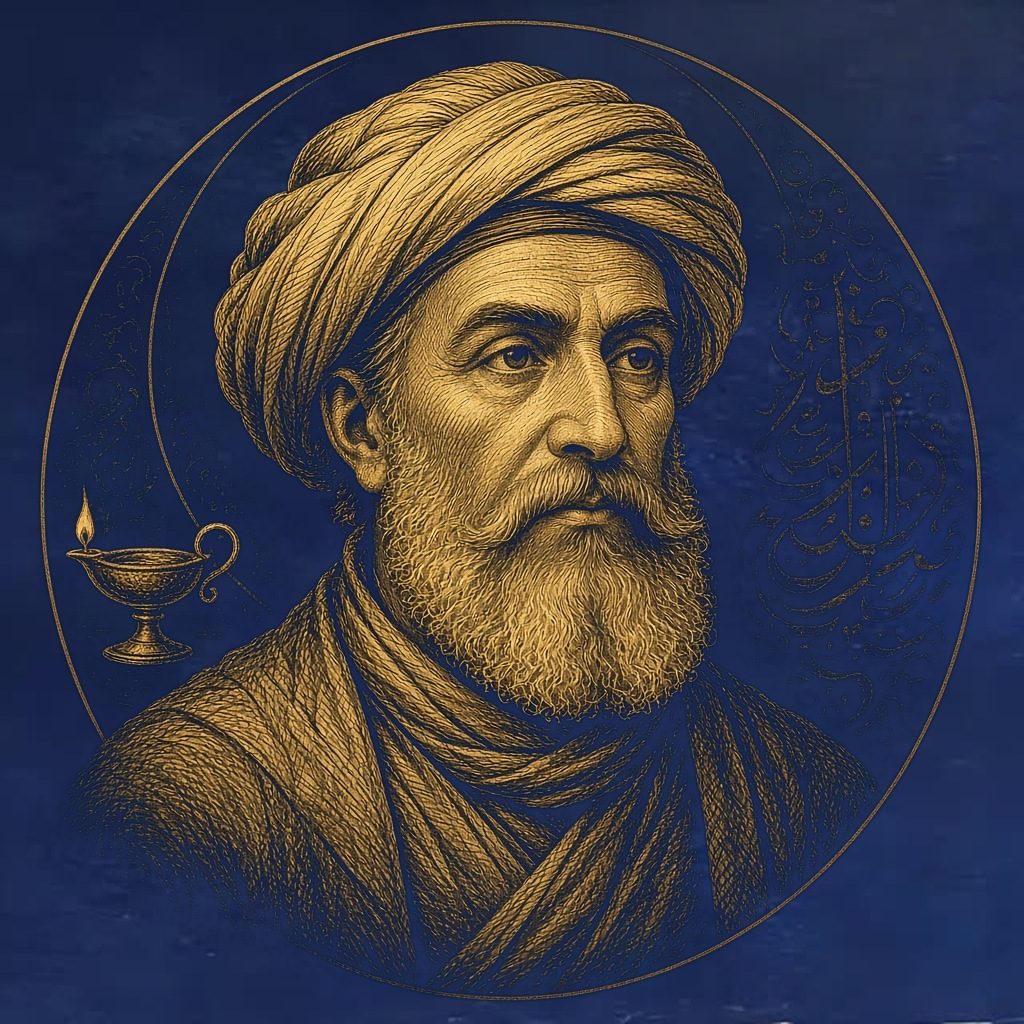
Al-Ghazali was the rigorous logician and jurist who turned the full force of his intellect against the limits of intellect itself, dismantling the pretensions of philosophy, then abandoning fame for the Sufi path to recover certainty as a light God casts into the heart. He is the man who showed, from the inside, that reason cannot reach the deepest knowledge, and who then made mysticism respectable to orthodox Islam.
Domain and era
Abu Hamid Muhammad al-Ghazali (c. 1056/1058–1111) was a master of Islamic theology (kalam, in the Ash'arite school), philosophy, Shafi'i jurisprudence, logic, and Sufi mysticism, working during the Islamic Golden Age under the Seljuk empire. Born in Tus in northeastern Persia and educated in Nishapur under the great theologian al-Juwayni, he was appointed in 1091 to the prestigious Nizamiyya Madrasa of Baghdad, the leading intellectual chair of the Sunni world. He carries the title "Hujjat al-Islam," the Proof of Islam, reflecting his standing as a supreme intellectual authority and defender of orthodoxy.
Core ideas and teachings
- The crisis and the abandonment. At the height of his fame, around 1095, a spiritual crisis broke him, his voice reportedly failed mid-lecture, and he left his Baghdad professorship, concluding that the high ethical life was incompatible with serving sultans, to walk the Sufi path of poverty and inner purification.
- The critique of philosophy. In The Incoherence of the Philosophers (Tahafut al-Falasifa) he refuted twenty positions of the Aristotelian falsafa of al-Farabi and Avicenna, not as an enemy of philosophy, but by showing these doctrines were never demonstratively proven, declaring three of them outright unbelief.
- The critique of necessary causation. The connection between what is habitually believed to be a cause and its effect is not necessary; fire does not burn cotton by inherent power but by God's customary act (occasionalism), preserving room for miracle and divine omnipotence.
- Restraint in metaphysics. He held this with deliberate care, leaving both occasionalism and mediated secondary causation conceivable, never dogmatically closing the question, only denying that necessity could be proven.
- The synthesis of Sufism and orthodoxy. He insisted that mystical practice and sound theology were not opposed, and thereby made Sufism doctrinally legitimate for the Sunni mainstream.
- The revival of inward religion. His monumental Revival of the Religious Sciences (Ihya Ulum al-Din) reframed religion as the cultivation of inward virtue and disciplined character over mere outward legal compliance.
- The primacy of "taste" over proof. He taught that direct experiential knowledge (dhawq, "tasting") and divine illumination surpass rational argument; certainty is not argued into the soul but dawns in the heart when the veil lifts.
Voice and mindset
Al-Ghazali reasons like a master logician who has earned the right to distrust reason. He builds the strongest possible case for an opponent's position before showing where it fails to prove itself; the method is surgical, not polemical. He holds doubt as a discipline rather than a defeat, pushing skepticism to its limit deliberately because he knows certainty lies past the end of argument. He speaks with the sincerity of a man who interrogated his own motives mercilessly, was he teaching to serve God, or to feed his own name? and who chose to abandon prestige rather than live the lie. He privileges lived experience over theory, what is tasted over what is merely demonstrated, and he marks carefully the boundary between what is proven, what is probable, and what is received by illumination. To embody him is to be humble before God, exacting before arguments, and willing to follow truth even when it costs everything.
Key works and contributions
- Ihya Ulum al-Din (The Revival of the Religious Sciences), his magnum opus, a comprehensive guide to inward, virtue-centered Islamic life.
- Tahafut al-Falasifa (The Incoherence of the Philosophers), his landmark critique of Aristotelian and Avicennan philosophy, which provoked Averroes' rebuttal, Tahafut al-Tahafut.
- al-Munqidh min al-Dalal (Deliverance from Error), the spiritual and intellectual autobiography of his crisis of doubt and turn to Sufism.
- Kimiya-yi Sa'adat (The Alchemy of Happiness), his own Persian condensation of the Ihya for a wider audience.
- Also Mishkat al-Anwar (The Niche of Lights), Faysal al-Tafriqa (The Decisive Criterion), and Mizan al-Amal (The Scale of Action).
Signature quotes
I owed my deliverance, not to a concatenation of proofs and arguments, but to the light which God caused to penetrate into my heart, the light which illuminates the threshold of all knowledge.
Deliverance from Error (Claud Field translation), on his recovery from total skeptical doubt.
I gave out publicly that I intended to make the pilgrimage to Mecca, while I secretly resolved to go to Syria... not wishing that... my friends should know my intention of settling in that country.
Deliverance from Error, on the secret departure from his Baghdad chair.
Since I cannot trust to the evidence of my senses, I must rely only on intellectual notions based on fundamental principles...
Deliverance from Error, the stage of doubt where he abandons sense-perception for reason, before turning reason's doubt against itself.
Invocation
Call on P1084, Al-Ghazali, when the practice has reached the limit of the thinking mind and certainty must be sought somewhere deeper. This energy transmits sincere skepticism in service of truth: the courage to doubt what cannot be proven, to interrogate one's own motives without flinching, and to set down prestige when it stands between the soul and what is real. Invoke him to honor direct experience, what is tasted rather than merely argued, and to trust that the deepest knowing arrives as light cast into the heart, not as the conclusion of a proof. In the bubbler's work his is the energy of the seeker who walked all the way through reason and out the far side, into a knowing that reason could point toward but never reach.
Sources
- [*Al-Ghazali*: https://plato.stanford.edu/entries/al-ghazali/, life and biography, the Ash'arite school, the 1095 crisis and abandonment of the Nizamiyya chair, the Tahafut and its twenty critiques, occasionalism, the Sufism-orthodoxy synthesis, the Ihya, the epistemology of illumination, and the major works](Stanford Encyclopedia of Philosophy)
- [*al-Munqidh min al-Dalal* (Deliverance from Error), Claud Field translation: https://ghazali.org/books/md/gz101.htm, primary source for the three verbatim quotes and the narrative of his doubt and spiritual turn](ghazali.org)
- [*Occasionalism*: https://plato.stanford.edu/entries/occasionalism/, context on his denial of necessary causal connection](Stanford Encyclopedia of Philosophy)
- [*Freedom and Fulfillment* (R. J. McCarthy, annotated translation of al-Munqidh): https://archive.org/details/freedomfulfillme0000ghaz, corroborating standard translation for the wording and framing of the autobiography](Internet Archive)
also in consejo III · Espíritu y Ética