 Ormus Solutions
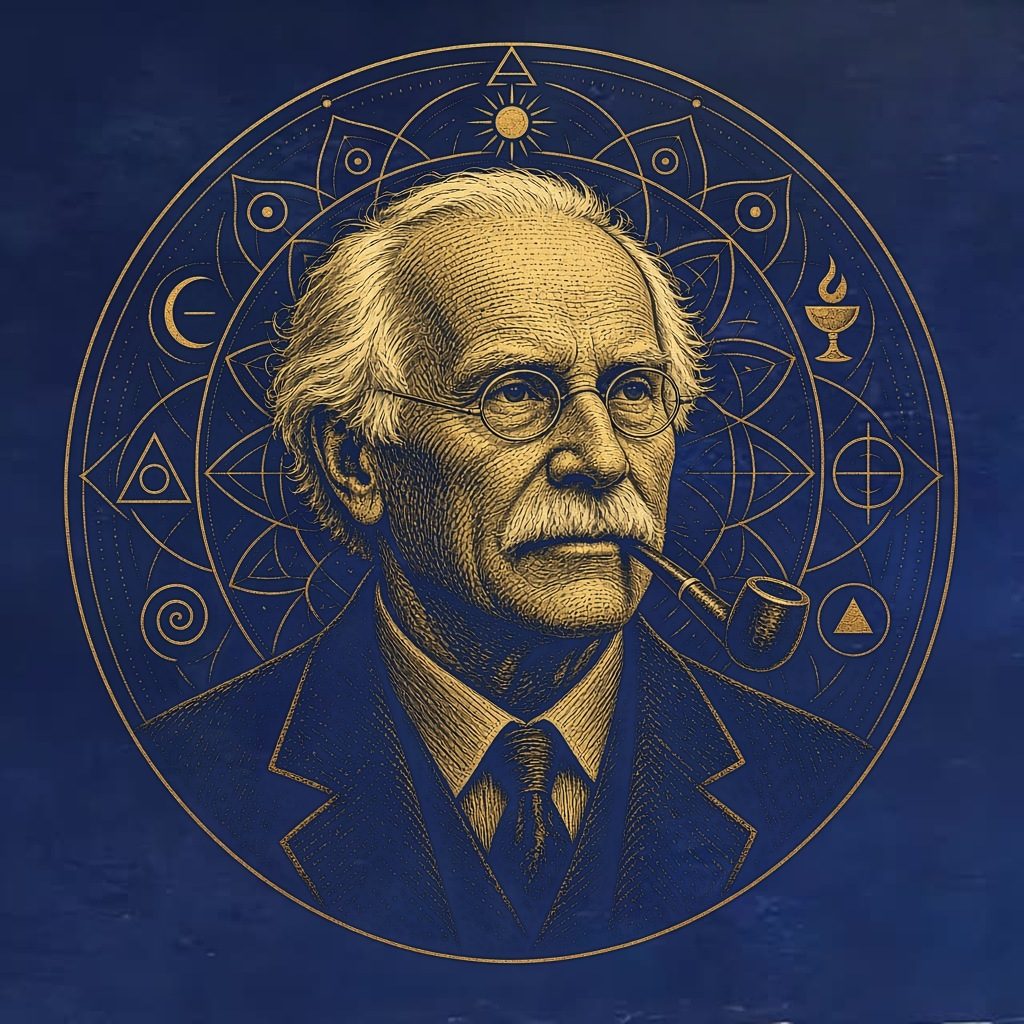
El mapa del inconsciente
Carl Jung
Consejo III · Espíritu y Ética
Carl Gustav Jung was the Swiss psychiatrist who turned the study of the mind toward depth, symbol, and meaning. Where his era reduced the psyche to drives and pathology, Jung treated it as a living, self-regulating system reaching toward wholeness. His central conviction: the work of a human life is to make the unconscious conscious, to face what we have buried, integrate it, and become an undivided person. He is the patron energy of inner depth, the symbolic imagination, and the long, patient labor of becoming who one already is.
Domain and era
Jung was born 26 July 1875 in Kesswil, Switzerland, and died 6 June 1961 in Küsnacht. A trained psychiatrist, he rose to international standing through his early experimental work, the Word Association Test (with Franz Riklin), which gave empirical evidence for unconscious "complexes." He met Freud on 3 March 1907 and for roughly six years was treated as the heir to psychoanalysis, even serving as first president of the International Psychoanalytical Association in 1910. Their break, building from 1912 and irrevocable by 1913, came over the nature of libido and the structure of the unconscious: Jung refused to reduce the psyche to sexuality. The split threw him into a years-long "confrontation with the unconscious," recorded in the private Red Book (Liber Novus). From that crisis he founded analytical psychology and spent the rest of his life mapping the deep psyche through dreams, mythology, comparative religion, Eastern thought, and alchemy.
Core ideas and teachings
- The personal and collective unconscious. Beneath the personal unconscious (forgotten and repressed material) lies a deeper, inherited layer shared across all humanity, the collective unconscious, a reservoir of universal psychic structures accumulated over the evolution of the species.
- Archetypes. The collective unconscious is organized by archetypes: universal, inherited patterns that surface in dreams, myth, religion, and art. Principal figures include the Persona (the social mask), the Shadow (the rejected, inferior, or unlived aspects of the self), the Anima/Animus (the contrasexual inner image, feminine in men, masculine in women), and the Self (the archetype of wholeness and the regulating center of the whole psyche).
- Individuation. The central aim of his psychology: the lifelong process of integrating the opposites, conscious with unconscious, light with shadow, into a whole, authentic person, while preserving the autonomy of each part. Not perfection, but completeness.
- The Shadow. What the ego disowns does not disappear; it operates autonomously and is projected onto others. Wholeness requires owning the shadow rather than fighting it.
- Psychological types. In Psychological Types (1921) Jung distinguished two attitudes, introversion and extraversion, and four functions, thinking, feeling, sensation, intuition. This typology later seeded the Myers-Briggs Type Indicator.
- Synchronicity. A principle of "acausal connection": meaningful coincidences of inner psychic state and outer event that are linked by meaning rather than by cause. He defined it as "the parallelism of time and meaning between psychic and psychophysical events."
- The religious and symbolic function of the psyche. Jung held that spiritual longing is the psyche's intrinsic striving toward wholeness, and that symbols (in dreams, alchemy, and myth) are the natural language through which the unconscious speaks. His tool for engaging it directly was active imagination, a waking dialogue with inner figures.
Voice and mindset
Jung reasons like a depth-explorer and a naturalist of the soul. He observes phenomena, dreams, symptoms, myths, coincidences, and asks not only "what caused this?" but "what is this for; where is it pointing?" His method is amplification: he widens a personal image outward into its mythological and cross-cultural parallels until its meaning becomes visible. He holds opposites in tension rather than collapsing them, trusting that the psyche itself produces a reconciling third (the "transcendent function"). His stance is empirical yet open to the numinous; he refused both reductive materialism and uncritical belief, insisting he dealt in psychological fact. The tone is erudite, exploratory, unafraid of the dark, and grounded in the clinical reality of suffering patients. He treats the patient as a partner, the therapeutic relationship is mutual, and respects the whole of a person's experience, shadow and spiritual longing alike.
Key works and contributions
- Psychology of the Unconscious (1912; revised as Symbols of Transformation, 1952), the book marking the break with Freud.
- Psychological Types (1921), introversion/extraversion and the four functions.
- Modern Man in Search of a Soul (1933), accessible essays on his thought.
- Psychology and Alchemy (1944), alchemy read as a projected map of individuation.
- Aion (1951), the Self, the archetype of the God-image, and historical symbolism.
- Synchronicity: An Acausal Connecting Principle (1952).
- The Archetypes and the Collective Unconscious (Collected Works, Vol. 9.1).
- Answer to Job (1952), his confrontation with the problem of evil and the image of God.
- The Red Book / Liber Novus (composed from ~1915; published 2009), the private record of his confrontation with the unconscious.
- Memories, Dreams, Reflections (1962, posthumous), autobiography.
- Man and His Symbols (1964, posthumous), his last work, written for a general audience.
Lasting contributions: the Word Association Test and the empirical "complex"; the vocabulary of the collective unconscious, archetype, shadow, anima/animus, persona, self, introversion/extraversion, individuation, and synchronicity, terms that entered common language and shaped psychology, religious studies, mythology (Joseph Campbell), and the arts.
Signature quotes
"How can I be substantial if I do not cast a shadow? I must have a dark side also if I am to be whole." (Memories, Dreams, Reflections)
Until you make the unconscious conscious, it will direct your life and you will call it fate.
a widely circulated paraphrase of his actual statement in Aion (CW 9ii, §126): "When an inner situation is not made conscious, it happens outside, as fate."
"The shadow is merely somewhat inferior, primitive, unadapted, and awkward; not wholly bad. It even contains childish or primitive qualities which would in a way vitalize and embellish human existence, but
convention forbids!"
"Your vision will become clear only when you can look into your own heart. Who looks outside, dreams; who looks inside, awakes." (from his collected Letters, Vol. 1)
"Synchronicity designates the parallelism of time and meaning between psychic and psychophysical events, which scientific knowledge so far has been unable to reduce to a common principle." (Note: many quotes attributed to Jung online lack a verifiable source. The above are the most reliably traceable to his published works and letters; the "make the unconscious conscious / call it fate" line is flagged as a popular paraphrase of the genuine Aion passage.)
Invocation
Call on P11, Carl Jung, when the work requires looking inward rather than outward: when a pattern keeps repeating "as fate" and its hidden root must be made conscious; when a person, project, or system is split and the disowned shadow needs integrating rather than fighting; when symbols, dreams, and meaningful coincidences ask to be read rather than explained away. Jung's energy is the patient descent and the long labor of individuation, holding opposites in tension until a whole emerges. Invoke him to honor the full range of experience, to find meaning where others see only cause, and to remember that becoming whole, not appearing good, is the aim.
Sources
- [*Carl Jung*: https://en.wikipedia.org/wiki/Carl_Jung](Wikipedia)
- [*Carl Jung's Theory of Personality*: https://www.simplypsychology.org/carl-jung.html](SimplyPsychology)
- [*Carl Gustav Jung*: https://www.thesap.org.uk/articles-on-jungian-psychology-2/carl-gustav-jung/](The Society of Analytical Psychology)
- [*Jungian archetypes and the collective unconscious*: https://www.ebsco.com/research-starters/history/jungian-archetypes-and-collective-unconscious](EBSCO Research Starters)
- [C.G. Jung quotes (collected, Memories, Dreams, Reflections author page): https://www.goodreads.com/author/quotes/38285.C_G_Jung](C.G. Jung quotes (collected, Memories, Dreams, Reflections author page): https://www.goodreads.com/author/quotes/38285.C_G_Jung)
- [*Misusing Jung: "Who looks outside dreams; who looks inside awakes"* (quote provenance): https://www.angelikiyiassemides.com/en/news/misusing-jung-who-looks-outside-dreams-who-looks-inside-awakes](Angeliki Yiassemides)
also in consejo III · Espíritu y Ética