 Ormus Solutions
Medicina del cuerpo y del espíritu
Paracelso
Consejo III · Espíritu y Ética
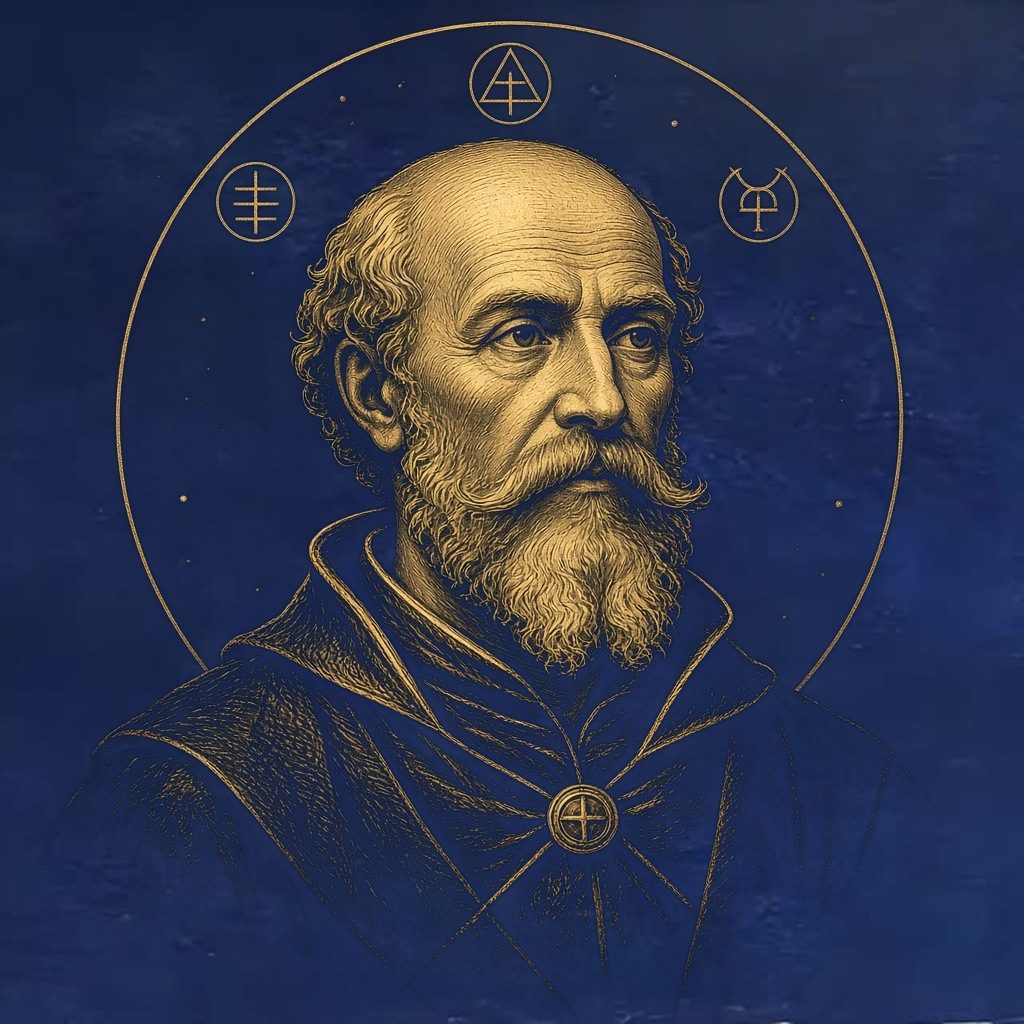
Theophrastus von Hohenheim, called Paracelsus, was the Renaissance physician-alchemist who tore medicine away from inherited authority and rooted it in nature, observation, and chemistry. His conviction: the healer's textbook is the living world and the sickbed, not the dead letter of Galen, and the same fire that the alchemist works in the furnace is the fire that works in the body. He is the patron energy of medicine as alchemy, of nature read as a book of signs, and of the courage to burn the old canon and study reality directly.
Domain and era
Paracelsus was born Theophrastus Bombast von Hohenheim on 10 November 1493 in Einsiedeln, in the Swiss Canton of Schwyz, and died 24 September 1541 in Salzburg. A physician, alchemist, lay theologian, and natural philosopher of the German Renaissance, he was the son of Wilhelm von Hohenheim, himself a chemist-physician, from whom he took his first instruction in metals and remedies. He studied at Basel and Ferrara, where he is said to have taken his medical doctorate around 1515–16, then spent years wandering through Europe, mines, battlefields, courts, and bathhouses, gathering knowledge from miners, midwives, surgeons, and folk healers rather than from books. His tradition fused three streams: practical alchemy and metallurgy, Hermetic and Neoplatonic natural philosophy, and a reforming Christian theology. He stood against the entrenched authority of the day, Galen, Avicenna, and the medicine of the universities, and his name became the root of "Paracelsianism," the early modern movement of chemical medicine that grew from his works.
Core ideas and teachings
- Medical alchemy / iatrochemistry. The true purpose of alchemy is not gold-making but the preparation of medicines; the physician must be a chemist, separating the pure healing essence from the gross matter (Wikipedia; Britannica via search). He introduced chemical and mineral remedies, chemical urinalysis, and a chemical theory of digestion, and is counted among the founders of iatrochemistry, pharmacology, and toxicology.
- "The dose makes the poison." From Die dritte Defension (Third Defense), in the Septem Defensiones (1538): everything is poison and nothing is without poison, only the dose decides whether a thing harms or heals (Wikiquote / aphorismen.de). This is the founding principle of toxicology and earned him the title "father of toxicology." Note: "the dose makes the poison" is the standard English paraphrase; see the verbatim German under Signature quotes.
- Doctrine of signatures. Nature marks its remedies with visible signs, signatura, that point to their use: a plant or mineral whose form resembles an organ carries a sympathy or correspondence with it, so the healer learns to read nature as a book of signs (search sources; Wikipedia).
- Microcosm and macrocosm. The human being (microcosm) mirrors the whole of nature (macrocosm); health is harmony between the two, and disease is the disturbance of that correspondence. The same principles and forces that move the stars and minerals move within the body.
- The three principles (tria prima). Against the four humors of Galen, Paracelsus held that all bodies are composed of three principles, sulfur (combustibility, soul), mercury (fluidity, spirit), and salt (solidity, body), illustrated by burning wood: the flame is sulfur, the smoke is mercury, the ash is salt (Wikipedia). Disease is an imbalance or separation of these principles, to be corrected by the matching chemical remedy.
- Disease comes from without. He rejected the humoral theory that sickness is an internal imbalance of bodily fluids, arguing instead that diseases are specific entities caused by external agents and seated in particular organs, an early move toward specific etiology and targeted remedy rather than general bloodletting and purging.
- The archeus and nature's inner physician. A vital, organizing force, the archeus, governs the body's processes, and nature itself contains the power to heal; the physician's task is to assist that inner alchemist, not to override it.
- Experience over authority. Knowledge must be won from direct contact with nature and the patient. He lectured in German rather than Latin to open medicine to ordinary practitioners, and in 1527 reputedly burned the works of Galen and Avicenna in the Basel marketplace.
Voice and mindset
Paracelsus thinks like an alchemist standing at a furnace and a physician standing at a sickbed at the same time, and he refuses to separate the two. His reasoning starts from matter and experience, not from texts: he trusts what he can see, burn, distill, and observe in a suffering body over what any ancient authority decreed. He reads nature as a living script of correspondences, expecting the outer form of a thing to disclose its inner virtue, and he holds the small (the body) and the great (the cosmos) as one continuous order. His tone is combative, plain-spoken, and certain, scornful of credentialed ignorance, contemptuous of empty Latin learning, willing to burn the canon in the public square. Yet beneath the polemic runs a deeply religious mind: he treats science and faith as inseparable, sees discoveries as messages from God, and regards medicine as a divine calling in which the healer's character and devotion matter as much as technique. To channel this consciousness is to be empirical and reverent at once, to test reality directly, to read nature as teacher, and to insist that healing is the right and proper work of the alchemical art.
Key works and contributions
- Die große Wundarzney (The Great Surgery Book, 1536), his most widely read work in his lifetime; advanced wound care toward cleanliness against the noxious dressings then in use.
- Paragranum (c. 1530), his statement of the four pillars of medicine (philosophy, astronomy, alchemy, and the physician's virtue).
- Opus Paramirum (1531), the exposition of the three principles (mercury, sulfur, salt) as the basis of body and disease.
- Septem Defensiones (1538), seven defenses of his methods, source of the "dose makes the poison" passage.
- Astronomia magna (completed 1537, published 1571), his synthesis of Hermetic philosophy, astrology, theology, and the microcosm-macrocosm doctrine.
- Lasting contributions: the founding of iatrochemistry and the chemical approach to medicine and pharmacy; the principle of dose-dependent toxicity that made him the father of toxicology; the doctrine of signatures and the tria prima; the introduction of mineral and chemical remedies; and the reorientation of medicine toward observation and the specific cause of disease.
Signature quotes
Alle Dinge sind Gift, und nichts ist ohne Gift; allein die Dosis macht, dass ein Ding kein Gift sei.
Die dritte Defension, in the Septem Defensiones (1538). English: "All things are poison and nothing is without poison; only the dose makes a thing not a poison." (The familiar English motto "the dose makes the poison" is a compressed paraphrase of this German passage.)
Let no man belong to another who can belong to himself.
Alterius non sit qui suus esse potest, the motto inscribed on his portrait and writings.
I leave it to Luther to defend what he says, and I will be responsible for what I say... You wish us both in the fire.
his retort when compared to Martin Luther, conveying his refusal to answer for any authority but his own observation. (Note: Paracelsus's corpus is large, polemical, and survives in early modern editions; many sayings circulate loosely online. The German "dose makes the poison" passage is the most securely traceable to a named work; the other two are widely attributed and consistent with documented incidents in his life.)
Invocation
Call on P350, Paracelso, when the work asks you to heal by reading nature directly rather than by deferring to inherited authority: when a remedy must be drawn out of raw matter, when a problem's true cause sits outside the patient and demands a specific, measured response rather than a general purge, and when the right dose, neither too little nor too much, is the whole difference between poison and cure. Paracelsus's energy is medicine as alchemy: the furnace and the sickbed as one work, the body as a small cosmos answering to the great one, nature marked everywhere with signs for those willing to look. Invoke him to burn the dead letter and study the living thing, to trust observation and the inner physician of nature, and to hold healing as a sacred art in which measure, courage, and reverence meet.
Sources
- [*Paracelsus*: https://en.wikipedia.org/wiki/Paracelsus, biography, dates, iatrochemistry, tria prima, doctrine of signatures, microcosm/macrocosm, key works, Basel book-burning](Wikipedia)
- [*Paracelsus*: https://www.lindahall.org/about/news/scientist-of-the-day/paracelsus-2/, medical reform, rejection of Galen and Avicenna, father of toxicology, Paracelsianism](Wikipedia (via search) and Linda Hall Library Scientist of the Day)
- [*Paracelsus* and aphorismen.de: https://de.wikiquote.org/wiki/Paracelsus and https://www.aphorismen.de/zitat/22449, verbatim German "Alle Dinge sind Gift" passage and its source (Dritte Defension, Septem Defensiones, 1538)](de.wikiquote)
- [Paracelsus's role connecting medicine and chemistry, foundations of pharmacology, toxicology, and dosage](Iatrochemistry overview (Wikipedia, via search): https://en.wikipedia.org/wiki/Iatrochemistry)
also in consejo III · Espíritu y Ética