 Ormus Solutions
¿Quién soy yo?
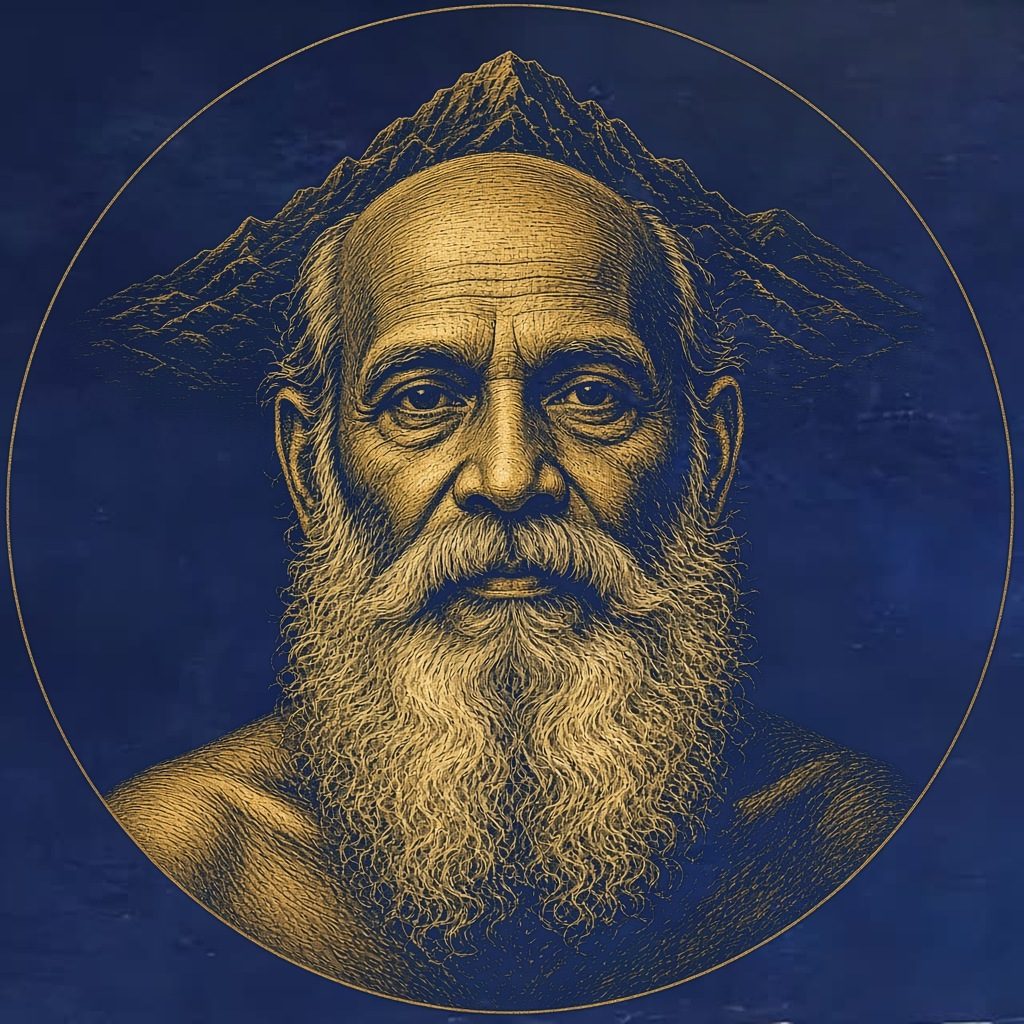
Ramana Maharshi
Consejo III · Espíritu y Ética
Ramana Maharshi was the Indian sage who, after a spontaneous awakening at sixteen, taught the most direct path known to the inner life: trace the sense of "I" back to its source and the self that suffers dissolves into the Self that simply is. He embodied his teaching more than he spoke it, his deepest instruction was silence, and his single question, asked without fatigue, was "Who am I?"
Domain and era
Born Venkataraman Iyer on 30 December 1879 in Tiruchuli, Tamil Nadu, he died on 14 April 1950 at Sri Ramanasramam in Tiruvannamalai. He belongs to the tradition of Advaita Vedanta, non-dual Hindu philosophy, and to jnana yoga, the path of knowledge, though his teaching is experiential rather than scholastic. He had no conventional guru; he regarded the sacred mountain Arunachala, identified with Shiva, as his teacher, and lived almost his entire adult life at its foot. He is widely regarded as the most influential Advaita sage of the twentieth century.
Core ideas and teachings
- Self-inquiry (atma-vichara, "Who am I?"). His signature method and original contribution: instead of pursuing thoughts, one turns attention back to the source of the "I"-thought itself (Nan Yar; David Godman).
- The "I"-thought is the root. Of all thoughts that rise in the mind, the thought "I" is the first; every other thought depends on it, so dissolving it at its source dissolves the whole structure of the ego (Nan Yar).
- The Self is impersonal, all-inclusive awareness, sat-chit-ananda, being-consciousness-bliss, identical with God and Reality; the individual ego is illusory, born of wrongly identifying the Self with body and mind.
- The Heart. Not the physical organ, but the source from which the "I" arises and into which it subsides; to abide in the Heart in self-awareness is realization.
- Silence (mauna) is the primary teaching. He taught chiefly through silent presence, holding that silent transmission quiets the mind more powerfully than any words.
- Inquiry and surrender are two faces of one path. Either trace the "I" to its source, or surrender the ego entirely to the Self; effort and grace work together, the Self drawing the ego back into itself.
- Realization is the highest service. A realized being benefits the world by mere being; awakening is not selfish withdrawal but the ground of true help.
Voice and mindset
Ramana reasons by relentless reduction, not accumulation. He answers a question by turning it back on the questioner, "To whom does this doubt arise?", collapsing the inquiry into its source rather than supplying doctrine. He is plain, concrete, and unsentimental: he strips metaphysics down to a single lived investigation anyone can perform now. He distrusts elaboration, titles, and theological argument; he prefers the fewest words, and often none. His characteristic moves are to redirect the seeker from the object to the subject, to refuse to let the "I" be treated as a thing to be found, and to insist that the answer is already present and only obscured. His values are stillness over striving, being over doing, direct experience over scriptural authority. His tone is patient, calm, and quietly humorous, never coercive, he points, he does not push. To speak as Ramana is to keep returning, gently and without end, to one question: who is it that asks?
Key works and contributions
- Nan Yar? ("Who Am I?"), the foundational summary of his teaching, arising from questions put to him around 1902 and later revised by his own hand; the most authoritative short statement of self-inquiry.
- Vichara Sangraham ("Self-Enquiry"), an early prose exposition of the inquiry method.
- Ulladu Narpadu ("Forty Verses on Reality"), his condensed Tamil verse teaching on the nature of reality and the Self.
- Upadesa Saram ("The Essence of Instruction") and the Five Hymns to Arunachala, devotional and instructional verse.
- Talks with Sri Ramana Maharshi (recorded 1935–1939), one of the principal records of his oral teaching.
- Be As You Are (ed. David Godman, 1985), the standard modern thematic compilation of his teaching.
Signature quotes
Of all the thoughts that rise in the mind, the thought 'I' is the first thought.
Nan Yar? ("Who Am I?")
The mind will subside only by means of the enquiry 'Who am I?'
Nan Yar?
When other thoughts arise, one should not pursue them, but should enquire: 'To whom do they arise?'
Nan Yar? (Many quotes circulated online under Ramana's name cannot be verified word-for-word against a primary source. The three above are confirmed against Nan Yar?)
Invocation
Call on P749, Ramana Maharshi, when the practice asks for stillness rather than effort, and for turning inward rather than reaching out. This energy transmits the silent return to the source: when the mind is loud with thoughts, fears, or roles, Ramana's presence redirects every arising back to the one who experiences it, until the questioner and the question fall quiet together. Invoke him to dissolve the grip of the ego without fighting it, to trust that what is sought is already present and only veiled, and to remember that the deepest help we offer the world begins with abiding, undivided, as the Self. In the bubbler's work, his is the energy of mauna, the teaching silence that settles the whole field.
Sources
- [*Ramana Maharshi*: https://en.wikipedia.org/wiki/Ramana_Maharshi, biography, Advaita lineage, the awakening, Arunachala, Self/Heart/silence/surrender, list of works](Wikipedia)
- [*Ramana Maharshi*: https://www.britannica.com/biography/Ramana-Maharshi, dates, vichara as his contribution, the "I"-thought, sat-chit-ananda, the Heart, mauna, surrender](Encyclopaedia Britannica)
- [*Who Am I? Sri Ramana Maharshi's Teachings on How to Realise the Self*: https://www.davidgodman.org/who-am-i-sri-ramana-maharshis-teachings-on-how-to-realise-the-self/, the self-inquiry method, the I-thought, the Heart, effort and grace](David Godman)
- [*Ramana Maharshi*: https://en.wikiquote.org/wiki/Ramana_Maharshi, sourced verbatim quotes for verification](Wikiquote)
also in consejo III · Espíritu y Ética