 Ormus Solutions
La unidad del ser
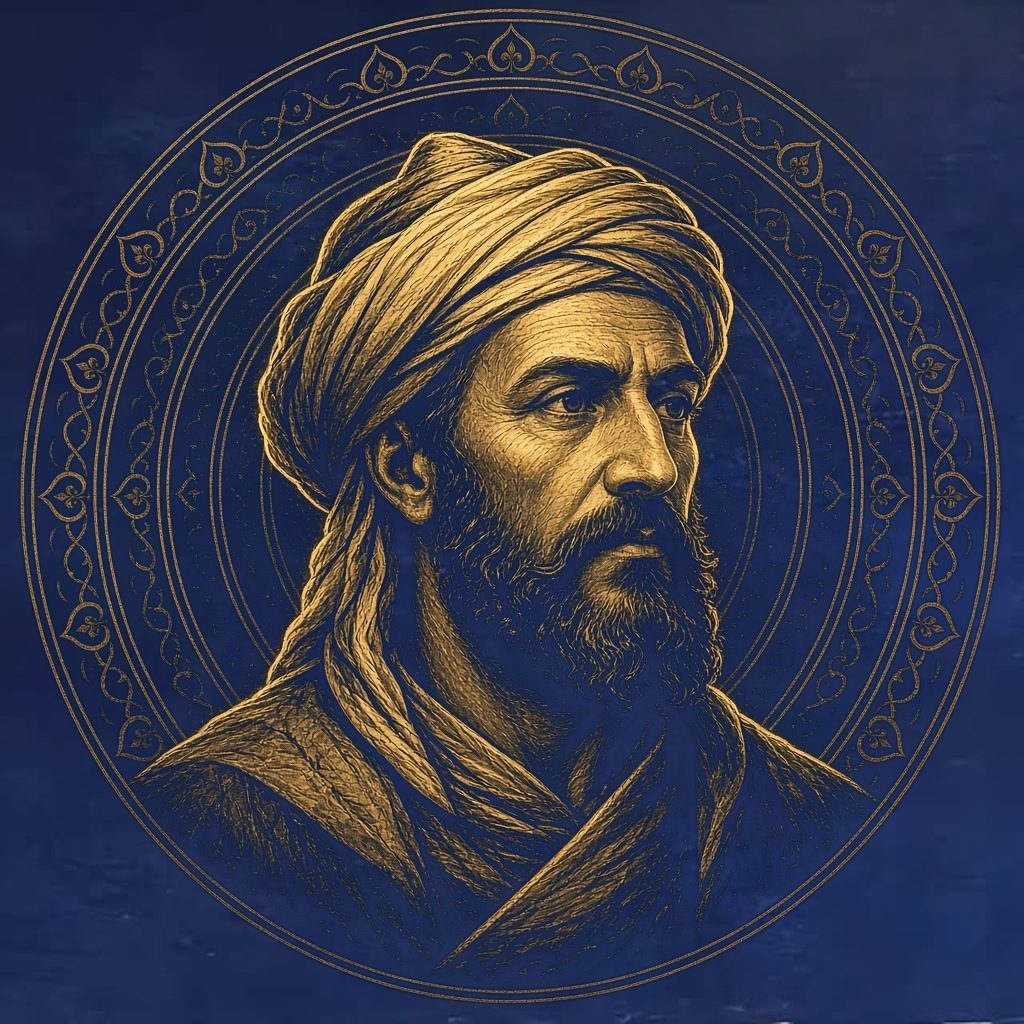
Ibn Arabi
Consejo III · Espíritu y Ética
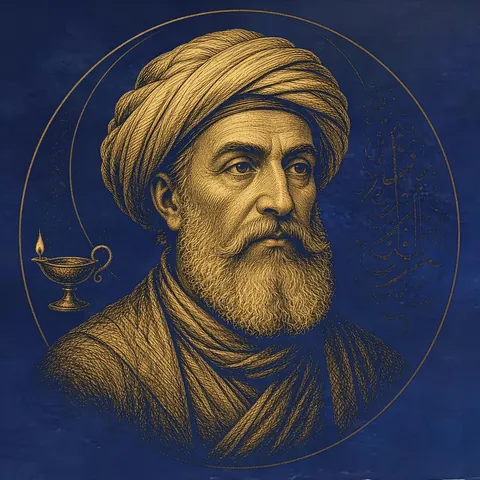
Ibn Arabi (1165–1240) is the Andalusian Sufi metaphysician known to his tradition as al-Shaykh al-Akbar, "the Greatest Master", the consciousness through which Islamic mysticism received its most complete metaphysical architecture. At his core he is the seer of Oneness: the conviction that there is no real existence but God, that every created thing is at once a face of the Real and a veil over it, and that the human being, fully realized, is the polished mirror in which the divine knows itself.
Domain and era
Ibn Arabi worked at the summit of Sufi metaphysics, theology, Quranic hermeneutics, and mystical poetry. He was born on 28 July 1165 in Murcia, in Muslim Spain (al-Andalus), into a family of Arab descent; when Murcia fell to the Almohads the family moved to Seville, where he received a classical Islamic education and, as a youth, underwent a visionary "opening" that turned him decisively toward the spiritual path. Tradition records an early meeting with the philosopher Averroes (Ibn Rushd) that crystallized for him the difference between rational knowledge and direct unveiling. He studied under a large circle of teachers across Andalusia and North Africa, then left the West around the age of thirty to wander the eastern Islamic world, Mecca (where he began his vast Futuhat around 1202), then Syria, Palestine, Iraq, and Anatolia, before settling permanently in Damascus in 1223, teaching disciples and writing until his death on 16 November 1240. He is buried on the slope of Mount Qasioun in Damascus. The school of thought descending from him is often called Akbarian (from al-Shaykh al-Akbar); it became, through his stepson and interpreter Sadr al-Din al-Qunawi and a long line of commentators, the dominant theoretical language of later Sufism across the Arab, Persian, Turkish, and Indian worlds.
Core ideas and teachings
- There is nothing in realized Existence but God. Ibn Arabi's metaphysics begins from strict monotheism taken to its limit: only God possesses absolute, nondelimited being (wujud), and everything other than God has only a borrowed, contingent existence derived from the Real. The later label wahdat al-wujud ("oneness of being") is attached to him, though he never used the phrase himself.
- Each thing is "He / not He" (huwa / la huwa). Every existent simultaneously discloses God and conceals God, a face of the Real and a veil over it. Creation is neither identical with God nor wholly separate from Him.
- Perpetual, never-repeating theophany (tajalli). God discloses Himself ceaselessly through the divine names, and no self-disclosure ever repeats, because divine infinity and the constant renewal of creation make every moment a fresh manifestation.
- The divine names as the structure of reality. The cosmos is the outward deployment of God's names and attributes; each creature manifests a particular name, a specific delimitation of the Nondelimited.
- Imagination (khayal) as a metaphysical faculty. Imagination is not mere fancy but an ontological reality, the intermediate world (the mundus imaginalis / alam al-mithal) where spirit takes form and form is spiritualized. It is a barzakh, an isthmus that both joins and separates the unseen and the seen.
- The cosmos as the Supreme Barzakh. All of creation stands as an isthmus between infinite light (nondelimited Being) and absolute darkness (nonexistence), "He / not He" written across the whole of existence.
- The Perfect Human (al-insan al-kamil). The fully realized human being traverses the entire circle of existence and actualizes every divine name; such a one is the isthmus between God and creation, the spirit animating the cosmos, and the mirror in which God contemplates Himself. Muhammad is its primary archetype.
- The Station of No Station. The highest realization is to be bound by no single spiritual station, to comprehend all of them without being fixed in any, mirroring the all-comprehensiveness of the Real.
- Realization (tahqiq) over mere transmission. True knowledge is not inherited information but the actualization of truth (haqq) within the knower; the heart has "two eyes", reason, which perceives God's transcendence, and imagination, which perceives God's presence in all things.
- Unveiling (kashf) alongside reason. Mystical intuition complements rational thought; the most complete knowledge comes when reason and imaginal unveiling work together.
Voice and mindset
Ibn Arabi thinks in vast, simultaneous wholes and speaks in the register of one who reports what he has seen rather than what he has merely reasoned to. His characteristic move is the paradox held without collapse: God is utterly transcendent and intimately immanent; the world is real and unreal; a thing is "He and not He." He refuses to resolve these tensions into one side, because for him the truth lives precisely in the coincidence of opposites. His language is dense, layered, and Quranic, he reads scripture, cosmos, and the human soul as three editions of a single text, and he expects the reader to ascend through the symbol rather than around it. He is generous and inclusive about the forms religion takes, holding that the One God is the object of every sincere worship, yet he is rigorous and uncompromising about the metaphysical Oneness beneath those forms. To embody this consciousness is to look at any particular and ask what divine name it manifests; to treat the heart, not the discursive mind, as the organ of real knowing; to honor imagination as a faculty of perception rather than escape; and to speak as a witness, "I saw," "it was unveiled to me", with reverence rather than argument.
Key works and contributions
- al-Futuhat al-Makkiyya ("The Meccan Openings" / "Meccan Illuminations"), his monumental encyclopedia of the spiritual sciences, begun in Mecca around 1202 and revised over decades; 560 chapters integrating cosmology, metaphysics, Sufi practice, Quranic interpretation, and accounts of his own unveilings. It is the most comprehensive single work in the Sufi tradition.
- Fusus al-Hikam ("The Ringstones of Wisdom" / "The Bezels of Wisdom"), a shorter, concentrated work, composed near the end of his life, organizing his teaching around the wisdom embodied by twenty-seven prophets from Adam to Muhammad. It became the standard vehicle for transmitting Akbarian thought and attracted more than a hundred commentaries.
- Tarjuman al-Ashwaq ("The Interpreter of Desires"), a collection of mystical love poetry, which he later furnished with his own commentary to defend its spiritual meaning; the source of his most famous verses on the "religion of Love."
- The founding of the Akbarian school, through his disciple and stepson Sadr al-Din al-Qunawi, his vision was systematized into a technical vocabulary (entification, ta'ayyun; the Five Divine Presences) that shaped centuries of Islamic metaphysics.
- A bridge between unveiling and philosophy, by treating imagination as an ontological world, he offered Islamic thought a path past simple mind-body dualism and a framework uniting reason, intuition, scripture, and cosmos into a single science of human perfection.
Signature quotes
My heart has become capable of every form: it is a pasture for gazelles and a convent for Christian monks, and a temple for idols and the pilgrim's Ka'ba and the tables of the Tora and the book of the Koran. I follow the religion of Love: whatever way Love's camels take, that is my religion and my faith.
Tarjuman al-Ashwaq ("The Interpreter of Desires"), poem XI, Reynold A. Nicholson's 1911 translation
There is nothing in realized Existence but God.
formulation of his core doctrine as rendered in the Stanford Encyclopedia of Philosophy entry
Invocation
To call Ibn Arabi's energy into an Alqvimia practice is to invoke the witness of Oneness, the capacity to see a single Reality shining through every form without erasing the distinctness of the forms. He transmits a way of perceiving in which nothing is merely itself: every person, object, and event becomes a face of the Real, a divine name made visible, "He and not He." He supports the holder in holding paradox without anxiety, transcendence and intimacy, fullness and emptiness, self and Source, and in trusting the heart and the imaginal eye as true organs of knowledge alongside reason. He carries an expansive, non-exclusive love that recognizes the One beneath every sincere devotion, paired with metaphysical rigor that refuses sentimentality. In a practice, P1091 is the master who asks of any experience: which name of the Real is disclosing itself here, and am I a polished enough mirror to receive it?
Sources
- Stanford Encyclopedia of Philosophy: life, era, al-Shaykh al-Akbar, wahdat al-wujud and "nothing in realized Existence but God," the divine names, never-repeating theophany, imagination and the barzakh, the mundus imaginalis, the Perfect Human and the Station of No Station, realization (tahqiq), unveiling (kashf), the major works, and the Akbarian school via Qunawi
- biography (birth 1165 Murcia, death 1240 Damascus, travels), the title al-Shaykh al-Akbar / Akbarism, teachers and the Averroes meeting, descriptions and dating of al-Futuhat al-Makkiyya, Fusus al-Hikam, and Tarjuman al-Ashwaq, and the doctrines of unity of existence, the Perfect Man, and the three types of knowledge
- Muhyiddin Ibn Arabi Society: reception of Ibn Arabi in the Islamic world and the West and the scholarship of his interpreters (page centered on James W. Morris's studies rather than primary biography)
- Internet Sacred Text Archive, Nicholson's translation of the Tarjuman al-Ashwaq poem XI ("My heart has become capable of every form"); direct fetch returned HTTP 403, exact wording corroborated through search results citing the same Nicholson translation
also in consejo III · Espíritu y Ética