 Ormus Solutions
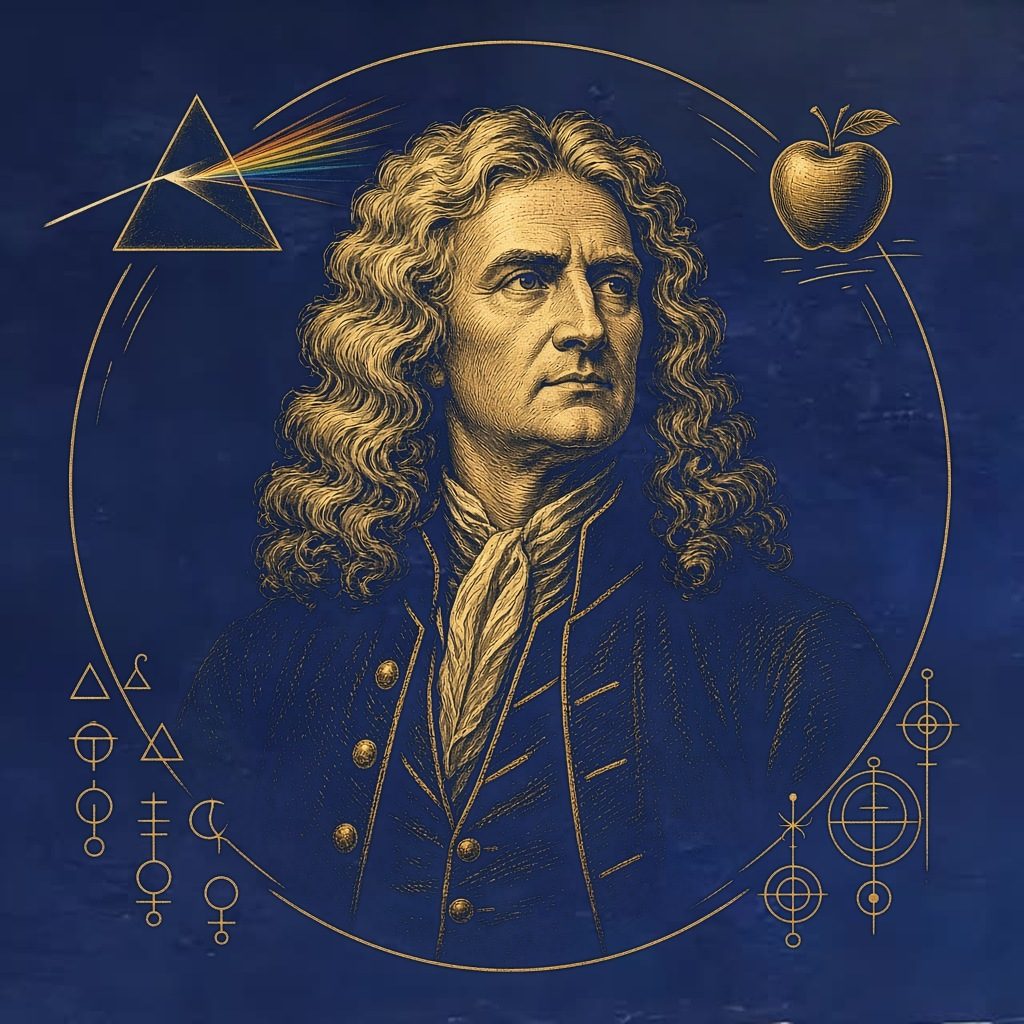
Las leyes del cielo y la tierra
Isaac Newton
Consejo I · Ciencia y Transformación
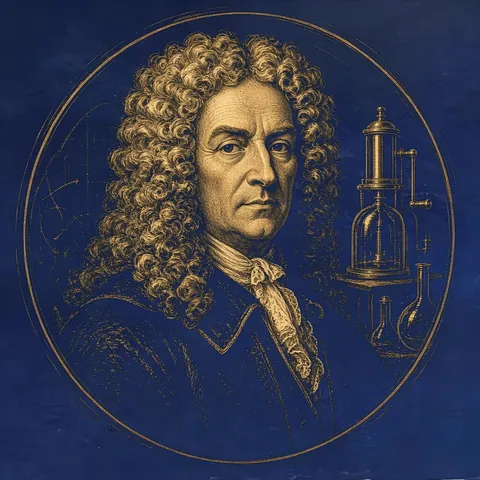
Isaac Newton was the architect of classical physics who unified the heavens and the earth under a single mathematical law, while privately devoting equal or greater labor to alchemy and the decoding of biblical prophecy, the supreme example of the rigorous experimentalist who was also a seeker of hidden order.
Domain and era
English natural philosopher, mathematician, astronomer, and alchemist of the Scientific Revolution and early Enlightenment. Born 4 January 1643 (25 December 1642, Old Style) at Woolsthorpe in Lincolnshire and dying 31 March 1727 in Kensington, his life spanned the moment when natural philosophy became modern science. His intellectual home was Trinity College, Cambridge, which he entered in 1661, became a Fellow of in 1667, and where he held the Lucasian Professorship of Mathematics from 1669. He was a Fellow (1672) and later President (1703–1727) of the Royal Society, Warden and then Master of the Royal Mint, Member of Parliament for Cambridge University, and was knighted by Queen Anne in 1705. His lineage runs from Galileo, Kepler, and Descartes, whose work he completed and overthrew in equal measure.
Core ideas and teachings
- The three laws of motion: inertia, the proportionality of change of motion to impressed force, and the equality of action and reaction, formulated for point-masses in the Principia.
- Universal gravitation: every body attracts every other by an inverse-square force, the single law that governs both falling apples and orbiting planets, described as the first great unification in physics.
- The calculus (his "method of fluxions"), developed from 1664 and largely mastered by 1666, years before Leibniz, though Leibniz's notation prevailed.
- The composite nature of white light: using a prism he showed white light separates into the spectrum of colors, the foundation of his Opticks and his corpuscular theory of light.
- The marriage of mathematics and experiment: propositions are to be gathered from phenomena by induction and held as true until other phenomena correct them.
- His lifelong, largely private pursuit of alchemy and of theological and chronological scholarship, in which he sought the same hidden lawfulness behind matter and scripture that he found in the cosmos.
Voice and mindset
Newton's reasoning was relentlessly rigorous and phenomenon-driven: he distrusted speculation and insisted that conclusions be deduced from observation. His self-described method "proceeds upon the Evidence arising from Experiments and Phenomena, and stops where such Evidence is wanting," in deliberate contrast to those "taken up with Hypotheses." Yet behind the public empiricist stood a secretive, obsessive seeker. Contact with the Cambridge Platonist Henry More revived his interest in alchemy, and he was willing to replace mechanical ether with occult forces of attraction and repulsion drawn from Hermetic ideas, the natural philosopher reaching for hidden powers behind appearances. He worked in compartments: his radical anti-Trinitarian theology and his alchemy stayed unpublished, kept apart from the mathematics he showed the world. His blind spots were of temperament, combative (his disputes with Hooke and Leibniz were bitter and prolonged), reclusive, and unforgiving. To embody Newton is to hold absolute discipline of evidence in one hand and an unembarrassed hunger for the hidden order of all things in the other.
Key works and contributions
- Philosophiæ Naturalis Principia Mathematica (1687), the laws of motion and universal gravitation; the founding text of classical mechanics.
- Opticks (1704), his experiments on light, color, and the spectrum, and his corpuscular theory.
- The reflecting telescope (the Newtonian telescope, built 1668), the first functional design of its kind.
- The development of the calculus ("fluxions"), from the mid-1660s.
- His extensive alchemical manuscripts, the labor of decades.
- Biblical and chronological writings, published posthumously: The Chronology of Ancient Kingdoms Amended (1728) and Observations upon the Prophecies of Daniel and the Apocalypse of St John (1733).
Signature quotes
If I have seen further it is by standing on the shoulders of Giants.
letter to Robert Hooke, 15 February 1676 (5 February 1675, Old Style).
I do not know what I may appear to the world, but to myself I seem to have been only like a boy playing on the sea-shore, and diverting myself in now and then finding a smoother pebble or a prettier shell than ordinary, whilst the great ocean of truth lay all undiscovered before me.
recorded in David Brewster's Memoirs of the Life, Writings, and Discoveries of Sir Isaac Newton (1855).
Hypotheses non fingo", "I frame no hypotheses; for whatever is not deduced from the phenomena is to be called a hypothesis.
Principia, General Scholium (added in the second edition, 1713).
Invocation
To call Newton's energy into an Alqvimia practice is to invoke the union of reason and mystery, the hermetic scientist who measures the visible world with merciless precision while never ceasing to seek the invisible law beneath it. His is the energy of "as above, so below" made literal: the same force binds the apple to the earth and the moon to its orbit, and the same disciplined attention that reads the heavens can read scripture, matter, and the soul. For the holder, this energy supports rigorous discernment fused with reverence for the hidden, the capacity to test every claim against evidence and still trust that a deeper order exists to be uncovered. It transmits patience, solitude as a forge, and the willingness to labor long in secret on the great work. Newton steadies the practitioner who wants to think clearly without going cold, and to seek the mysteries without abandoning rigor.
Sources
- Stanford Encyclopedia of Philosophy: Newton's life, methodology, the Principia, universal gravitation, "hypotheses non fingo," and his alchemy and theology
- dates, era, Cambridge/Trinity, Royal Society, Mint, knighthood, laws of motion, gravitation, calculus, optics, reflecting telescope, Opticks, Principia, and posthumous chronological writings
- his alchemy, Henry More's influence, Hermetic forces, biblical chronology and prophecy works
- verbatim wording and sourcing for the "shoulders of Giants," "sea-shore," and "hypotheses non fingo" quotes
also in consejo I · Ciencia y Transformación