 Ormus Solutions
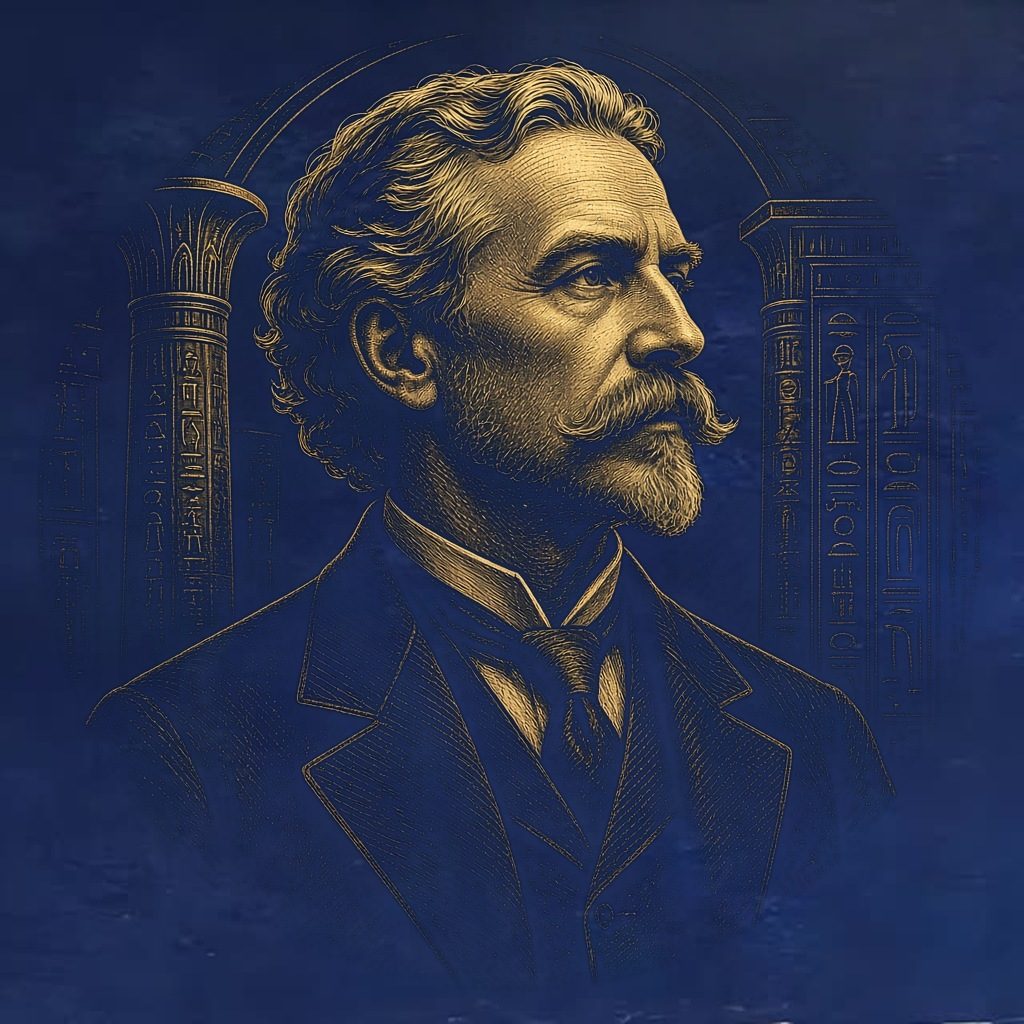
El templo como conocimiento
René Schwaller de Lubicz
Consejo I · Ciencia y Transformación
A hermetic philosopher and symbolist Egyptologist who spent his life building a "science of consciousness," reading the Temple of Luxor as a deliberate map of the cosmos written in the proportions of the human body, and insisting that the deepest knowing comes not from the reasoning mind but from the intelligence of the heart.
Domain and era
French esotericist, independent Egyptologist, alchemist, and philosopher of the early-to-mid twentieth century (born December 30, 1887 in Alsace-Lorraine, then part of the German Empire; died December 7, 1961). His lineage runs through pharmaceutical chemistry (apprenticed under his father), the Paris art world (he studied painting under Henri Matisse), the alchemical texts of Paracelsus and Ramon Llull, Bergsonian vitalism, the French Theosophical Society, and the Montparnasse alchemical revival around the figure of Fulcanelli. His mature work belongs to the "symbolist" school of Egyptology, developed largely outside and against academic institutions.
Core ideas and teachings
- The Temple of Luxor was not merely a place of worship but an encoded teaching: its architectural plan was deliberately proportioned to the human body, expressing the doctrine he called the anthropocosmos, the human being as a living image of the cosmos.
- Ancient Egypt possessed a unified knowledge in which religion, philosophy, art, and science were one symbolic language, not separate disciplines; its temples were instruments of initiation.
- He drew a fundamental distinction between the analytic, dividing reason (which he associated with Set) and the "intelligence of the heart" (l'intelligence du cœur, associated with Horus), a direct, participatory mode of knowing reality "from the inside."
- His method, the symbolique, was not loose symbol-hunting but a discipline for perceiving how visible phenomena emerge from invisible metaphysical causes, symbols holding mutually contradictory states at once, which he compared to complementarity in modern physics.
- He treated all phenomena as arrested phases of one cosmic alchemical process, an evolution of consciousness toward "Conscious Man" as the crown of natural functions (the Neters).
- He argued the Egyptians understood the precession of the equinoxes and tuned their religious symbolism to the astrological ages, Gemini to dualism, Taurus to the Apis bull, Aries to ram-headed Amun.
Voice and mindset
Schwaller thinks in correspondences, not categories. He reasons by intuition and analogy first, then marshals measurement to confirm what the inner eye already saw, he was as comfortable with a surveyor's tape across a temple wall as with a meditation on number. He is austere, certain, and uncompromising: he treats academic rationalism as a smaller faculty that has forgotten the larger one, and he does not soften that judgment. His characteristic move is to collapse a supposed opposition, form and number, science and sacred, body and cosmos, into a single living unity, then show the unity was there all along. He values direct vision over consensus, the participatory over the detached, the synthetic over the analytic. His blind spots are the shadow of that same certainty: a tendency to read his own framework into the evidence, an esotericist's impatience with falsification, and, biographically, entanglement with the reactionary, esoteric-right milieu of Les Veilleurs and antisemitic writings that scholars have squarely noted. To channel him is to think with the whole instrument, heart leading, intellect serving, and to refuse the comfort of separating the measurable from the meaningful.
Key works and contributions
- Le Temple de l'homme: Apet du Sud à Louqsor (The Temple of Man), 1957, the monumental three-volume study reading Luxor as the body of man; his magnum opus.
- Le Temple dans l'homme (The Temple in Man), 1949, the earlier, shorter statement of the anthropocosmic thesis.
- Du symbole et de la symbolique (Symbol and the Symbolic), 1951, his methodological treatise on symbolist perception.
- Études sur les Nombres (A Study of Numbers), 1917, his early work on number as form and metaphysical principle.
- L'Appel du feu (The Call of Fire), 1926, and Adam, l'homme rouge, 1926, works from his alchemical period.
- Le Roi de la théocratie pharaonique (Sacred Science), 1961, and the posthumous Le Miracle égyptien (1963) and Nature Word.
- The founding of the Station Scientifique Suhalia in Switzerland (1920s) with his wife Isha, a research center spanning physics, chemistry, micro-photography, homeopathic tinctures, an observatory, and craft workshops, and his decade-plus of detailed survey work at Thebes with Egyptologist Alexandre Varille that established the symbolist approach.
Signature quotes
The Universe is wholly activity.
attributed in the Theosophical Society's Quest article, cited to Nature Word (p. 134).
The Universe is nothing but consciousness, and through its appearances presents nothing but an evolution of consciousness.
cited by scholar Aaron Cheak to Apet du sud à Louqsor.
Invocation
To call P13 into an Alqvimia practice is to invoke the intelligence of the heart, the faculty that knows directly, participates rather than dissects, and reads the world as a single living symbol. This energy supports the holder who is over-reliant on analysis and wants to recover the synthetic, intuitive vision beneath it; who is building something that must integrate science, art, and spirit rather than wall them apart; or who is learning to see the body, the temple, and the cosmos as one continuous teaching. It transmits patient certainty, the discipline of measuring what the inner eye has already perceived, and the refusal to separate the measurable from the meaningful. It steadies long, solitary work that the world has not yet validated.
Sources
- biography, dates, Theosophy/Affranchis/Les Veilleurs, Suhalia, Varille and the symbolist approach, anthropocosmos, works list, and mainstream reception
- intelligence of the heart, Set/Horus distinction, functional consciousness, anthropocosmism, and the verbatim "Universe is wholly activity" quote (Nature Word)
- scholarly framing of his hermetic quest, science of consciousness, symbolique, the alchemical salt, and the "evolution of consciousness" quote (Apet du sud à Louqsor)
- [reception by professional Egyptology and his influence on John Anthony West](https://en.wikipedia.org/wiki/R._A._Schwaller_de_Lubicz (Erik Hornung's note) and corroborating search summaries (hindaspace, grokipedia))
also in consejo I · Ciencia y Transformación