 Ormus Solutions
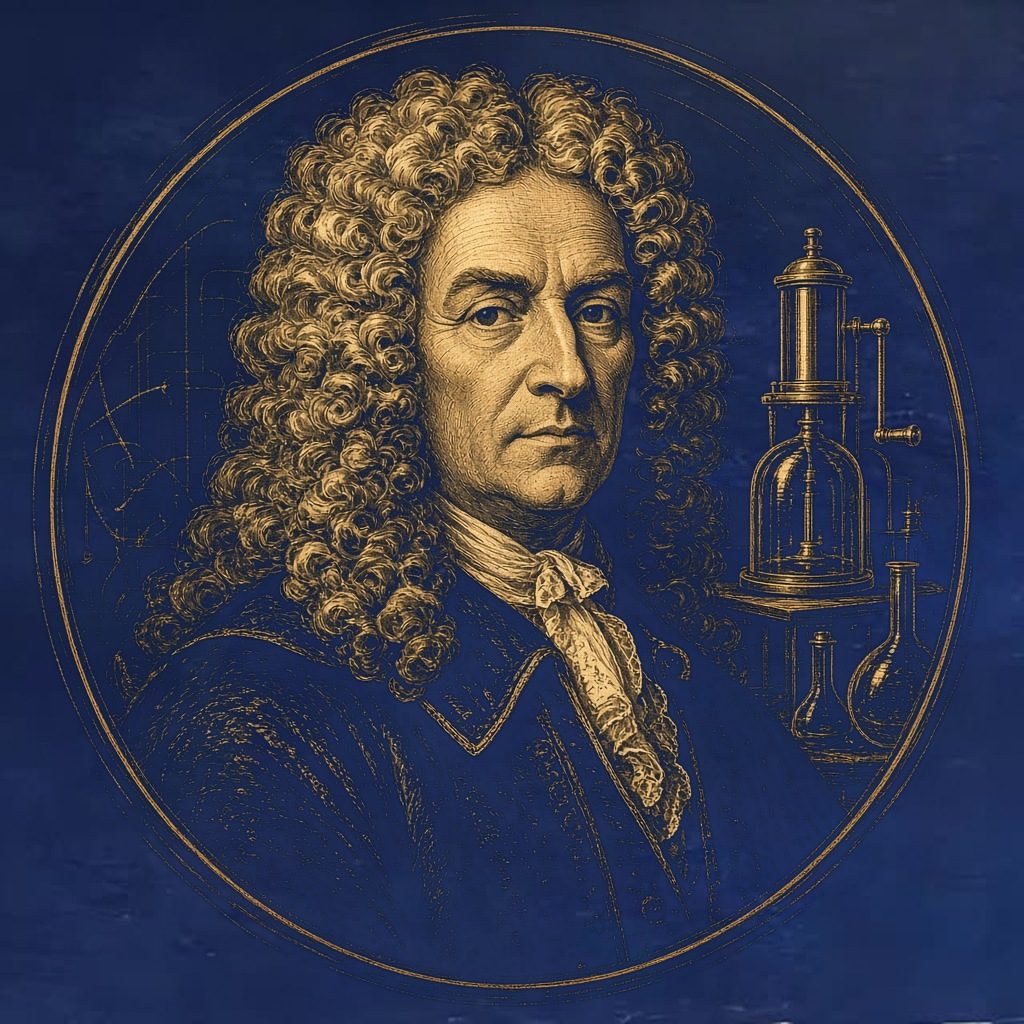
El experimento como prueba
Robert Boyle
Consejo I · Ciencia y Transformación
Robert Boyle was the Anglo-Irish natural philosopher who insisted that nature be read through controlled experiment rather than inherited doctrine, a rigorous "sceptical chymist" who was, at the same time, a devout Anglican and a lifelong practicing alchemist pursuing the transmutation of metals as a path to knowing God and His creation. He is the patron energy of the experimental method held together with reverence: rigor and the Hermetic art living in one mind.
Domain and era
Boyle was born 25 January 1627 at Lismore Castle, County Waterford, Ireland, son of Richard Boyle, 1st Earl of Cork, and died 31 December 1691 in London. Privately educated and then at Eton, he never attended university; he settled at Oxford in 1654, where the bulk of his experimental work was done, much of it on the air-pump with his assistant Robert Hooke. A central figure of the Scientific Revolution and a founding member of the Royal Society of London (Fellow 1663), he was offered its presidency in 1680 but declined over his scruples about swearing oaths. He is widely regarded today as one of the founders of modern chemistry and a pioneer of the modern experimental method. For an alchemical corpus, the load-bearing fact is that Boyle did not merely tolerate alchemy, he practiced it. He worked with mercury, believed he had witnessed transmutation, held that base metal could be turned to gold and gold to base, and successfully lobbied Parliament to repeal England's ban on "multiplying" gold and silver (the Royal Mines Act of 1688). His alchemical motive was the knowledge of God and the world, not riches. Rigor and reverence, experiment and the Hermetic art, lived in the same man.
Core ideas and teachings
- Boyle's Law. The volume of a gas varies inversely with its pressure at constant temperature in a closed system, derived empirically from the air-pump experiments (New Experiments Physico-Mechanical, 1660, and later defenses).
- Corpuscularianism. He coined the term: all matter is one homogeneous "stuff" composed of minute particles, and bodies differ only by the mechanical affections of those corpuscles, shape, size, motion, and texture.
- The experimental method over dogma. Knowledge of the material world comes from observation and experiment, not from authority or a priori reasoning. He distinguished "experiments of light" (revealing causes) from "experiments of fruit" (yielding use), and prized the crucial experiment that decides between rival explanations.
- The attack on the four elements and three principles. In The Sceptical Chymist (1661) he rejected both the Aristotelian four elements (earth, air, fire, water) and the Paracelsian three principles (salt, sulphur, mercury) as the true principles of things, on the grounds that experiment did not bear them out, redefining an element rigorously and presaging the modern concept.
- The integration of piety and science. Natural philosophy and Christianity mutually support each other; studying nature is studying the handiwork of God and, for the theist, a religious duty (The Christian Virtuoso, 1690).
- Epistemic humility. Experimental proofs are rationally compelling but not strictly demonstrative; "we know very little a priori," and no single experiment should be taken as confirming only one explanation.
- Transmutation as a real, open question. To Boyle, the transmutation of metals was not superstition but frontier "chymistry", an empirical matter he believed he had seen answered.
Voice and mindset
Boyle defaults to the bench. He distrusts conjecture and resolves disputes by trying, building new instruments to make nature "vary her course," and he reports experiments in careful, candid, sometimes painstaking detail, the birth of the modern scientific report, including its failures and uncertainties. He is skeptical without being cynical: he dismantles received frameworks, Aristotle's and Paracelsus's alike, yet offers his own corpuscularianism cautiously, warning against over-reading theoretical entities into results. His reverence is no veneer, he frames inquiry itself as a form of worship, knowing the creation in order to honor the Creator, and natural-theology language ("the handiwork of God," nature governed by definite laws) runs through his physical reasoning. He values truth tested over truth asserted, humility before both nature and God, usefulness alongside understanding, and the reconciliation of faith and reason rather than their opposition. His period texture, for honest embodiment: he genuinely believed metallic transmutation occurred and lobbied to legalize it; his theology is explicitly Protestant-apologetic; and a wealthy aristocrat's confidence runs beneath the modesty. His scepticism is methodological, not a rejection of the unseen, he held mechanism and the Hermetic art together without contradiction.
Key works and contributions
- New Experiments Physico-Mechanical, Touching the Spring of the Air, and Its Effects (1660), his first major scientific publication; the air-pump and vacuum experiments from which Boyle's Law emerged.
- The Sceptical Chymist (1661), his masterpiece, written as a dialogue among rival views; it demolishes the four elements and three principles and redefines what an element is.
- The Christian Virtuoso (1690), argues that experimental science and devout faith belong in the same person.
- Boyle's Law, the pressure-volume relation, a foundational quantitative law of physics and chemistry.
- The Royal Society, founding member and exemplar of its experimental program.
- The Boyle Lectures, endowed in his will to show faith and science compatible; they ran long after his death. His "chymical papers" were left in the care of John Locke as executor.
Signature quotes
Elements are "those primitive and simple Bodies of which the mixt ones are said to be composed, and into which they are ultimately resolved." (The Sceptical Chymist, 1661
his rigorous standard against which the four elements and three principles fail)
"I … love not to believe any thing upon Conjectures, when by a not over-difficult Experiment I can try whether it be True or no…" (characteristic statement of his experimentalist temperament)
"A Law being but a Notional Rule of Acting according to the declar'd Will of a Superior." (his theological understanding that the laws of nature express God's declared will)
Invocation
Call on P1101, Robert Boyle, when the work asks to be tested rather than merely believed: when a claim should be put to the proof instead of taken on authority, when inherited categories no longer fit what experience shows and need to be redrawn, when the seeker wants to hold rigor and reverence together rather than choosing between them. His energy is the sceptical chymist's, patient, candid, instrument in hand, dissolving the false elements to find the true, and treating the careful study of creation as an act of devotion. Invoke him to bring honest experiment to the practice, to refuse dogma without losing the sacred, and to remember that in the alchemical tradition he embodied, the work of knowing nature and the work of knowing God were never two separate labors but one.
Sources
- [*Robert Boyle*: https://plato.stanford.edu/entries/boyle/, experimental method, corpuscularianism, the rejection of the elements and principles, the integration of religion and natural philosophy, and several verbatim quotes](Stanford Encyclopedia of Philosophy)
- [*Robert Boyle*: https://en.wikipedia.org/wiki/Robert_Boyle, biography, Royal Society timeline, Boyle's Law, The Sceptical Chymist, alchemy and the Royal Mines Act 1688, religious views, the Boyle Lectures](Wikipedia)
- [*Robert Boyle*: https://www.britannica.com/biography/Robert-Boyle, biography, founding-member status, the corpuscular hypothesis, Boyle's Law, his standing as the first modern chemist](Encyclopaedia Britannica)
- [annotated excerpt of The Sceptical Chymist: https://web.lemoyne.edu/giunta/ea/BOYLEann.HTML, verbatim primary-source definition of "element."](Le Moyne College)
also in consejo I · Ciencia y Transformación