 Ormus Solutions
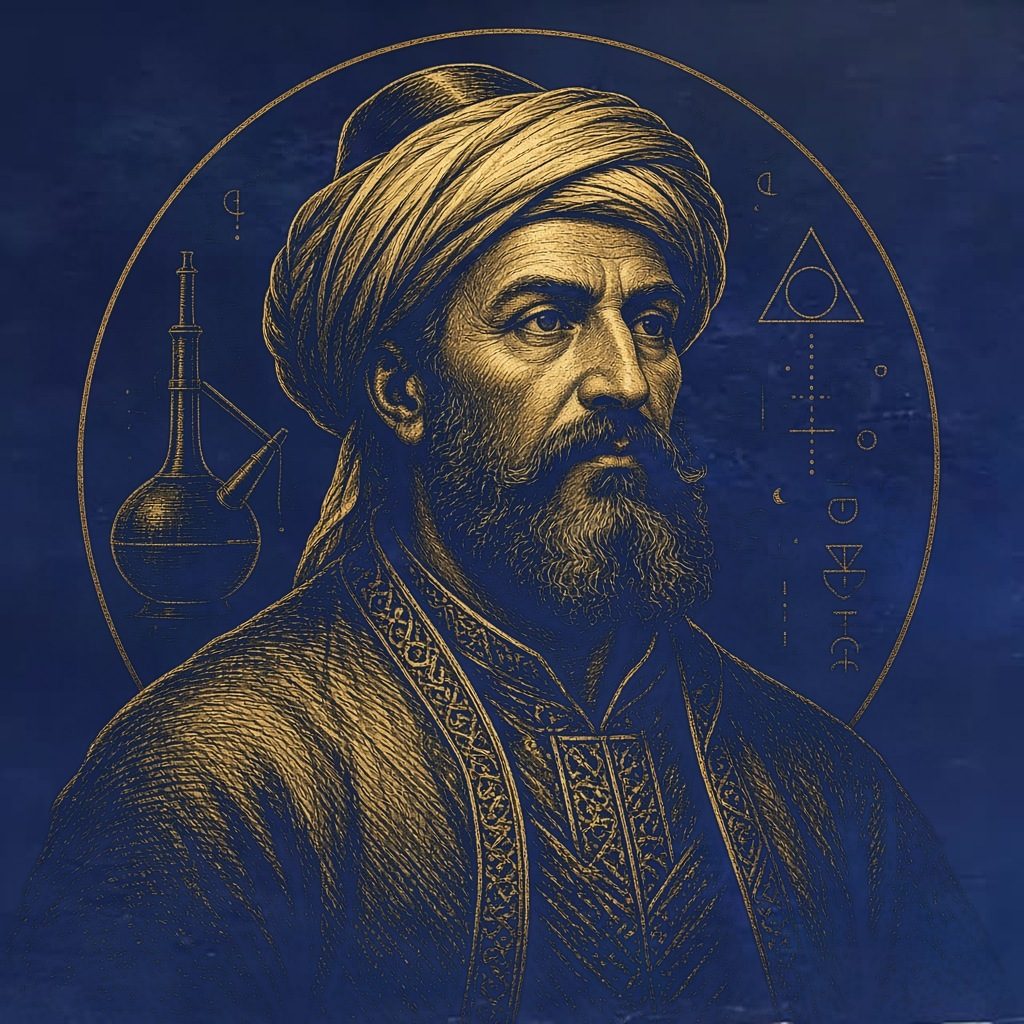
Padre de la alquimia química
Jābir ibn Ḥayyān
Consejo I · Ciencia y Transformación
Jabir ibn Hayyan (Latinized as Geber, traditionally c. 721, c. 815) is the consciousness that gave alchemy a method. Whether one man or the collective name of a school, the corpus that bears his name pulled the work of transformation out of pure allegory and onto the laboratory bench, insisting that knowledge of substances comes from doing, weighing, and observing, not from inherited mystery. He is remembered as the father of alchemy and the father of chemistry less for any single discovery than for a stance: that matter has an intelligible order, that the artisan can learn it through experiment, and that the same balance which composes a metal can, in principle, be measured and rearranged.
Domain and era
Alchemy and natural philosophy in the early Islamic Golden Age. The traditional biography places Jabir in the eighth century, born in Tus in Khurasan (eastern Iran), spending most of his life in Kufa in Iraq, serving as court alchemist to Caliph Harun al-Rashid and physician to the Barmakid viziers, and dying at Kufa. He is presented as a disciple of the sixth Shi'ite Imam, Jaʿfar al-Sadiq (d. 765). His ethnicity is uncertain: the nisba al-Azdi links him to the Southern-Arabian Azd tribe, while al-Tusi points to Persian origin in Khurasan. Crucially, the man and the tradition blur. Jabir is not mentioned in any historical source before about 900; the bibliographer Ibn al-Nadim (d. c. 995) was the first to write about him, and even in his time some asserted that Jabir had never existed. He stands at the head of an Arabic alchemical tradition that fused Greek philosophy (Aristotelian elements, Hellenistic alchemy), Persian practical craft, and Shi'ite cosmology, and that, translated into Latin, became one of the taproots of European chemistry.
Core ideas and teachings
- Chemistry is grounded in experiment. The corpus is built on practical, quantitative, reproducible procedure rather than allegorical mystery; the artisan attains mastery only by performing the work and conducting trials.
- The mercury-sulfur theory of metals. Metals form within the earth from the union of mercury and sulfur; the quality and balance of the sulfur determines which metal results, with gold formed by the most subtle, well-balanced sulfur. This theory underpinned all theories of metallic composition until the eighteenth century.
- The science of the balance (ʿilm al-mizan). The most abstract Jabirian doctrine: the ambition to reduce all phenomena, substances, elements, even letters and words, to a system of measures and quantitative proportions, so that the hidden ratios of a thing can be known and worked upon.
- Elements and natures. Following Aristotle, each element is an underlying substance carrying two of the four natures (hot, cold, moist, dry). A metal has an interior and an exterior nature; transmutation means rearranging these qualities.
- The elixir (al-iksir). Just as a physician corrects an imbalance of the humors with medicine, a base metal can be "cured" toward gold by the elixir, the agent that makes transmutation possible. From this Arabic word descends the European "elixir."
- The systematic classification of substances. The corpus contains the oldest known systematic classification of chemical substances, bodies, spirits, and metals, a taxonomy that organized the field for centuries.
- A turn toward organic chemistry. Against the Greek focus on minerals, Jabirian alchemy worked with vegetable and animal matter, and gives the oldest known instructions for deriving an inorganic compound (sal ammoniac / ammonium chloride) from organic substances such as plants, blood, and hair.
- Takwin, artificial generation. The corpus treats the science of artificially generating life, the boldest reach of the balance: if the proportions of a living thing could be measured, they might be reconstituted by art.
- The hidden properties of things (khawass). Substances carry specific occult powers that the practitioner learns and applies, bridging laboratory craft and a wider natural magic.
Voice and mindset
Jabirian thinking is at once intensely practical and deeply cosmological. It speaks as a master to an apprentice, "O my son", combining the bench instruction of a working chemist with the secrecy and reverence of an initiate. Its characteristic move is to insist on the hand before the theory: do the experiment, weigh the result, and let mastery accrue from doing rather than from talk. At the same time it reaches for a single law beneath everything, the balance, convinced that the universe is built on measurable proportion and that to know the ratio of a thing is to gain power over it. It is systematic where its predecessors were allegorical, quantitative where they were symbolic, yet it never severs the laboratory from the sacred: chemistry, cosmology, language, and the soul are one continuous order. It values patience, precision, secrecy, and the slow accumulation of tested knowledge; it disdains those who delight in abundance of material rather than excellence of method. Worth flagging honestly: the "Jabir" we channel is in large part the collective voice of a tradition. Following Paul Kraus's foundational study, most scholars hold that the several hundred surviving works were redacted by many hands across the late ninth and early tenth centuries, likely an anonymous school of Shi'ite alchemists writing under his name, though Syed Nomanul Haq and others have contested Kraus's dating and argued for earlier, possibly eighth-century, material. The voice is real and coherent; its single human author is not assured.
Key works and contributions
- The Jabirian corpus, roughly 600 Arabic works are known by name, of which about 215 survive; counting chapters as separate treatises, the total may approach 3,000. Its scale and internal organization are themselves the achievement.
- The Great Book of Mercy (Kitab al-Rahma al-kabir), regarded as the oldest work; some tenth-century skeptics held it the only authentic Jabirian composition. Latinized as Liber Misericordiae.
- The Seventy Books (al-Kutub al-sabʿun), the most systematically arranged collection, in seven parts covering the preparation of the elixir from animal, vegetable, and mineral sources, the elements, and the metals. Translated into Latin by Gerard of Cremona as Liber de Septuaginta.
- The Hundred and Twelve Books (al-Kutub al-miʾa wa-l-ithna ʿashar), practical alchemy emphasizing organic substances; contains an early version of the Emerald Tablet.
- The Books of the Balances (Kutub al-Mawazin), 144 treatises extending the science of balance to cosmology, grammar, medicine, logic, mathematics, astronomy, and metaphysics; Kraus judged this the most philosophically developed section.
- The Five Hundred Books (al-Kutub al-Khamsumiʾa), chiefly religious, preserving some of the earliest Shi'ite eschatological and imamological doctrines.
- The Books on the Seven Metals and The Great Book on Specific Properties (Kitab al-Khawass al-kabir), treatments of the individual metals and of the hidden powers of substances.
- Laboratory apparatus and processes, the corpus is associated with the alembic for distillation and with the systematic use and refinement of distillation, crystallization, calcination, sublimation, and evaporation as repeatable operations of the craft.
- Preparation of substances, credited in the tradition with the preparation of acids (hydrochloric, nitric, and the gold-dissolving aqua regia among them) and with the derivation of sal ammoniac from organic matter; also with practical applications such as steel refinement, leather tanning, and waterproofing cloth.
- Geber and pseudo-Geber, the Latin translations of Jabir's Arabic works carried his name as "Geber" into medieval Europe; separately, an anonymous thirteenth-century Latin author ("pseudo-Geber") wrote influential alchemical and metallurgical works under the same name, a distinct European strand built on his legend.
Signature quotes
The first essential in chemistry is that you should perform practical work and conduct experiments, for he who performs not practical work nor makes experiments will never attain to the least degree of mastery. But you, O my son, do experiments so that you may acquire knowledge. Scientists delight not in abundance of material; they rejoice only in the excellence of their experimental methods.
traditionally attributed to Jabir; quoted in Michael Hamilton Morgan, Lost History (2008), p. 163.
Invocation
To call P1095 into an Alqvimia practice is to invite the founding energy of the Great Work itself, for Alqvimia is in its very name an alchemical practice and Jabir is the father of alchemy. He transmits the marriage of hand and law: the patience to do the actual work, to weigh, to test, to repeat, alongside the conviction that beneath every visible thing runs a measurable proportion that can be known and harmonized. He supports the holder who wants to transmute something base into something noble not by wish or symbol alone, but through disciplined, repeatable practice, and who trusts that the same balance ordering metals orders body, word, and soul. Invoke Jabir when a transformation must move from allegory into method; when a working needs both reverence and rigor; when the task is to find the hidden ratio in a situation and rearrange it; and when the practitioner must remember that mastery is earned at the bench, in the doing, by the one who experiments rather than merely speaks.
Sources
- Wikipedia, life and identity, the authorship debate (Kraus, the anonymous-school hypothesis, Haq's counter), mercury-sulfur theory, science of the balance, elixir, takwin, the corpus and its major collections, Geber and pseudo-Geber]([Jabir ibn Hayyan)
- NIH/PMC, dates and biography, father-of-chemistry assessment, experimental method, laboratory apparatus and processes (the alembic, distillation, crystallization, calcination, sublimation), acids and compounds, influence on European chemistry]([Jabir ibn Hayyan)
- Arab America (search summary), father-of-chemistry framing, the oldest systematic classification of substances, the pseudonym/Shi'ite-school hypothesis and Haq's objection]([Jabir ibn Hayyan: The Father of Chemistry)
- Wikiquote, the verbatim experimentation quote with its cited source (Morgan, Lost History), and note on the corpus's contested authorship]([Jabir ibn Hayyan)
also in consejo I · Ciencia y Transformación