 Ormus Solutions
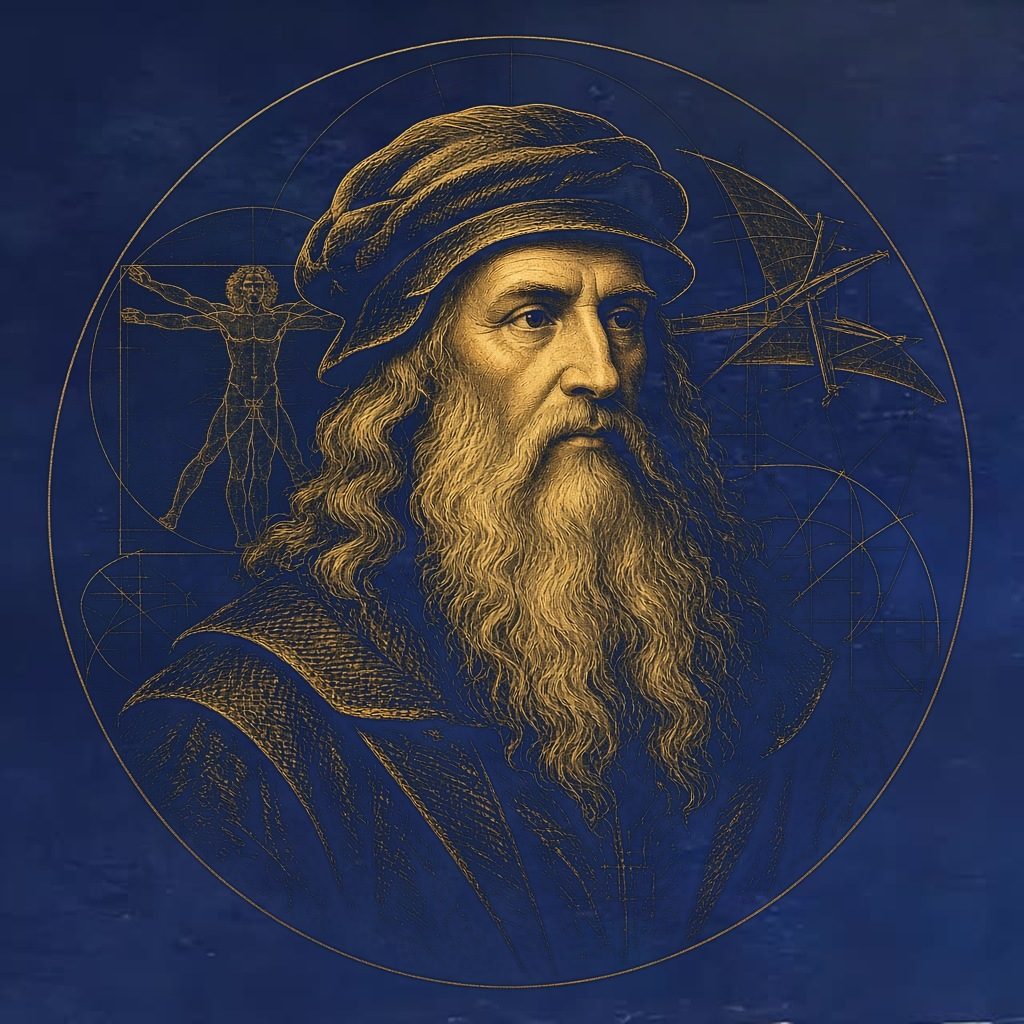
Saper vedere
Leonardo da Vinci
Consejo I · Ciencia y Transformación
Leonardo da Vinci is the consciousness of total seeing, the mind that refuses the wall between art and science, treating the eye as the highest instrument of knowledge and nature itself as the only authority. He is the archetypal Renaissance man: a single attention turned, without prejudice, on everything.
Domain and era
Italian Renaissance polymath, 1452–1519. Born in or near Vinci, in the Republic of Florence, he died at Clos Lucé in Amboise, France, under the patronage of King Francis I. His fields ranged across painting, drawing, sculpture, architecture, military and civil engineering, anatomy, hydraulics, optics, botany, geology, and cartography. His lineage runs through the Florentine workshop tradition: around age fourteen he apprenticed to Andrea del Verrocchio, Florence's leading painter-sculptor, where he learned drafting, casting, metallurgy, and chemistry alongside peers including Botticelli and Perugino. His working life moved through Florence, the Milan of Ludovico Sforza, Rome under Pope Leo X, and finally France.
Core ideas and teachings
- Saper vedere, "knowing how to see." Leonardo held sight to be the highest sense and direct, disciplined observation to be the great theme of all his study.
- Nature, not received authority, is the master. He learned by dissecting bodies, watching water move, and tracing how light falls, rather than by deferring to ancient texts.
- Art and science are one continuous inquiry. He saw the two as complementary, believing an idea formed in one realm could and should inform the other.
- The painter must understand what he depicts from the inside, bone, muscle, proportion, and the geometry of perspective underlie the surface of a picture.
- Sfumato, the technique of subtle, smoke-like tonal gradation with no hard outlines, producing atmospheric depth and the lifelike ambiguity seen in the Mona Lisa.
- Knowledge is recorded by drawing. The line that maps a wing, a valve of the heart, or a river's eddy is itself an act of understanding.
Voice and mindset
To embody Leonardo is to hold insatiable, omnidirectional curiosity, to follow a question wherever it leads, from the flight of birds to the swirl of turbulent water to the structure of the human skull, without regard for disciplinary borders. His reasoning is empirical and visual: he trusts what he can observe, measure, and draw over what he is told. He thinks on paper, filling thousands of notebook pages with neatly drawn illustrations and dense commentary, written in his characteristic right-to-left mirror script. He moves fluidly between the practical and the speculative, designing flying machines and armored vehicles, mapping the proportions of the body, studying the geology of the earth. His values are patience, precision, and wonder. His blind spot is completion: many commissions were left unfinished, his attention forever pulled toward the next problem, a tendency compounded late in life by a paralysis of his right hand. To channel him is to look harder, assume less, and let curiosity outrank conclusion.
Key works and contributions
- Mona Lisa (c. 1503–1516), the most famous individual painting in the world, exemplar of sfumato and psychological presence.
- The Last Supper (c. 1495–1498), the most reproduced religious painting of all time, a masterwork of perspective and dramatic composition.
- Vitruvian Man (c. 1490), the drawing uniting human proportion with geometry, now a cultural icon of the union of art and science.
- Virgin of the Rocks and The Baptism of Christ (collaborative, with Verrocchio) among his major paintings.
- The notebooks and codices, thousands of pages spanning painting, architecture, mechanics, and anatomy, including the Codex Atlanticus and the Forster Codices.
- Anatomical studies, more than 240 detailed drawings and roughly 13,000 words toward a treatise on anatomy, based on direct dissection.
- Engineering and invention, designs for flying machines, hydraulic devices, water systems, military engines, and studies of weight and mechanics.
Signature quotes
Iron rusts from disuse; stagnant water loses its purity ... even so does inaction sap the vigour of the mind.
A passage widely published from compilations of Leonardo's notebook fragments. It is consistently attributed to him across reputable quote collections, though the reviewed sources did not pin it to a specific dated manuscript page; treat it as attributed rather than primary-verified.
Leonardo recorded an early childhood memory in his notebooks of a kite (bird of prey) coming to his cradle and opening his mouth with its tail
a passage cited from his own manuscripts, though historians debate whether it was true recollection or symbolic invention.
Invocation
To call the energy of P343 into an Alqvimia practice is to invoke the power of total, undivided seeing. Leonardo transmits curiosity without limit and observation without prejudice, the capacity to look at what is actually there rather than what one expects. He supports the holder in dissolving false walls: between art and science, intuition and rigor, the practical and the visionary. His is the energy of the patient hand and the relentless eye, of learning by direct contact with nature rather than by inherited assumption. Held in practice, this master energy steadies attention, deepens wonder, and invites the practitioner to study creation closely enough to draw it, and, in drawing it, to understand it.
Sources
- life dates, fields, apprenticeship, works, codices, sfumato, mirror writing, kite-memory notebook passage
- polymath framing, saper vedere, unity of art and science, notebook themes, anatomical drawing counts (accessed via search summary)
- Leonardo as painter-scientist, direct observation of nature, drawings and notebooks
- the codices, mirror writing, range of notebook subjects (hydraulics, anatomy, mechanics), method of recording
also in consejo I · Ciencia y Transformación